境外制作电影

Search documents
特朗普5天下达4道关税令,税率最高达100%,美国要将油门踩到底?
Sou Hu Cai Jing· 2025-10-10 19:12
Group 1: Tariff Policies - President Trump issued four tariff orders within five days, targeting imported patented drugs, cabinets and soft furniture, heavy trucks produced abroad, and foreign-made films, with the highest tax rate reaching 100% for patented drugs and films [1][3] - The tariffs are designed to protect domestic industries, with specific rates set at 100% for patented drugs, 50% for cabinets, and 30% for soft furniture, aiming to encourage manufacturing to return to the U.S. [3][5] - The 25% tariff on heavy trucks includes exemptions for products under the USMCA agreement, balancing regional trade cooperation with domestic industry protection [5] Group 2: Economic and Political Implications - The tariffs reflect a response to significant trade deficits and the outflow of manufacturing jobs, which are critical concerns for the Trump administration [8] - The targeted industries correspond to the needs of swing states, such as Michigan's auto manufacturing and North Carolina's furniture industry, aiming to secure support from blue-collar voters [8] - The classification of foreign film production as a "national security threat" indicates concerns over the erosion of American cultural influence, as Hollywood has been a key vehicle for U.S. values [8] Group 3: Global Trade Reactions - The U.S. tariffs have triggered a global backlash, with the EU considering trade countermeasures and China implementing targeted measures against U.S. entities [10] - Canada expressed dissatisfaction with the discriminatory exemptions for heavy trucks, indicating a refusal to concede on trade issues with the U.S. [10] - The unilateral approach of the U.S. may risk shrinking overseas markets for American companies and destabilizing global supply chains [10] Group 4: Societal Impact - The tariffs may lead to increased costs for American consumers, particularly in pharmaceuticals and other goods, raising concerns about the actual benefits of the policies [12] - The disconnect between the intended goals of the tariffs and their real-world effects is becoming evident, with ordinary citizens facing higher living costs [12] - The ongoing pressure from both domestic and international fronts may challenge the sustainability of Trump's aggressive tariff strategy [14]

对境外制作电影征100%关税!特朗普又发出了关税威胁
Zhong Guo Ji Jin Bao· 2025-09-29 22:07
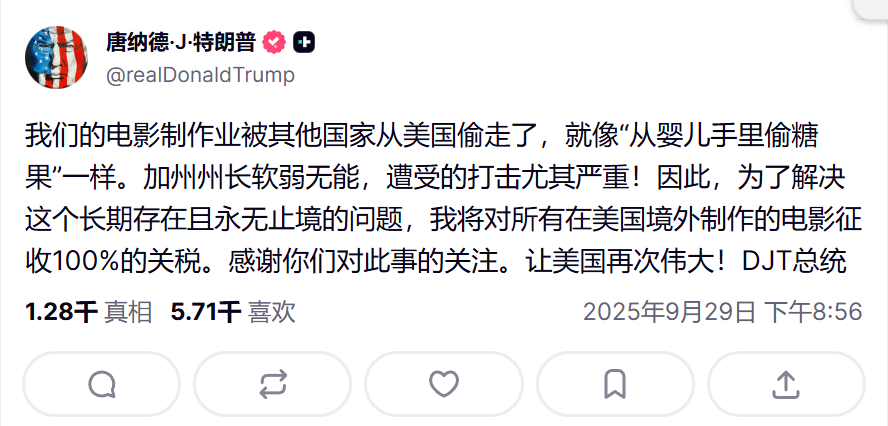
Core Viewpoint - President Trump threatens to impose a 100% tariff on all movies produced outside the United States, claiming that international competition is harming the U.S. film industry [2][3]. Group 1: Tariff Announcement - Trump stated that the U.S. film industry is being "stolen" by other countries, comparing it to taking candy from a baby [2]. - The announcement marks a potential shift in U.S. trade policy, as it would be the first time tariffs are applied to services rather than physical goods [3]. Group 2: Industry Impact - The film industry, particularly in California, is reportedly facing significant challenges due to international competition and tax incentives offered by other countries [3]. - Industry insiders express confusion regarding the implementation of such tariffs, as modern films are often produced across multiple countries, complicating enforcement [3]. Group 3: Legal and Trade Concerns - Legal and trade analysts question the feasibility of imposing tariffs on films, as they are considered intellectual property and part of global service trade, where the U.S. typically has a surplus [3]. - The increasing prevalence of co-productions with foreign entities raises further questions about how these films would be classified under the proposed tariff [3]. Group 4: Market Reaction - Following the announcement, Netflix's stock price experienced a decline during early trading [4].
刚刚!特朗普:100%关税
Zhong Guo Ji Jin Bao· 2025-09-29 14:37
Core Viewpoint - President Trump threatens to impose a 100% tariff on all movies produced outside the United States, claiming that international competition is harming the American film industry [1][2]. Group 1: Tariff Announcement - The proposed tariff would mark the first instance of tariffs being applied to "services" rather than physical goods [2]. - Trump previously threatened this tariff in May, citing tax incentives from other countries that attract filmmakers away from the U.S. [2]. - California is specifically mentioned as being severely impacted by this potential policy [2]. Group 2: Industry Reaction - The film industry was caught off guard by the initial announcement in May, with industry insiders expressing shock and confusion regarding the feasibility of such a tariff [2]. - Filmmakers often prefer to work close to home, but the lower labor costs and fewer restrictions abroad make overseas production more economical [2]. - Executives from multiple production companies have expressed confusion about how to implement the proposed movie tariff, given the global nature of modern film production [2]. Group 3: Legal and Trade Implications - Legal and trade analysts question the basis for imposing tariffs on films, as they are considered intellectual property and part of global service trade, where the U.S. typically has a surplus [2]. - The increasing prevalence of co-productions with foreign entities complicates the classification of these films and raises further questions about the applicability of tariffs [2]. Group 4: Market Impact - Following the announcement, Netflix's stock price experienced a decline during early trading [3].