外汇基金票据

Search documents
香港金管局:2025年第四季“百分百担保特惠贷款”坏账率为18.67%
智通财经网· 2026-02-02 05:48
Core Viewpoint - The Hong Kong Monetary Authority (HKMA) anticipates an increase in the bad debt ratio of the "100% Guaranteed Special Loans" to 18.67% by Q4 2025, reflecting a rise of 0.5-0.6 percentage points from Q3, with a slowdown in the growth rate compared to earlier increases of over 3 percentage points [1] Group 1: Bad Debt and Economic Indicators - The bad debt ratio for the "100% Guaranteed Special Loans" is projected to reach 18.67% by Q4 2025, indicating a slight increase from the previous quarter [1] - The growth rate of the bad debt ratio has slowed down, with earlier increases exceeding 3 percentage points [1] Group 2: Investment Strategy and Market Conditions - The HKMA's Vice President, Li Dachih, noted that the foreign exchange fund holds a small amount of physical gold, with limited exposure to gold-related investments despite strong price increases over the past two years [1] - Li highlighted the need for risk diversification in the foreign exchange fund due to various market uncertainties, including geopolitical factors and the direction of U.S. interest rates [1] - Precious metals are considered to have investment value, but their price fluctuations differ from those of bonds [1] Group 3: Fund Management and Returns - HKMA President, Yu Weiman, stated that the foreign exchange fund's investment strategy is effective, using a rolling 6-year investment return rate or a 3-year foreign exchange fund note yield as benchmarks to ensure more predictable and stable government investment returns [1]
香港金管局:外汇基金有配置黄金 但数量不多
智通财经网· 2026-01-28 11:25
Core Viewpoint - The Hong Kong Monetary Authority (HKMA) is focused on diversifying its foreign exchange fund investments, with an emphasis on long-term returns, including a modest allocation to gold [1] Group 1: Foreign Exchange Fund Diversification - The HKMA president, Eddie Yue, indicated that the foreign exchange fund aims for diversified investments and has a small allocation to gold [1] - Historically, the foreign exchange fund had a high allocation of 85-86% in US dollar assets, which is projected to decrease to 79% by the end of 2024, leaving 21% in non-US dollar assets [1] Group 2: Issuance of Foreign Exchange Fund Notes - The CEO of the HKMA's Foreign Exchange Fund Investment Office, Li Dak-chi, stated that the decision to issue additional foreign exchange fund notes depends on monetary management factors, such as Hong Kong interbank rates and the yield of the foreign exchange fund [1] - The issuance of foreign exchange fund notes is not considered an investment action [1] Group 3: Long-Term Growth Portfolio Performance - Since 2009, the HKMA has been investing in alternative assets through a "Long-Term Growth Portfolio," which has shown stable performance in the first three quarters of 2025 [1] - The annualized internal rate of return for the portfolio from inception until September 2025 is reported at 11.2% [1] - As of September 2025, the total market value of the main asset categories in the portfolio is HKD 579.6 billion, with private equity valued at HKD 420.4 billion and physical assets at HKD 159.2 billion [1]
港元资金利率之谜:为何长期低于美元?鲁政委详解港美资金利差现象
Sou Hu Cai Jing· 2025-09-05 02:22
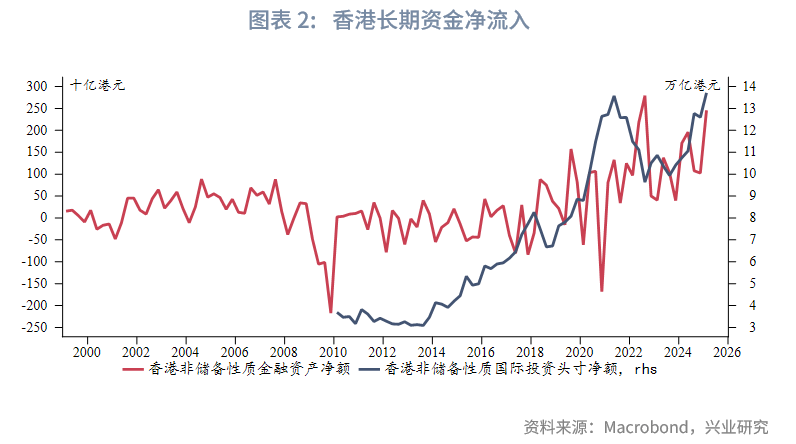
Core Insights - The phenomenon of Hong Kong dollar (HKD) interest rates being persistently lower than US dollar (USD) interest rates is primarily attributed to long-term net capital inflows leading to excess HKD liquidity [1][6] - The significant growth in HKD monetary base since 2000 is largely due to Hong Kong's status as a free trade port and a gateway between China and the world, resulting in substantial international capital inflows, particularly into the securities market [1] - The HKD/USD exchange rate has remained close to the strong-side guarantee level of 7.75, reflecting the impact of these capital inflows [1] Group 1 - The demand for short-term foreign exchange fund notes has surged as Hong Kong banks manage liquidity in the context of ongoing net capital inflows [2] - The Hong Kong Monetary Authority (HKMA) has increased the supply of high-quality foreign exchange fund notes, leading to an excess of HKD liquidity in the market [2] - The HKD swap market plays a crucial role in HKD funding, with active trading and strong liquidity, resulting in actual swap points being consistently lower than theoretical swap points [2] Group 2 - The carry trade between HKD and USD offers some opportunities, but the strategy is subject to significant short-term volatility, making it difficult to maintain a zero interest rate differential over the long term [6] - Market interventions by the HKMA can have a substantial impact, such as causing rapid widening of the HKD/USD interest rate spread following interventions [6] - The persistent lower interest rates of HKD compared to USD are influenced by multiple factors, including excess liquidity from long-term capital inflows, strong demand for HKD in the swap market, and the short-term volatility of carry trades [6]