
套息交易

Search documents
墨西哥基金股票2026年或受多因素影响,市场波动性或将增加
Jing Ji Guan Cha Wang· 2026-02-12 17:42
Core Insights - The Mexican stock market may be influenced by macroeconomic policies, international agreement reviews, and changes in capital flows by 2026 [1] Recent Events - The US-Mexico-Canada Agreement (TMEC) is set for a mid-term review in the summer of 2026, which may lead to increased market volatility due to negotiations over origin rules and labor standards [2] Industry Policies and Environment - The Bank of Mexico is expected to lower the benchmark interest rate to 7% by December 2025, with a potential gradual decrease to around 6.5% in 2026, supporting carry trade in the current interest rate environment. The central bank emphasizes inflation control, with an expected return to a 3% inflation rate by the third quarter of 2026 [3] Capital Flows - The Federal Reserve's anticipated rate cuts in 2026, potential interest rate hikes by the Bank of Japan, and global investors diversifying away from US tech stocks towards emerging markets may impact the performance of Mexican assets [4] Future Development - The Mexican government is optimizing the investment environment through tax reforms, such as simplifying tax processes for small businesses, to support long-term stock market development [5]
分析师:始于黄金的抛售潮可能具有“传染性”
Ge Long Hui A P P· 2026-02-06 10:38
Core Viewpoint - The sudden drop in gold prices may trigger a chain reaction, leading investors to take profits and potentially sell off other fundamentally strong assets to cover losses [1] Market Analysis - There is a significant amount of unrealized gains in the market, with the stock market remaining strong overall, except for AI-related stocks [1] - Investors in high-risk, high-yield currencies have also seen substantial profits due to the carry trade trend over the past year [1] Currency Impact - The euro has appreciated significantly during the trade war, enhancing its perception as a safer asset than global reserve currencies [1] - A decline in gold prices has coincided with a drop in the euro against the dollar, prompting traders to take profits [1] - The positioning in euro/dollar long positions is showing signs of being overbought as it approaches the 1.20 level, with a $20 billion bet on euro appreciation exceeding that of any other currency pair [1] Risk Aversion - As risk aversion increases, previously sold dollars are being repurchased, providing traders with reasons to take profits [1]
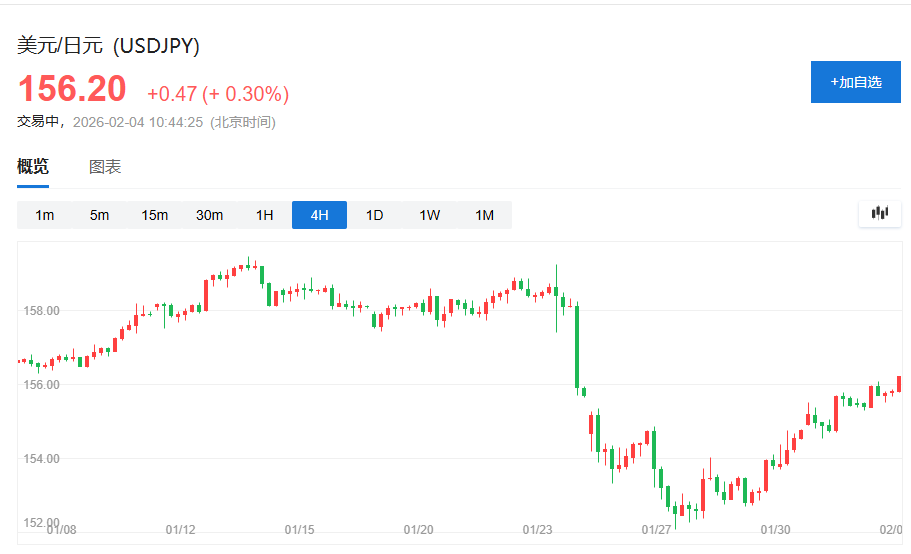
干预担忧消退,对冲基金重启“看空日元”交易
Hua Er Jie Jian Wen· 2026-02-04 02:57
Group 1 - The Japanese yen is expected to weaken further as hedge funds restart short positions ahead of the upcoming key election, with Prime Minister Kishi emphasizing the benefits of a weak currency [1] - The options market reflects a significant shift in sentiment, with demand for call options on USD/JPY increasing, leading to a decrease in the premium for downside risk [1] - Following the recent comments from Kishi about the advantages of a weaker yen for exporters, market interest in buying USD/JPY has been reignited [5] Group 2 - The yen has been steadily declining since Kishi won the leadership of the Liberal Democratic Party in October last year, recently hitting an 18-month low against the dollar [3] - Traders are increasingly returning to carry trades and high-yield strategies, anticipating a rise in USD/JPY, especially if Kishi's party wins decisively [2] - Actual fund investors have adopted a more cautious stance amid recent volatility, opting for protective options rather than committing to a clear direction for USD/JPY [5]

债市动荡 凸显日本的政策困境
Sou Hu Cai Jing· 2026-02-01 16:18
Core Viewpoint - The Japanese bond market is experiencing significant turmoil, with long-term bond yields reaching unprecedented levels, reflecting concerns over the sustainability of Japan's fiscal situation and the impact of recent government policies [1][2][3]. Group 1: Market Reaction - On January 20, 2026, the yield on 40-year Japanese government bonds surpassed 4%, marking the highest level since their issuance in 2007 [1]. - The yields on 10-year, 20-year, and 30-year bonds also reached historical highs, indicating a broader market reaction to fiscal concerns [1]. - The market's response is characterized by a "vote with their feet" mentality, as investors express worries about Japan's deteriorating fiscal health [1][2]. Group 2: Government Policies - The new government under Prime Minister Sanna Takashi has implemented a fiscal expansion and tax reduction strategy, including a ¥21.3 trillion economic stimulus plan, the largest since the COVID-19 pandemic [2][3]. - The proposed tax cuts, particularly a reduction in consumption tax on food items to zero over two years, have raised doubts about the sustainability of Japan's fiscal discipline [3]. - The market perceives these tax cuts as potentially leading to significant revenue losses, estimated at around ¥5 trillion annually, without clear plans for offsetting the fiscal gap [3]. Group 3: Monetary Policy and Market Dynamics - The Bank of Japan's cautious approach to normalizing monetary policy, including recent interest rate hikes, has contributed to the volatility in the bond market [4][7]. - The central bank's role as the largest buyer of government bonds has diminished, leading to a supply-demand imbalance in the market [4][5]. - Foreign investors have shown limited interest in long-term Japanese government bonds, further exacerbating liquidity issues in the market [5]. Group 4: Broader Implications - The rising yields in Japan may have ripple effects on global bond markets, as Japan has been a significant source of low-cost funding for international investments [12][13]. - Concerns over fiscal sustainability are not limited to Japan, as many developed economies are facing similar challenges, leading to a potential feedback loop of rising yields and declining market confidence [13][14]. - The International Monetary Fund has highlighted the fragility of global financial markets, particularly in countries with high public debt levels, indicating that Japan's situation may be a precursor to broader financial instability [14].
疯了!英镑兑日元多空血拼 日本央行干预“箭在弦上”?
Jin Tou Wang· 2026-01-28 12:37
Core Viewpoint - The GBP/JPY currency pair is experiencing significant volatility due to a complex interplay of UK-Japan policy divergence, expectations of yen intervention, and fluctuations in carry trade sentiment [1][2][3] Group 1: Market Dynamics - The GBP/JPY has shown a typical pattern of rising and then retreating, reflecting market caution amid significant fluctuations [1] - Initial upward movement was driven by interest rate differentials and improved risk appetite, with the exchange rate rising from a recent low [1][2] - Midweek, the exchange rate faced downward pressure due to intervention signals from Japan's finance minister and increased concerns over yen intervention, leading to a notable pullback [1][2] Group 2: Economic Indicators - The GBP is supported by persistent inflation and a favorable interest rate differential, with the UK service price index remaining high and core inflation above the central bank's target [2] - The Bank of England's low expectations for short-term rate cuts, combined with a robust labor market, provide strong valuation support for the GBP [2] - Conversely, the yen is caught in a tug-of-war between ongoing monetary easing and intervention concerns, with the Bank of Japan maintaining low rates and the Prime Minister's fiscal stimulus plan raising debt sustainability worries [2] Group 3: Carry Trade and Market Sentiment - Carry trade dynamics are influencing short-term capital flows, with initial borrowing of yen to invest in UK assets pushing the exchange rate higher [3] - However, fluctuations in Japanese bond yields and rising intervention expectations have led to rapid position unwinding, causing swift corrections in the exchange rate [3] - External factors such as global risk appetite and fluctuations in the US dollar index further amplify market uncertainty [3] Group 4: Technical Analysis - Key resistance levels are identified at weekly and yearly highs, which have proven to be strong barriers against upward movement [3] - Support levels are established at recent lows and short-term moving averages, indicating effective support during multiple tests [3] - Technical indicators show a neutral momentum, with the relative strength index retreating from overbought conditions and MACD indicating a reduction in upward momentum [3] Group 5: Future Outlook - The GBP/JPY is likely to maintain a volatile trading pattern, with potential for trend breakthroughs depending on key economic variables [4] - Positive UK inflation and employment data could strengthen hawkish expectations from the Bank of England, while weakened intervention signals from Japan may allow the exchange rate to challenge previous highs [4] - Conversely, intervention actions from the Bank of Japan or weak UK data could trigger downward corrections, testing lower support levels [4] - Investors should focus on three core variables: the outcome of Japan's February 8 election and subsequent fiscal policies, UK inflation and employment data, and official intervention actions from Japan [4]
日本散户逆势减码日元多头头寸 或为汇率反弹套上“隐形枷锁”
智通财经网· 2026-01-28 08:30
Group 1 - The core viewpoint of the articles highlights that Japanese retail investors are reducing their bullish positions on the yen, potentially setting an "invisible ceiling" on its recent strength amid expectations of intervention by Japanese authorities in the foreign exchange market [1] - Data from the Tokyo Financial Exchange (TFX) indicates that from last Friday to this Tuesday, individual investors cut their net short positions on USD/JPY by a total of 85.7 billion yen (approximately $561 million), marking the largest three-day reduction since October 2022 [1] - The recent changes in positions suggest that as the USD/JPY exchange rate experienced its largest three-day decline in over a year, these investors may have opted for profit-taking or stop-loss exits [1] Group 2 - As of the latest report, the yen has depreciated by 0.3% to 152.62 against the dollar, with the yen rising at least 1% each trading day over the past three days due to market speculation about potential coordinated intervention by Japanese and U.S. authorities to curb the yen's decline [2] - Takuya Kanda, head of Gaitame.com, noted that the 158 to 159 yen range poses a high risk for intervention, leading to expectations of more tactical trading strategies, where investors buy dollars around 153-154 and quickly sell once the exchange rate surpasses 155 [2]
这或是日本市场巨大”黑天鹅“!花旗:若确认这一点 日元恐还有15%暴涨空间
Sou Hu Cai Jing· 2026-01-28 05:27
Group 1 - The Japanese yen has experienced its strongest three-day rebound since August 2024, but Citigroup strategist Daniel Tobon remains cautious about turning bullish on the yen [1] - Tobon suggests that for the yen to maintain its upward momentum, Japanese investors need to reinvest in the domestic bond market [1] - The recent rise in the yen is attributed to market speculation that Japan and the U.S. are preparing to support the yen, especially after it approached 160 yen per dollar, a level that previously prompted intervention [1] Group 2 - The sell-off in the Japanese bond market last week significantly increased bond yields, which may encourage investors to withdraw funds from overseas and reinvest in the domestic market [4] - There is a potential for hedge funds to unwind carry trades, which involve borrowing in Japan and investing in higher-yielding countries [4] - Tobon believes that the yen may weaken again before the upcoming elections, and a shift of local investors towards Japanese government bonds could signal a better time to buy yen [4]

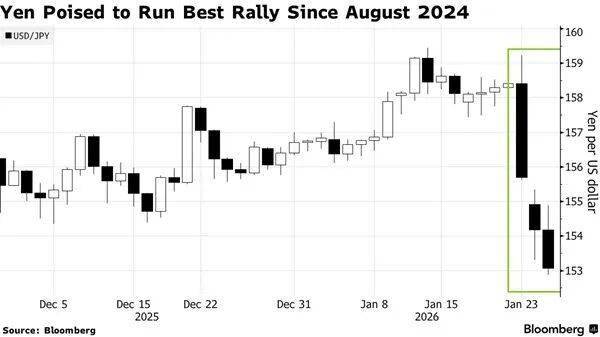
大涨三天,日元仍缺“临门一脚”?花旗策略师:回流国债才是真正催化剂
Zhi Tong Cai Jing· 2026-01-28 00:51
Core Viewpoint - The Japanese yen has experienced its strongest three-day rally since August 2024, but Citigroup strategist Daniel Tobon remains cautious about turning bullish on the yen until domestic investors start reallocating funds back into the Japanese bond market [1] Group 1: Yen Movement and Market Reactions - The recent rebound of the yen was triggered by market speculation that Japan and the U.S. are preparing to intervene to support the yen's exchange rate, especially after the yen approached the 160 mark against the dollar, close to the level that would prompt official intervention [1] - On Tuesday, the yen appreciated by 1%, breaking below the 153 mark against the dollar [1] Group 2: Bond Market Dynamics - The backdrop of the yen's rise includes a recent sell-off in the Japanese government bond market, driven by concerns over Prime Minister Fumio Kishida's fiscal plans, which may exacerbate Japan's already high government debt burden [1] - The bond market sell-off has led to a significant increase in Japanese government bond yields, potentially encouraging investors to withdraw funds from overseas and reinvest in domestic assets [1] Group 3: Future Outlook - Tobon suggests that a return of domestic funds to Japanese government bonds could signal a stronger buying opportunity for the yen, as it would alleviate fiscal concerns, although this may occur soon after the upcoming elections or take longer [2] - There remains a risk of the yen weakening again before the elections next month [1]
花旗在等待日本买家重回债市 奢望在那之后日元仍有大幅上涨空间
Xin Lang Cai Jing· 2026-01-27 20:27
Core Viewpoint - The recent strong three-day rally of the Japanese yen since August 2024 is not enough for Citigroup strategist Daniel Tobon to turn bullish on the yen, as a significant shift in domestic investment towards Japanese bonds is needed for the rally to sustain [1][4]. Group 1: Market Dynamics - The recent yen appreciation is driven by market speculation that Japan and the U.S. are preparing to support the yen, following a drop to nearly 160 yen per dollar, which is close to levels that could prompt intervention by Japanese officials in 2024 [3][6]. - The yen rose by 1% on Tuesday, trading below 153 yen per dollar, following a significant sell-off in the Japanese bond market, which raised concerns about the government's fiscal plans exacerbating its already heavy debt burden [3][6]. Group 2: Investment Opportunities - Tobon highlights that the biggest trading opportunity lies in waiting for a turning point, where a confirmation signal could indicate that the yen has more than 15% upside potential [1][4]. - The recent bond market turmoil has led to a sharp increase in Japanese government bond yields, which may encourage investors to withdraw funds from overseas and reinvest domestically, increasing the likelihood of hedge funds closing carry trades [3][6]. Group 3: Future Risks - Tobon expresses concerns about the risk of the yen weakening again as elections approach next month, indicating that a shift of domestic funds into Japanese bonds would be a stronger signal to buy the yen, potentially alleviating fiscal concerns [4][7].
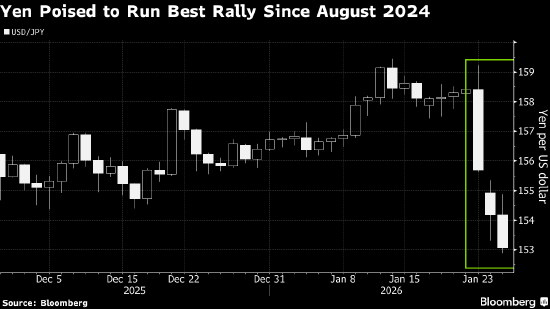
进退两难的日元再度迎来“干预窗口”
HTSC· 2026-01-27 04:30
Group 1: Yen Exchange Rate Dynamics - The yen appreciated by 2.6% to 154.2 yen/USD over two trading days following the Bank of Japan's (BOJ) meeting, driven by signals of potential "rate checks" from both the US and Japan[1] - Historical interventions by Japanese authorities typically follow "rate checks," suggesting a possible coordinated intervention could lead to further yen appreciation[2] - Since 2021, the average appreciation of the yen after interventions has been 1.4% within a week, indicating potential short-term gains from intervention[3] Group 2: Long-term Outlook and Risks - Historical data shows that interventions do not alter the long-term trend of the yen, which remains vulnerable to depreciation if the BOJ does not accelerate interest rate hikes[4] - The BOJ's delayed monetary policy has resulted in persistently low real interest rates, contributing to the yen's weakness[5] - Upcoming fiscal expansion measures, equivalent to 0.8% of Japan's GDP, may increase inflationary pressures, complicating the BOJ's policy decisions[5] - Risks include unexpected outcomes from the Japanese House of Representatives elections and inflation levels exceeding expectations, which could further impact the yen's stability[6]
