外骨骼系统

Search documents
雷傲协同-傲意科技脑机接口交流会
2026-01-04 15:35
Summary of the Conference Call on Brain-Computer Interface Technology Company and Industry Overview - The conference focused on Shanghai Aoyi Information Technology, which has been in the brain-computer interface (BCI) field for ten years, specializing in BCI and neural signal decoding technology, as well as core components for robotics [2][19]. Core Insights and Arguments - **Market Positioning**: Shanghai Aoyi is actively involved in medical applications of BCI technology, particularly for treating neurological diseases such as stroke. The company provides EEG machines for signal acquisition and analysis, and has developed smart prosthetic hands for amputees using non-invasive techniques [2][3]. - **Government Support**: The BCI technology has been recognized by the government as one of the six key industries for the future. Recent policy changes in cities like Shanghai and Beijing have included certain surgical procedures under medical insurance, which is expected to accelerate the application of BCI technology in healthcare [4][14]. - **Applications of BCI**: Current applications of BCI technology include treatment for neurological diseases (e.g., stroke, Alzheimer's, epilepsy), rehabilitation training, and human-computer interaction in industrial and military settings, as well as AR/VR entertainment [5][10]. - **Signal Acquisition Methods**: There are three main methods for acquiring neural signals: invasive, non-invasive, and peripheral electromyography. Invasive methods provide high-quality signals but come with significant risks, while non-invasive methods are safer but yield lower quality signals [6][7]. - **AI Integration**: AI plays a crucial role in optimizing signal processing in BCI technology, enhancing system accuracy and efficiency, and enabling real-time feedback and adjustments [20][21]. Additional Important Points - **Challenges in BCI**: The industry faces challenges related to effectiveness, safety, material science, and technical issues. Each surgical procedure requires follow-up to assess outcomes, and materials used must be soft yet removable to avoid damage to brain tissue [15][17]. - **Future Prospects**: The BCI industry is expected to see significant advancements by 2026, with several important certifications anticipated to facilitate the application of both implanted and non-implanted devices in medical settings [13][14]. - **Commercialization of Non-Invasive Devices**: Non-invasive devices, such as exoskeletons, are being developed and are expected to enter the market soon. However, high costs may limit their initial penetration, although prices are expected to decrease with technological advancements [16][29]. - **Collaboration with Redick**: Shanghai Aoyi is collaborating with Redick on advanced technologies, including AI algorithms and electric control systems, with plans for comprehensive cooperation in prosthetics, exoskeletons, and robotics [30]. This summary encapsulates the key points discussed during the conference, highlighting the advancements, challenges, and future outlook of the brain-computer interface industry and Shanghai Aoyi Information Technology's role within it.
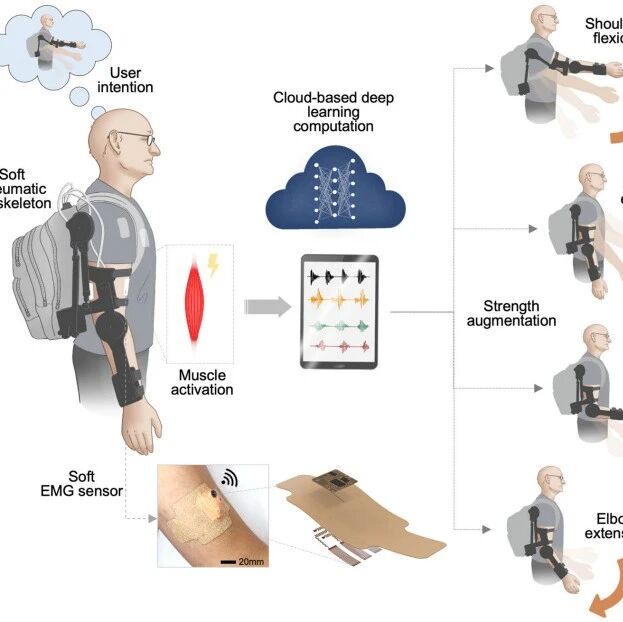
外骨骼“读心术”来了!意念增强肌肉力量,深度学习预测准确率96.2%
机器人大讲堂· 2025-11-10 04:07
Core Viewpoint - A new "mind-reading" exoskeleton system developed by a research team from Georgia Tech predicts user intentions 500-550 milliseconds before actions occur, providing timely assistance for individuals with limited mobility, such as stroke patients and the elderly [1][3]. Group 1: Technology and Innovation - The exoskeleton utilizes flexible bioelectronic sensors to capture muscle signals, combined with cloud-based deep learning algorithms for real-time analysis of user intentions [1][4]. - A breakthrough in sensor technology involves ultra-thin flexible EMG sensors that can be applied like a band-aid, maintaining performance even under significant strain [4][6]. - The system employs a CNN+LSTM hybrid architecture for processing EMG signals from four muscle groups, achieving classification accuracy rates of 95.38% for biceps/triceps and 97.01% for deltoid/lats [6][9]. Group 2: Performance and Effectiveness - The soft pneumatic artificial muscles (PAM) provide up to 897 Newtons of assistance, with a lightweight design that enhances the system's usability [7][9]. - The entire exoskeleton system weighs only 4.7 kilograms, including components like PAMs and batteries, and features a scalable design to accommodate users of various heights [9][10]. - Testing shows that muscle activity is reduced by 3.9 times for biceps and 3.5 times for deltoids when using the exoskeleton, even under load conditions [10][12]. Group 3: Applications and Future Development - The system supports four primary upper limb movements, effectively assisting in daily tasks such as lifting objects and using tools [9][12]. - The technology aims to enhance the quality of life for stroke patients and the elderly, with potential applications in industrial and healthcare settings [12][13]. - Ongoing development focuses on creating a universal deep learning model that can adapt to various users without individual training, leveraging cloud computing for continuous improvement [13].