
人机交互技术

Search documents
苹果史上第二大收购案,目标却不是手机
3 6 Ke· 2026-01-31 01:57
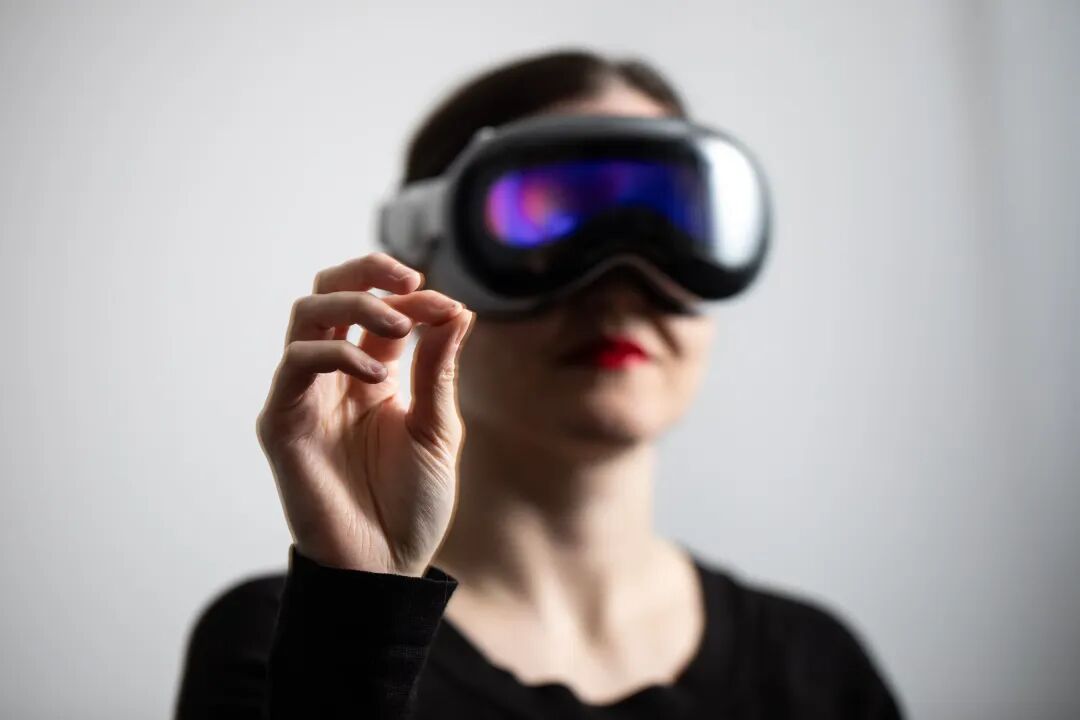
Core Viewpoint - Apple is evolving from a product-centric company to an investment company focused on future technologies, exemplified by its recent acquisition of the Israeli human-computer interaction company Q.ai for an estimated $1.6 to $2 billion, marking one of its largest investments in the AI sector [3][4][30]. Group 1: Acquisition Details - Apple has acquired Q.ai, a company specializing in technology that reads facial movements and understands silent communication, although specific details of the acquisition have not been disclosed [3][4]. - This acquisition is projected to be Apple's second-largest in history, following the $3 billion purchase of Beats in 2014 [4]. - Q.ai's technology is based on machine learning algorithms that analyze facial muscles and micro-expressions to interpret silent commands, distinguishing it from conventional AI companies [4][11]. Group 2: Background of Q.ai and Its Founder - Q.ai was founded by Aviad Maizels, who previously co-founded PrimeSense, known for its 3D sensing technology that powered Microsoft's Kinect [6][9]. - After Apple acquired PrimeSense for approximately $350 million in 2013, its technology became foundational for Apple's TrueDepth camera and ARKit, leading to the development of Face ID [9][11]. - Maizels left Apple in 2022 to establish Q.ai, which has now returned to Apple through this acquisition, suggesting a strategic plan behind his career moves [20][22]. Group 3: Strategic Implications for Apple - The acquisition of Q.ai aligns with Apple's need for innovative interaction methods for future products, particularly smart glasses expected to launch by 2027 [13][30]. - Q.ai's technology could enable silent command input through facial gestures, addressing privacy concerns associated with voice commands in public settings [14][30]. - The integration of Q.ai's technology may also lead to advancements in Face ID, potentially allowing for under-display implementations [16][30]. Group 4: Financial Context and Market Position - Apple reported a record revenue of $143.76 billion for the 2026 fiscal year, with a gross margin of 48% and a net profit of $42.1 billion, yet the stock price reaction was muted, indicating market concerns about reliance on iPhone sales [26][28]. - iPhone sales contributed nearly 60% of total revenue, highlighting a potential vulnerability in Apple's business model as the market seeks new growth avenues [28][30]. - The acquisition of Q.ai is seen as a long-term investment strategy, emphasizing Apple's commitment to enhancing human-computer interaction and diversifying its product offerings [32].


外骨骼“读心术”来了!意念增强肌肉力量,深度学习预测准确率96.2%
机器人大讲堂· 2025-11-10 04:07
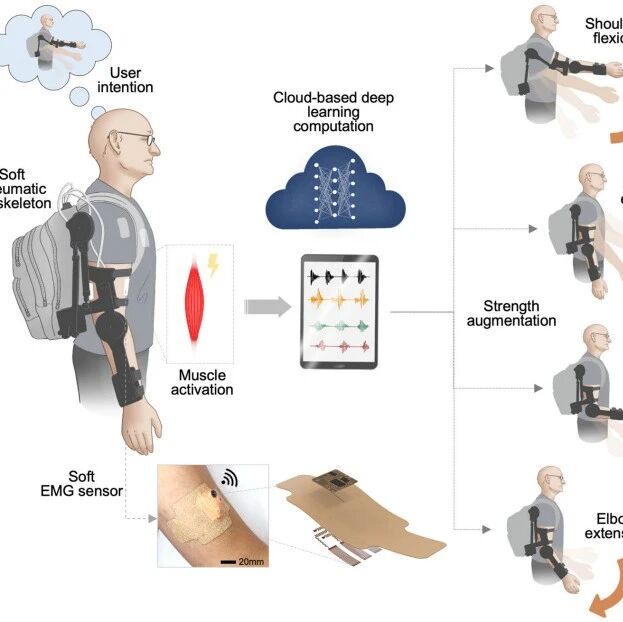
Core Viewpoint - A new "mind-reading" exoskeleton system developed by a research team from Georgia Tech predicts user intentions 500-550 milliseconds before actions occur, providing timely assistance for individuals with limited mobility, such as stroke patients and the elderly [1][3]. Group 1: Technology and Innovation - The exoskeleton utilizes flexible bioelectronic sensors to capture muscle signals, combined with cloud-based deep learning algorithms for real-time analysis of user intentions [1][4]. - A breakthrough in sensor technology involves ultra-thin flexible EMG sensors that can be applied like a band-aid, maintaining performance even under significant strain [4][6]. - The system employs a CNN+LSTM hybrid architecture for processing EMG signals from four muscle groups, achieving classification accuracy rates of 95.38% for biceps/triceps and 97.01% for deltoid/lats [6][9]. Group 2: Performance and Effectiveness - The soft pneumatic artificial muscles (PAM) provide up to 897 Newtons of assistance, with a lightweight design that enhances the system's usability [7][9]. - The entire exoskeleton system weighs only 4.7 kilograms, including components like PAMs and batteries, and features a scalable design to accommodate users of various heights [9][10]. - Testing shows that muscle activity is reduced by 3.9 times for biceps and 3.5 times for deltoids when using the exoskeleton, even under load conditions [10][12]. Group 3: Applications and Future Development - The system supports four primary upper limb movements, effectively assisting in daily tasks such as lifting objects and using tools [9][12]. - The technology aims to enhance the quality of life for stroke patients and the elderly, with potential applications in industrial and healthcare settings [12][13]. - Ongoing development focuses on creating a universal deep learning model that can adapt to various users without individual training, leveraging cloud computing for continuous improvement [13].
灵伴科技集团副总裁宓群: AI眼镜重新定义“看见”的力量
Shen Zhen Shang Bao· 2025-05-27 20:00
Core Viewpoint - The company emphasizes the importance of human-computer interaction technology as a key driver of computer development, highlighting nearly 11 years of effort by over 1,000 partners in this field [1][2]. Group 1: Human-Computer Interaction - The biggest barrier to the revolution in computer technology is no longer hardware, but rather the need to lower the threshold for technology use [1]. - Historical advancements in human-computer interaction include the introduction of the mouse by Bill Gates and the iOS system by Steve Jobs, which made technology more accessible and intuitive [1]. Group 2: AI and AR Integration - Since 2020, the company has been exploring the use of "AI + AR" glasses for cultural heritage tours, enhancing visitor experiences at sites like Dunhuang Mogao Caves and Sanxingdui Ruins [2]. - The integration of AI and AR is transforming cultural heritage from mere display to immersive dialogue, allowing for a deeper connection with history [2]. Group 3: Future Vision - The company aims to evolve glasses from mere visual tools to a "third brain," incorporating advanced technologies such as optical waveguide lenses and multi-modal sensors [1]. - The goal is to leverage technology to support the creative transformation and innovative development of traditional Chinese culture, positioning each pair of glasses as a key to new perspectives [2].