
多通道全程辅助血管介入手术机器人

Search documents
金达莱重金跨界押注医疗新兴赛道
Sou Hu Cai Jing· 2025-12-22 16:28
Core Viewpoint - Company Jindalai (688057) is diversifying into the medical sector by investing in two companies focused on stem cell research and medical robotics, following a decline in its performance since its IPO. The market reacted positively to these announcements, with a stock price increase of over 11% on December 22 [1][4]. Investment Details - Jindalai plans to invest CNY 280 million in Yunnan Jici Medical Technology Co., acquiring a 34% stake, and CNY 30 million in Zhongke Hongtai Medical Technology Co., acquiring a 10% stake [3][4]. - Jici Medical specializes in autologous cell technology and has conducted safety and efficacy validations for over 30 clinical indications [3]. - Zhongke Hongtai focuses on medical robotics and has completed clinical trials for its vascular intervention surgery robot [3][4]. Financial Performance - Jindalai has faced declining revenues and profits since its IPO, with revenues dropping from CNY 9.71 billion in 2020 to CNY 4.09 billion in 2024, and net profits decreasing from CNY 3.87 billion to CNY 1.37 billion in the same period [9]. - For the first three quarters of 2024, Jindalai reported revenues of approximately CNY 236 million, a 23.5% year-on-year decline, and net profits of CNY 75 million, down 30.14% [9]. Risks and Concerns - Both target companies present financial risks: Zhongke Hongtai has not yet achieved profitability, while Jici Medical has negative net assets, indicating it is in a state of insolvency [6][7]. - The investments are made at a premium, with Jici Medical's valuation at CNY 544 million, raising concerns about the potential for future returns [8]. - The medical technology sector is characterized by high barriers to entry and significant R&D costs, which may pose challenges for Jindalai, a company primarily focused on environmental services [10].



金达莱重金押宝医疗新兴赛道
Bei Jing Shang Bao· 2025-12-22 15:39
Core Viewpoint - Jindalai, a water environment management company, is diversifying into the healthcare sector by investing in two medical technology firms, despite facing financial uncertainties in these target companies [1][5]. Group 1: Investment Details - Jindalai plans to invest CNY 280 million in Yunnan Jici Medical Technology Co., acquiring a 34% stake, focusing on autologous cell technology [2]. - The company will also invest CNY 30 million in Zhongke Hongtai Medical Technology Co., obtaining a 10% stake, which specializes in medical robotics [2]. - Both investments are seen as a strategic move to optimize Jindalai's industry structure and enhance its risk resilience [3]. Group 2: Financial Performance of Target Companies - Zhongke Hongtai reported revenues of approximately CNY 132,100 and CNY 102,600 for the last year and the first three quarters of this year, respectively, with net losses of CNY 11.4 million and CNY 5.5 million [5]. - Jici Medical's revenues were CNY 8.69 million and CNY 11.23 million for the same periods, with net profits of CNY 2.23 million and CNY 1.15 million [5]. - As of the end of Q3 this year, Jici Medical had negative net assets of CNY 31.53 million, indicating a state of insolvency [5]. Group 3: Valuation and Risks - The investments are made at a premium, with Jici Medical's assessed value at CNY 544 million, primarily due to the value of its patents and ongoing projects [6]. - The success of Jici Medical's business and financial outlook heavily relies on the successful clinical development and commercialization of its drug candidates [6].
前脚干细胞后脚医疗机器人,金达莱重金跨界押注医疗新兴赛道
Bei Jing Shang Bao· 2025-12-22 12:20
Core Viewpoint - Company Jindalai (688057) is diversifying into the medical sector by investing in two companies focused on stem cell research and medical robotics, despite facing declining performance in its core water treatment business since its IPO [1][10]. Investment Details - Jindalai plans to invest CNY 280 million in Yunnan Jici Medical Technology Co., acquiring a 34% stake, which focuses on the development and application of autologous cell technology [4]. - The company also intends to invest CNY 30 million in Zhongke Hongtai Medical Technology Co., obtaining a 10% stake, which specializes in medical robotics [4]. - Both investments are seen as cross-industry moves for Jindalai, which has traditionally focused on water environment management [5]. Financial Performance - Jindalai has experienced a decline in revenue and net profit for four consecutive years since its IPO, with revenues dropping from CNY 9.71 billion in 2020 to CNY 4.09 billion in 2024 [11]. - In the first three quarters of 2024, Jindalai reported revenues of approximately CNY 236 million, a year-on-year decrease of 23.5%, and a net profit of CNY 75 million, down 30.14% [11]. Risks and Concerns - Both target companies present financial risks: Zhongke Hongtai has not yet achieved profitability, while Jici Medical has negative net assets, indicating a state of insolvency [7][8]. - The investments are made at a premium, with Jici Medical's assessed value at CNY 5.44 billion, raising concerns about the potential for future returns [9]. - The medical technology sector is characterized by high barriers to entry and significant R&D costs, which may pose challenges for Jindalai, a company lacking experience in this field [12].
豪掷3.1亿元,增资两家公司,金达莱“跨界”大健康
Xin Lang Cai Jing· 2025-12-22 11:19
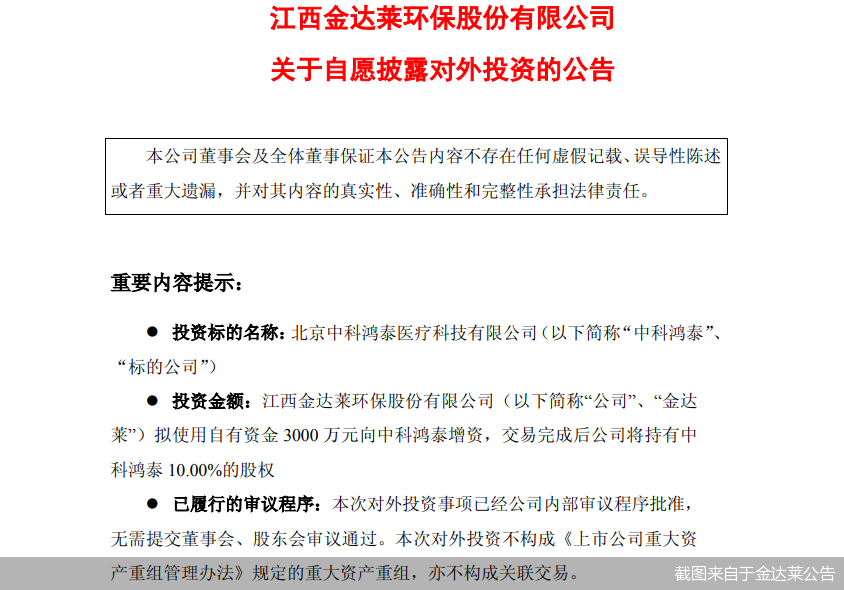
Core Viewpoint - Jiangxi Jindalai Environmental Protection Co., Ltd. is making significant moves towards diversification by investing in the healthcare sector, specifically in stem cell technology and medical robotics, to optimize its industrial structure and cultivate new profit growth points [2][3][21]. Investment in Healthcare - On December 19, Jindalai announced an investment of 280 million yuan in Yunnan Jici Medical Technology Co., Ltd., acquiring a 34% stake, making it the second-largest shareholder [2][21]. - On December 21, the company announced an additional investment of 30 million yuan in Beijing Zhongke Hongtai Medical Technology Co., Ltd., acquiring a 10% stake [3][21]. - Both investments target the "big health industry," with Jici Medical focusing on proprietary stem cell technology and Zhongke Hongtai excelling in medical artificial intelligence [3][21]. Rationale for Investment - Jindalai aims to respond to national calls for investment in biomanufacturing and healthcare sectors, enhancing its risk resistance and creating new profit avenues [3][21]. - The company believes that the aging population and the maturation of the industry in China present ample investment opportunities in the big health sector [3][21]. Financial Overview of Jici Medical - As of September 30, Jici Medical reported total assets of 10.01 million yuan, with revenues and net profits of 11.23 million yuan and 1.15 million yuan, respectively, for the first nine months of 2025 [6][26]. - Despite not being particularly strong financially, Jici Medical's ability to generate initial self-sustaining revenue is notable in the capital-intensive biomanufacturing sector [6][26]. Financial Overview of Zhongke Hongtai - Zhongke Hongtai reported total assets of 61.58 million yuan and a net loss of 5.51 million yuan for the first nine months of 2025 [10][31]. - The company is recognized for its innovative medical robotics and has completed 16 clinical trials for its products, which are currently in the regulatory approval process [10][31]. Jindalai's Current Position - Jindalai has a strong financial position, with a debt ratio of only 10.2% and cash reserves exceeding 1.898 billion yuan, allowing it to fund these investments entirely with its own capital [12][33]. - However, the company has experienced a decline in its main business, with a 23.5% drop in total revenue and a 30.14% decrease in net profit for the first nine months of 2025 [13][33]. Strategic Shift - The investments in Jici Medical and Zhongke Hongtai mark Jindalai's formal entry into the biomanufacturing and big health sectors, aligning with national policies that support these industries as emerging growth areas [16][36]. - The company is part of a broader trend among environmental firms diversifying into non-environmental sectors, with nearly half of the listed environmental companies exploring such opportunities [17][38].

看好医疗机器人发展前景 金达莱拟对中科鸿泰进行增资
Zheng Quan Ri Bao Wang· 2025-12-22 08:36
Core Viewpoint - Jiangxi Jindalai Environmental Protection Co., Ltd. plans to invest 30 million yuan in Beijing Zhongke Hongtai Medical Technology Co., Ltd., acquiring a 10% stake, marking another step into the biomedical field after its previous investment in stem cell technology [1] Company Overview - Zhongke Hongtai specializes in the research, production, and sales of medical robot technology and systems, established as a technology transfer enterprise by the Chinese Academy of Sciences [2] - The company has undertaken over 10 major projects, including the first domestic 863 program for vascular interventional surgical robots, and is a pioneer in this field [2] - Zhongke Hongtai is recognized as a national high-tech enterprise and has over 100 independent intellectual property rights, contributing to industry standards and leading national key research projects [2] Product Development - The company has developed the world's first multi-channel assisted vascular interventional surgical robot, which successfully completed its first clinical trial for percutaneous coronary intervention [2][3] - The robot is designed using bionic principles, capable of simultaneous operations with multiple guidewires and balloons, and features force feedback capabilities [3] Market Potential - Jindalai's investment strategy includes forward-looking investments in non-listed companies within the health sector, aiming to optimize its industrial structure and enhance risk resistance [4] - The advantages of robotic-assisted vascular interventions include higher precision, reduced radiation exposure for doctors, and the potential for standardized and digitized surgical processes [4] - The integration of robotic technology with advanced technologies like 5G and AI is expected to enhance the capabilities of interventional surgeries, indicating a promising market outlook [4]