大润发优鲜APP

Search documents
知名企业公告:女CEO失联,上任仅2个月!
Sou Hu Cai Jing· 2026-02-05 07:46
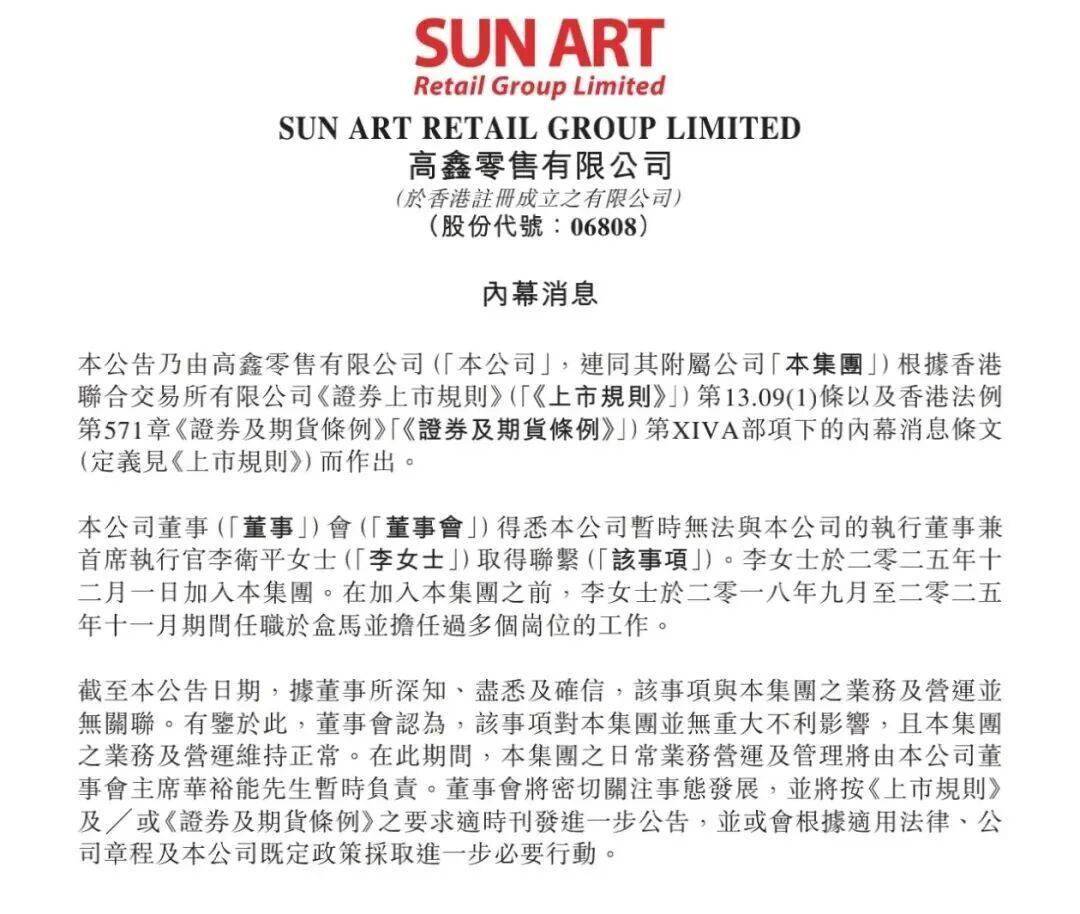
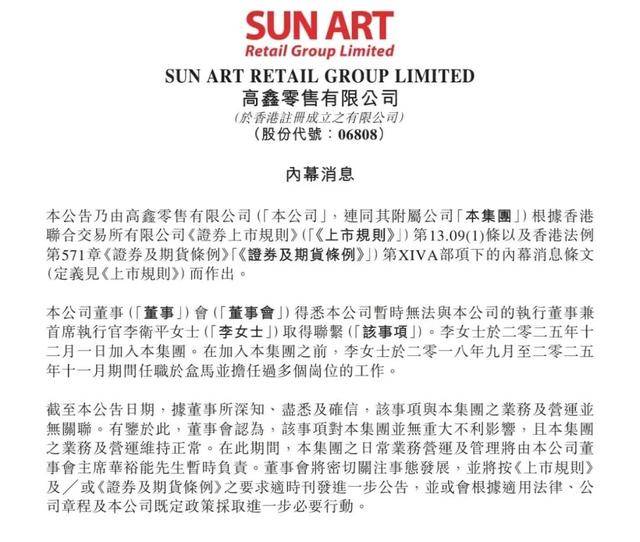
Core Viewpoint - The announcement from Gao Xin Retail indicates that the company is currently unable to contact its CEO, Li Weiping, but the board believes this matter does not adversely affect the group's business operations [1][3]. Group 1: Company Operations - The board of directors is confident that the inability to contact the CEO is unrelated to the group's business and operations, and they believe it does not have a significant negative impact on the group [3]. - During this period, the daily business operations and management will be temporarily overseen by the board chairman, Hua Yuneng [3]. - Gao Xin Retail reports that all business activities are proceeding normally, with the peak sales season for the New Year being managed effectively, and there are no disruptions in product supply or service guarantees [5]. Group 2: Leadership Changes - Li Weiping has been in the CEO position for less than three months and receives an annual fixed salary of 3.36 million yuan, along with annual management bonuses [5]. - Prior to joining Gao Xin Retail, Li Weiping had extensive experience in the retail industry, including roles at Hema and Lotte Supermarket [7]. - His appointment is seen as part of Alibaba's retail transformation strategy, following a significant transaction where Alibaba announced the sale of its entire stake in Gao Xin Retail for approximately 13.138 billion HKD, representing 78.7% of the company's issued shares [8].

履职仅约两个月,高鑫零售CEO李卫平失联!转型关键期再遭变数
Hua Xia Shi Bao· 2026-02-05 03:26
Core Viewpoint - The unexpected disappearance of Li Weiping, CEO of Gao Xin Retail, poses new uncertainties for the company's ongoing transformation towards community retail amidst a challenging traditional supermarket industry landscape [3][4]. Company Situation - Gao Xin Retail announced on February 4 that the board was unable to contact CEO Li Weiping, who had only joined the company on December 1, 2025, and had been in the role for approximately two months [3][5]. - Li Weiping's disappearance comes at a critical time as Gao Xin Retail is facing significant operational challenges, including a reported net loss of 123 million yuan for the first half of the 2025 fiscal year, compared to a profit of 206 million yuan in the same period the previous year [5]. - The company is currently being managed by Chairman Hua Youneng, with assurances that business operations remain normal and that the annual sales season is progressing smoothly [5][8]. Industry Context - The traditional supermarket industry has been struggling, with Gao Xin Retail's revenue declining by 12.1% year-on-year to 30.502 billion yuan for the first half of the 2025 fiscal year [5]. - The year 2025 has seen a significant reform wave in the supermarket sector, with major players like Yonghui Superstores and Wumart Supermarket adopting new transformation models [7]. - Gao Xin Retail is shifting its strategy towards community retail, aiming to create a retail model that balances experience and efficiency within a three-kilometer radius of customers [7][8]. Transformation Efforts - Gao Xin Retail has introduced a three-year strategic plan focusing on transforming stores into community life centers and eliminating inefficient locations [7]. - The company is also incorporating a "front warehouse" model, which is crucial for rapid delivery of fresh and fast-moving consumer goods, a strategy that Li Weiping was expected to influence significantly due to his prior experience at Hema [8]. - Despite the uncertainties surrounding Li Weiping's disappearance, industry experts believe that the company will continue to find a viable direction for its transformation efforts [8].

业绩扭亏路上CEO失联,高鑫零售转型关键期再遭变数
Hua Xia Shi Bao· 2026-02-04 08:54
Core Viewpoint - The unexpected disappearance of CEO Li Weiping poses new uncertainties for the transformation of Gao Xin Retail, which is currently seeking to shift towards community retail amidst ongoing losses in the traditional supermarket sector [2][3]. Company Situation - Gao Xin Retail's board announced that they could not contact CEO Li Weiping, who had only been with the company for about two months since joining on December 1, 2025 [2]. - Li Weiping's previous experience at Hema, where he held several key positions, was expected to contribute positively to Gao Xin Retail's strategic planning and business development [3]. - The company reported a revenue of 30.502 billion yuan for the first half of the 2025 fiscal year, a decrease of 12.1% year-on-year, and a net loss of 123 million yuan, compared to a profit of 206 million yuan in the same period the previous year [3]. Transformation Strategy - Gao Xin Retail is undergoing a significant transformation, focusing on community retail as part of a broader industry trend initiated by competitors like Yonghui Supermarket and Wumart [5]. - The company aims to create a retail model that balances experience and efficiency within a three-kilometer radius, planning to eliminate inefficient stores and transition to community life centers [5]. - The introduction of "front warehouses" as a key development area marks a shift in strategy, allowing for rapid delivery of fresh and fast-moving consumer goods [5]. Operational Impact - Despite Li Weiping's disappearance, Gao Xin Retail stated that its operations remain normal and that the chairman, Hua Yuneng, is overseeing management to ensure stability [4]. - New retail expert Bao Yuezhong believes that the impact of Li Weiping's absence will be minimal, as the company is a leading player in the supermarket sector [4][7]. - The recent opening of a new Dailunfa Supermarket in Dongying, which features a modern retail approach, has received positive market feedback, indicating that the transformation efforts are still progressing [6][7].

知名企业突发公告:女CEO失联,上任仅2个月!
Sou Hu Cai Jing· 2026-02-04 08:15
Core Viewpoint - The announcement from Gao Xin Retail indicates that the company is currently unable to contact its CEO, Li Weiping, but the board believes this matter does not significantly impact the company's operations or business continuity [1][3]. Group 1: Company Operations - Gao Xin Retail's board asserts that the inability to contact the CEO is unrelated to the company's business and operations, and normal operations are maintained [3]. - The daily business operations and management will be temporarily overseen by the board chairman, Hua Yuneng, ensuring stability and continuity in operations [3][5]. - The company reports that all business activities are progressing normally, with no impact on product supply or service assurance during the peak sales season [5]. Group 2: Leadership and Management - Li Weiping has been in the CEO position for less than three months and has a fixed annual salary of 3.36 million yuan, along with annual management bonuses [5]. - Prior to joining Gao Xin Retail, Li Weiping had extensive experience in the retail industry, including roles at Hema and Lotte Supermarket [7][8]. - His appointment as CEO is seen as part of Alibaba's retail transformation strategy, with significant changes in ownership and management structure occurring recently [8].
大润发母公司称CEO失联,今日股价却涨了
Di Yi Cai Jing Zi Xun· 2026-02-04 02:56
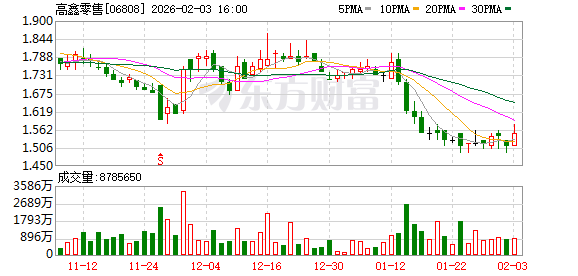
Group 1 - The new CEO of Gao Xin Retail, Li Weiping, has been taken by the police for investigation just two months after taking office, and the company is currently unable to contact him [2] - Gao Xin Retail's stock price opened at HKD 1.55 and reached a high of HKD 1.60, reflecting a 3.226% increase [2] - The company stated that its business operations are proceeding normally, with no impact on product supply or service guarantees, and management is being overseen by the chairman, Hua Yuning [2] Group 2 - Li Weiping was appointed as CEO on December 1, 2025, after previously serving in various roles in the retail industry, including at Hema and Lotte Supermarket [3] - Since Li's appointment, Gao Xin Retail has been expanding its store openings and online services, including the launch of a new store in Dongying, Shandong, and the rapid rollout of the "Dai Ru Fan You Xian" app [3] - The recent changes in Gao Xin Retail's leadership are part of Alibaba's retail transformation strategy, with Alibaba selling its entire stake in Gao Xin Retail for approximately HKD 13.138 billion [4] Group 3 - Gao Xin Retail reported a revenue of CNY 30.502 billion for the six months ending September 30, 2025, a decrease of 12.1% year-on-year, with a loss attributable to shareholders of CNY 123 million compared to a profit of CNY 206 million in the same period last year [4] - The decline in revenue is attributed to intensified market competition, leading to lower average transaction quantities and prices, which in turn reduced the average customer spending [4] - As of September 30, 2025, Gao Xin Retail operates 462 hypermarkets, 32 medium-sized supermarkets, and 7 member stores, with approximately 65% of the stores being leased and 35% owned [5]

大润发母公司称CEO失联,今日股价却涨了
第一财经· 2026-02-04 02:48
Core Viewpoint - The recent turmoil at Gao Xin Retail, the parent company of RT-Mart, stems from the CEO's involvement in a police investigation just two months after taking office, raising concerns about leadership stability and operational continuity [2]. Group 1: Company Leadership and Management - CEO Li Weiping has been uncontactable since being taken by police for investigation, leading to the board chairman, Hua Yunen, overseeing management to ensure operational stability [2][3]. - Li Weiping was appointed as CEO on December 1, 2025, after a career spanning 26 years in the retail industry, including significant roles at Hema and Lotte Supermarket [3][4]. Group 2: Business Operations and Performance - Despite the leadership issues, Gao Xin Retail reports that business operations are proceeding normally, with ongoing sales activities and no impact on supply or service [3]. - The company opened a new RT-Mart store in Dongying, Shandong, and is advancing its online services, including a rapid delivery app [4]. - For the six months ending September 30, 2025, Gao Xin Retail reported revenues of 30.502 billion yuan, a decrease of 12.1% year-on-year, and a loss attributable to shareholders of 123 million yuan, compared to a profit of 206 million yuan in the previous year [4].

大润发母公司称暂无法联系上CEO,今日股价却涨了
Di Yi Cai Jing· 2026-02-04 02:27
Core Viewpoint - Gao Xin Retail is currently facing leadership challenges with the recent investigation of CEO Li Weiping, but the company asserts that its operations are proceeding normally and business activities are stable [1][2]. Group 1: Leadership Changes - Li Weiping was appointed as the CEO of Gao Xin Retail on December 1, 2025, after the resignation of Shen Hui due to personal reasons [2]. - Li Weiping has extensive experience in the retail industry, having worked for 26 years prior to joining Gao Xin Retail, including roles at Hema and Lotte Supermarket [2]. Group 2: Business Operations - Despite the leadership turmoil, Gao Xin Retail reports that its business activities are progressing smoothly, with no impact on product supply or service assurance [1]. - The company is actively working on its annual sales during the peak season, with management responsibilities temporarily overseen by Chairman Hua Yunen [1]. Group 3: Financial Performance - Gao Xin Retail reported a revenue of 30.502 billion yuan for the six months ending September 30, 2025, representing a year-on-year decrease of 12.1% [3]. - The company recorded a loss attributable to equity shareholders of 123 million yuan, compared to a profit of 206 million yuan in the same period last year [3]. - The decline in revenue is attributed to intensified market competition, leading to lower average transaction quantities and prices, which in turn reduced the average customer spending [3]. Group 4: Store Network - As of September 30, 2025, Gao Xin Retail operates 462 hypermarkets, 32 medium-sized supermarkets, and 7 membership stores, with approximately 65% of the stores being leased and 35% owned [3].
大润发母公司回应CEO被警方带走:假的,人正在上班
2 1 Shi Ji Jing Ji Bao Dao· 2026-02-03 10:12
Core Viewpoint - Recent news regarding the CEO of Gao Xin Retail, the parent company of RT-Mart, being taken by police for investigation has been denied by the company, asserting that the CEO is currently at work [1] Group 1: Leadership Changes - Li Weiping has been appointed as the Executive Director and CEO of Gao Xin Retail since December 1, 2025, following the resignation of Shen Hui due to family reasons [1] - Li Weiping has a strong background in the retail industry, having served at Hema from September 2018 to November 2025, where she held various leadership roles [2] - Gao Xin Retail has signed a three-year service agreement with Li Weiping, with a fixed annual salary of 3.36 million yuan, plus potential annual bonuses based on performance [2] Group 2: Business Developments - RT-Mart has opened a new store in Dongying, Shandong, emphasizing a "small but beautiful, refined and complete, fast and fresh" model, which marks a shift from traditional hypermarket formats [1] - The new store utilizes the "RT-Mart Youxian" app to offer delivery services in as little as 29 minutes, indicating a focus on efficiency and multi-channel upgrades [1] Group 3: Corporate Governance and Challenges - Recent reports indicate a crackdown on corruption within the company, with a high-level executive being arrested for bribery involving over 7 million yuan [3] - This incident highlights the ongoing efforts by Dehong Capital to strengthen corporate governance within Gao Xin Retail [3]
大润发母公司回应CEO被警方带走:假的,人正在上班
21世纪经济报道· 2026-02-03 10:05
Core Viewpoint - The recent news regarding the CEO of Gao Xin Retail, the parent company of RT-Mart, being taken by the police for investigation has been denied by the company, asserting that the CEO is currently at work [1]. Group 1: Leadership Changes - Li Weiping has been appointed as the CEO of Gao Xin Retail since December 1, 2025, succeeding Shen Hui, who resigned due to personal reasons [1]. - Li Weiping has a strong background in the retail industry, having served at Hema from September 2018 to November 2025, where she held various leadership roles [2][3]. - Gao Xin Retail has signed a three-year service agreement with Li Weiping, with a fixed annual salary of 3.36 million yuan, plus potential annual bonuses based on performance [4]. Group 2: Business Developments - RT-Mart has opened a new store in Dongying, Shandong, focusing on a "quality lifestyle supermarket" model, which emphasizes a smaller, more refined shopping experience [1]. - The new store utilizes the "RT-Mart Youxian" app to provide delivery services in as little as 29 minutes [1]. - The company is undergoing significant upgrades in product offerings, efficiency, and omnichannel strategies, aligning with Li Weiping's experience in the retail sector [2]. Group 3: Governance and Compliance - The recent leadership changes coincide with a broader effort by Dehong Capital to strengthen corporate governance, including anti-corruption measures [5]. - A significant bribery case involving a senior executive at a major supermarket chain has been reported, highlighting ongoing issues within the industry [5].
德弘入主后再现人事动荡?大润发否认高鑫零售CEO李卫平被查
2 1 Shi Ji Jing Ji Bao Dao· 2026-02-03 09:24
Core Viewpoint - Recent news regarding the CEO of Gao Xin Retail, the parent company of RT-Mart, being taken by police for investigation has been denied by the company, asserting that the CEO is currently at work [2]. Group 1: Management Changes - Li Weiping has been appointed as the Executive Director and CEO of Gao Xin Retail since December 1, 2025, following the resignation of Shen Hui due to family reasons [2]. - Li Weiping has a strong background in the retail industry, having served at Hema from September 2018 to November 2025, where she held various leadership roles [2][3]. - A three-year service agreement has been signed with Li Weiping, with a fixed annual salary of 3.36 million yuan, plus the potential for annual bonuses based on performance [3]. Group 2: Business Developments - RT-Mart has opened a new store in Dongying, Shandong, emphasizing a "small but beautiful, refined and complete, fast and fresh" model, which marks a shift from traditional hypermarket formats [2]. - The new store utilizes the "RT-Mart Youxian" app to offer delivery services in as little as 29 minutes, indicating a focus on efficiency and multi-channel upgrades [2]. Group 3: Corporate Governance and Challenges - Recent reports indicate a crackdown on corruption within the company, with a high-level executive being arrested for soliciting large "loans" from suppliers, amounting to over 7 million yuan [4]. - This incident highlights the ongoing efforts by Dehong Capital to strengthen corporate governance within Gao Xin Retail [4].