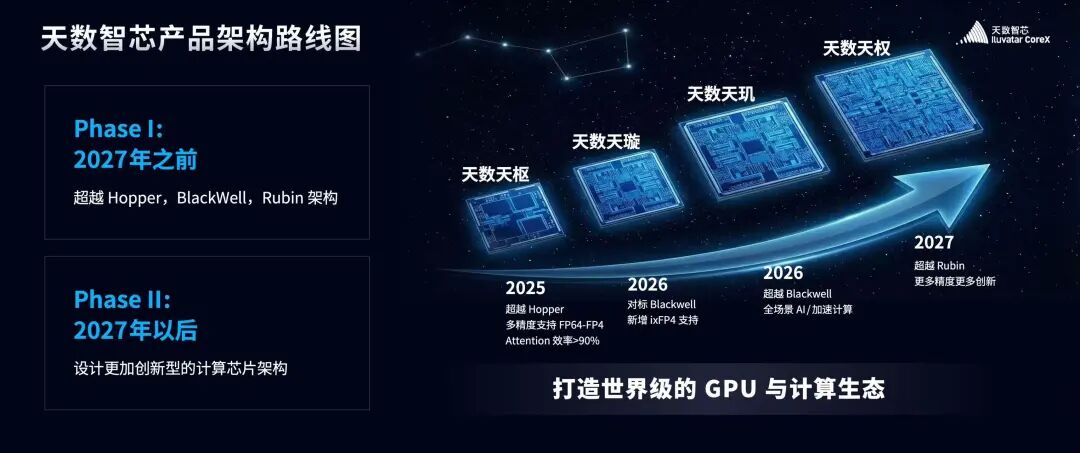
天枢架构

Search documents
天数智芯公布四代架构路线图及边端产品“彤央”
Zhong Guo Jing Ying Bao· 2026-01-26 15:07
Core Insights - TianShu ZhiXin (09903.HK) announced its fourth-generation architecture roadmap, aiming to surpass international competitors, with the "TianShu" architecture set to exceed NVIDIA's Hopper by 2025, followed by "TianXuan" and "TianJi" targeting Blackwell in 2026, and "TianQuan" aiming to surpass NVIDIA's Rubin in 2027 [2] - The company launched the "TongYang" series of edge computing products, which includes models with performance metrics ranging from 100 TOPs to 300 TOPs, with the TY1200 model achieving 300 TOPs, outperforming NVIDIA's AGX Orin in various applications [2] Group 1 - The fourth-generation architecture details include the TianShu architecture supporting high-precision scientific and AI calculations, achieving over 90% effective utilization efficiency in attention mechanism computations [3] - The TianXuan architecture introduces ixFP4 precision support, while the TianJi architecture aims for comprehensive AI and accelerated computing coverage [3] - The TianQuan architecture will incorporate more precision support and innovative designs [3] Group 2 - TianShu ZhiXin's products and solutions have served over 300 clients and completed more than 1,000 deployments, with the "TongYang" series already implemented in various sectors including embodied intelligence and industrial automation [3] - The CEO, Gai Lujian, emphasized the importance of self-developed AI computing power to establish a robust ecosystem and the need for open collaboration to define new development paradigms [3]

2027年超越Rubin:这家国产GPU用七年深蹲,交出一份敢写日期的路线图
3 6 Ke· 2026-01-26 11:22
Core Viewpoint - The company, Tensu Zhixin, has boldly outlined its roadmap to surpass major competitors like Hopper, Blackwell, and Rubin between 2025 and 2027, emphasizing its commitment to long-term development without shortcuts [1][12]. Group 1: Roadmap and Performance - Tensu Zhixin announced its four-generation architecture roadmap for 2025 to 2027, aiming to exceed Hopper in 2025, match Blackwell in 2026, and surpass Rubin in 2027 [1]. - The performance of the upcoming architecture, Tian Shu, has already been validated, showing approximately 20% higher average performance than NVIDIA's Hopper in the DeepSeek V3 scenario [3][4]. Group 2: Credibility and Testing - The company's credibility is supported by a performance white paper based on extensive internal testing, demonstrating a 90% effective utilization efficiency in AI chip calculations, which is 60% higher than the industry average [4]. - The newly released Tongyang series products have shown dense computing capabilities ranging from 100T to 300T, with the entry-level model TY1000 outperforming NVIDIA's AGX Orin in various applications [4]. Group 3: Long-term Commitment and Market Strategy - The company has spent seven years on full-stack self-research, covering architecture, core IP, compilers, drivers, chips, systems, and applications, which is seen as a "slow but steady" approach in a fast-paced industry [7][9]. - Tensu Zhixin has over 300 clients and more than 1,000 practical deployments, indicating its deep integration into various sectors such as finance, healthcare, and internet services [7]. Group 4: Commercial Viability and User Experience - The company's products have demonstrated tangible value in real business scenarios, such as improving risk control efficiency for financial giants and significantly reducing processing times in healthcare [10][11]. - The low adaptation threshold for clients, requiring only one-third of the planned development effort, allows for rapid conversion of technical advantages into productivity gains [11]. Conclusion - The release of the architecture roadmap serves to manage market expectations effectively, built on the company's conservative yet diligent approach over the past seven years [12].