
奇富借条

Search documents
金融监管总局约谈分期乐、奇富借条、你我贷借款、宜享花、信用飞等5家平台运营机构
YOUNG财经 漾财经· 2026-03-13 11:19
Group 1 - The Financial Regulatory Administration has recently interviewed five platform operators, including Fenqile, Qifu Borrowing, Niwo Loan, Yixianghua, and Xinyongfei, regarding issues in the internet lending business [1] - The interview emphasized the need for platform operators to standardize marketing practices, clearly disclose loan product interest and fee information, and strictly adhere to personal information protection regulations [1] - Operators are required to conduct debt collection in compliance with the law, establish effective customer complaint resolution mechanisms, and protect the legitimate rights and interests of financial consumers [1]

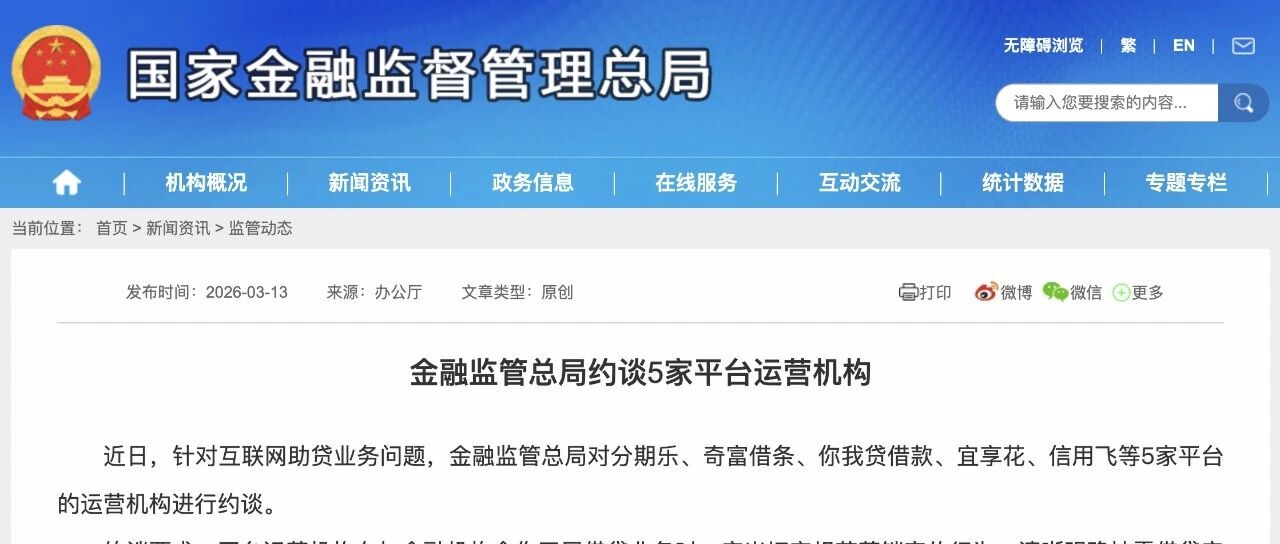
分期乐、奇富借条、你我贷借款、宜享花、信用飞等被约谈
财联社· 2026-03-13 10:55
Core Viewpoint - The Financial Regulatory Bureau has conducted interviews with five platforms regarding issues in internet lending, emphasizing the need for compliance and consumer protection measures [1] Group 1: Regulatory Actions - The Financial Regulatory Bureau has addressed concerns related to internet lending businesses, specifically targeting platforms such as Fenqile, Qifu Borrowing, Niwo Loan, Yixianghua, and Xinyongfei [1] - The platforms are required to standardize their marketing practices and clearly disclose interest and fee information related to lending products [1] - There is a strong emphasis on adhering to personal information protection regulations and conducting debt collection in a lawful manner [1] Group 2: Consumer Protection - The regulatory body has mandated the establishment of effective customer complaint resolution mechanisms to safeguard the legal rights of financial consumers [1]

小额贷款哪个平台好?2026年正规小额贷款全指南
Sou Hu Wang· 2026-02-23 12:05
Core Insights - The article discusses four reputable small loan products available in the market, highlighting their features and benefits for borrowers. Group 1: Loan Products Overview - WeBank's WeLiDai offers loan amounts ranging from 500 to 200,000 yuan, with an annual interest rate of 3.06% to 23.76%, and allows for flexible repayment options including early repayment without penalties [2] - Ant Group's Jiebei provides a maximum loan amount of 300,000 yuan, with an annual interest rate between 3.6% and 24%, and allows for unlimited borrowing as long as there is available credit [3] - JD Finance's Jingdong Jintiao offers a maximum loan amount of 300,000 yuan, although specific interest rates and repayment terms are not detailed [4] - 360's Qifu Jietiao has a maximum loan amount of 200,000 yuan, with an annual interest rate ranging from 7.2% to 24%, and allows for repayment over a maximum of 24 installments [5] Group 2: Considerations for Borrowers - The choice of a small loan platform should consider factors such as safety, convenience, transparency, and alignment with personal needs, emphasizing the importance of rational borrowing [5]
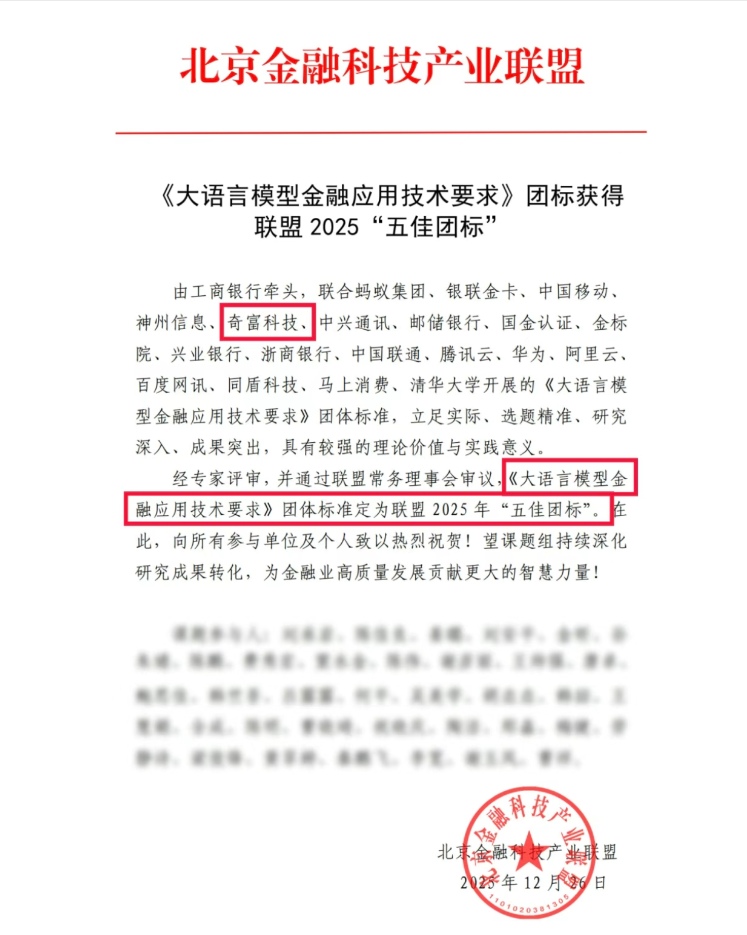
奇富借条所属奇富科技参编两项金融大模型标准 获评“五佳团标”
Cai Fu Zai Xian· 2026-01-23 09:28
Core Insights - The Beijing Financial Technology Industry Alliance announced the results of the "Top Five Group Standards" for 2025, recognizing the contributions of Qifu Technology in the standardization of financial large models [1][5] - Qifu Technology's participation in the development of two important group standards, namely "Technical Requirements for Financial Applications of Large Language Models" and "Evaluation Specifications for Financial Applications of Large Language Models," has been acknowledged as a significant achievement [1][3] Group 1: Standardization Efforts - Qifu Technology, as a core participating unit, has leveraged nine years of experience in financial technology to provide essential support across dimensions such as technology implementation, risk control, and business adaptation [3] - The standards were led by Industrial and Commercial Bank of China and involved collaboration with major industry players like China Mobile, Huawei, Tencent, and Alibaba, addressing the lack of unified norms in the application of large models in the financial sector [3][4] - The standards define core requirements including application framework, task capabilities, and security trustworthiness, establishing a comprehensive evaluation system for financial institutions' model construction, assessment, and risk management [3][4] Group 2: Company Initiatives - Qifu Technology is one of the early entrants in the financial large model sector, consistently advancing both "technology research" and "standard development" in tandem [4] - In 2023, the company formed a specialized large model team and collaborated with the China Academy of Information and Communications Technology to compile the first financial industry large model standard [4] - The company aims to launch a super intelligent agent in 2025 that enhances core lending operations by integrating modules for credit decision-making, credit assessment, and compliance assistance, thereby providing a practical example of standardized technology implementation [4][5] Group 3: Future Directions - The recognition as one of the "Top Five Group Standards" is seen as a positive affirmation of Qifu Technology's efforts in promoting industry standardization [5] - The company plans to continue collaborating with academic and research partners to deepen technological research and practical transformation, actively participating in the construction of industry standard ecosystems [5]
周鸿祎辞任董事长一年,奇富科技陷增收不增利,Q3净利降20%,合规压力也更大了
Sou Hu Cai Jing· 2025-11-21 01:43
Core Viewpoint - QiFu Technology, a credit platform under Zhou Hongyi, has seen its stock price drop nearly 20% in two trading days, with a market value of less than $2.4 billion, down over 60% from its historical high in March this year, primarily due to disappointing financial results [2] Financial Performance - In Q3, QiFu Technology reported total revenue of 5.2 billion yuan, roughly flat from the previous quarter, but up 19% year-on-year [2] - The company experienced a net profit decline of approximately 20% year-on-year and quarter-on-quarter, attributed to the expansion of its heavy asset credit business, increased risk exposure, and rapidly rising expenses [2][6] - The revenue from credit services reached nearly 3.9 billion yuan, a year-on-year increase of over 34%, contributing 75% to the company's total revenue [3] - The financing income (loan interest) was 2.3 billion yuan, up 35% year-on-year, while the income from the release of guaranteed liabilities exceeded 900 million yuan, a nearly 15% increase [3] User Growth and Loan Volume - As of the end of September, QiFu Technology had 62.1 million users with approved credit limits, a 13% year-on-year increase, and 38.1 million successful withdrawal users, a 15% year-on-year increase [3] - The total loan volume facilitated by QiFu Technology reached 83.3 billion yuan, a 1% year-on-year increase, with an outstanding loan balance of 138.1 billion yuan, up 8% year-on-year [3] Challenges in Light Asset Business - The light asset business, which provides credit matching and solutions, generated 1.3 billion yuan in revenue, down nearly 9% year-on-year and almost 19% quarter-on-quarter [4] - Revenue from loan matching services for financial institutions halved to 260 million yuan, reflecting a cautious lending environment [4] Increased Costs and Risk Exposure - Total costs and expenses reached 3.5 billion yuan, a significant increase of 68%, outpacing revenue growth [6] - The company reported a provision for bad loans of 838 million yuan, up 75% year-on-year, indicating increased credit risk [6] - The first-day overdue rate was approximately 5.5%, up from 4.6% a year earlier, signaling rising default risks [6] Future Outlook and Compliance Challenges - QiFu Technology plans to prioritize risk control and adopt a cautious approach in its business planning for the upcoming quarters, with projected Q4 net profit expected to decline by 39% to 49% year-on-year [5] - The company faces ongoing compliance challenges, including user complaints about aggressive collection practices and regulatory scrutiny in the online lending industry [10][11]

金融助力“618”电商大促活动 分期免息等受消费者偏爱
Zheng Quan Ri Bao· 2025-06-17 16:11
Core Insights - The annual "618" e-commerce promotion is experiencing significant changes this year, with keywords such as discounts, national subsidies, consumption vouchers, and interest-free installments becoming prominent [1][2] Financial Institutions' Participation - Various financial institutions, including e-commerce lending platforms, banks, and consumer finance companies, are actively engaging in promotional activities during the "618" event, utilizing methods like payment discounts, interest-free installments, double points, and cash back [2][3] - E-commerce platforms' installment financial products are driving consumption, with examples including Ant Group's interest-free installment plans on Taobao and Tmall, and JD's nationwide interest-free upgrade activities [2][3] Consumer Finance and Credit Technology Companies - Licensed consumer finance and credit technology companies are also participating in the promotion, focusing on scenario marketing. For instance, Haier Consumer Finance offers zero down payment, zero interest, and zero fees for purchasing home appliances [3] - Research indicates that financial institutions are lowering consumer spending thresholds through installment products, providing tangible benefits rather than mere promotional gimmicks [3] Release of Consumer Vitality - The combination of national subsidies and multiple installment offers has effectively stimulated consumer spending, with data showing a 70% increase in interest-free installment orders on Taobao and Tmall compared to last year [4] - JD's data indicates that the integration of national subsidies and interest-free installments has significantly boosted transaction volumes, with average increases exceeding 2.5 times in regions like Beijing, Guangdong, and Jiangsu [4] - A survey revealed that 85% of consumers prefer using interest-free installments even when they can afford to pay in full, highlighting the effectiveness of this marketing strategy [4]