宗帅家酒

Search documents
茅台镇华领国酒业被拍卖:娃哈哈曾控股,或与华林集团有关联
Nan Fang Du Shi Bao· 2025-07-22 08:55
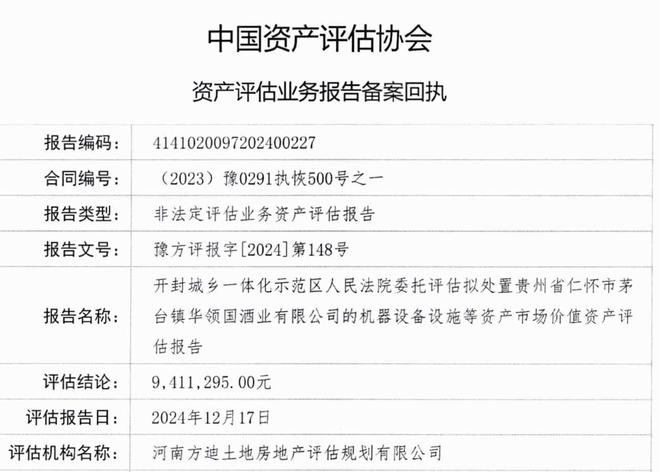
Core Viewpoint - The recent auction of assets belonging to Hualing Guojiao Industry, previously controlled by Wahaha, has drawn attention due to the ongoing controversy surrounding Wahaha, highlighting the challenges faced by the company in the liquor industry [1][4]. Group 1: Asset Auction Details - On July 19, assets including 10 properties and equipment from Hualing Guojiao Industry were auctioned for a base price of 108 million yuan, with the winning bidder being Kaifeng Economic Development Zone's subsidiary [1]. - The assessed value of the auctioned assets was approximately 132 million yuan, indicating a potential loss for the company [1][3]. Group 2: Company Background and History - Hualing Guojiao Industry was established in November 2013, originally named Lingjiang Guojiao Industry, as part of Wahaha's foray into the liquor sector [3][4]. - Wahaha held an 80% stake in Hualing Guojiao Industry, which launched a sauce-flavored liquor product called "Lingjiang Guojiao" [4]. Group 3: Market Performance and Challenges - The initial sales performance of "Lingjiang Guojiao" was poor, with losses exceeding 6 million yuan in its first year due to a shift in liquor consumption patterns [4][5]. - Despite Wahaha's exit from the liquor market in 2017, the company attempted to re-enter with new products in 2022, but market response was underwhelming [5][7]. Group 4: Future Prospects and Industry Context - Following the transfer of control to Huajiang Trading, Hualing Guojiao Industry planned to invest 120 million yuan to enhance production capacity, aiming for an annual output of 1,500 tons of sauce-flavored liquor [7]. - The company faced significant operational challenges due to legal issues and market conditions, leading to a halt in production and uncertainty regarding future market re-entry [8][11].

宗庆后与百花潞酒:中国商业转型期的一场文化价值错位
Sou Hu Cai Jing· 2025-06-17 06:54
Core Insights - The article discusses the historical and cultural significance of Baijiu, particularly the Baihua Lujiu brand, and highlights the strategic missteps made by Wahaha Group in its acquisition and management of the brand, leading to missed opportunities in the evolving Chinese liquor market [2][11]. Group 1: Cultural Heritage of Lujiu - Baihua Lujiu is not an ordinary liquor; its value is deeply rooted in the 1500-year history of Lujiu culture, which dates back to the Northern Zhou period, and has a brewing history of 6000 years [5][6]. - Baihua Lujiu embodies three cultural genes: the spirit of Jin merchants, the folk customs of the Three Gorges region, and traditional Chinese medicine principles, making it a regional cultural symbol alongside other local products [6][5]. Group 2: Wahaha's Strategic Missteps - Wahaha's acquisition of Baihua Lujiu in 1994 was primarily a response to a political task rather than a commercial strategy, leading to a lack of proactive investment and strategic vision [7]. - The rebranding efforts, including renaming the factory and altering traditional brewing methods, resulted in significant cultural asset damage and consumer backlash, demonstrating a lack of understanding of the brand's historical value [8][9]. - Wahaha's fast-moving consumer goods mindset clashed with the long-term nature of the liquor industry, leading to unsuccessful attempts to penetrate the market and ultimately the closure of the Baihua Lujiu factory in 2011 [9][10]. Group 3: Consequences of Strategic Failures - Wahaha's failure to capitalize on the cultural and historical significance of Baihua Lujiu represents a lost opportunity in the competitive liquor market, where cultural value is becoming increasingly important [11][12]. - The exit of Wahaha from the Baihua Lujiu market has hindered the economic transformation of the Three Gorges region, as the brand could have served as a benchmark for both immigrant economic transformation and the revival of time-honored brands [12]. Group 4: Revival of Lujiu Culture - The contemporary revival of Lujiu culture, led by the Shanxi Lujiu brand, showcases a successful integration of cultural heritage with modern business practices, including the establishment of cultural events and tourism initiatives [14][17]. - The strategic focus on "living culture" and long-term brand development contrasts sharply with Wahaha's previous approach, emphasizing the importance of respecting traditional brewing practices and cultural narratives [17][18]. Group 5: Lessons for the Industry - The encounter between Wahaha and Baihua Lujiu serves as a metaphor for the challenges faced during China's commercial transformation, highlighting the need for cultural decoding capabilities and respect for industry fundamentals in cross-sector expansions [18][19]. - The rise of new consumer trends, particularly among younger generations, indicates a potential market for historical brands, suggesting that the cultural scarcity of traditional products can translate into competitive advantages [20].