家乐氏谷物早餐

Search documents
刚刚,玛氏再出手,全资拿下品客母企中国业务,玛氏箭牌在华年收入超150亿也浮出水面
3 6 Ke· 2026-01-16 00:35
Core Viewpoint - Kellanova's Chinese business will transition from a joint venture model to full ownership by Mars, marking a significant shift in its operational strategy in China [3][9]. Group 1: Transaction Details - The transaction involves the transfer of 50% stakes in two joint ventures, Kellogg's Shanghai and Kellogg's Kunshan, from Yihai Kerry to Mars Wrigley, with a total transaction value of $60 million (approximately 418 million RMB) [4][6]. - The stakes are valued at $45 million for Kellogg's Shanghai and $15 million for Kellogg's Kunshan, with the deal expected to close on the third business day after all conditions are met [8][4]. Group 2: Financial Performance - Mars Wrigley reported a registered capital of $91.49 million, with projected revenues exceeding 15 billion RMB and a net profit of nearly 860 million RMB for the year 2024 [4]. - Kellogg's Shanghai generated approximately 290 million RMB in revenue and 47.6 million RMB in net profit for 2024, while Kellogg's Kunshan had revenues of about 130 million RMB and net profits nearing 7.6 million RMB [6]. Group 3: Market Position and Future Opportunities - The acquisition allows Mars to fully control Kellanova's operations in China, enhancing its portfolio in the snack food sector, particularly in the salty snack category, where it previously had limited presence [19][15]. - Kellanova's market share in the Chinese oatmeal sector is currently at 5.3%, indicating significant room for growth under Mars's management [17]. - The integration of Kellanova's products, such as Pringles and breakfast cereals, into Mars's existing portfolio could lead to enhanced market penetration and innovation in the Chinese snack market [19][15].


德芙携手品客:玛氏360亿美元豪购背后的零食帝国野心
Xin Lang Cai Jing· 2025-12-16 10:05
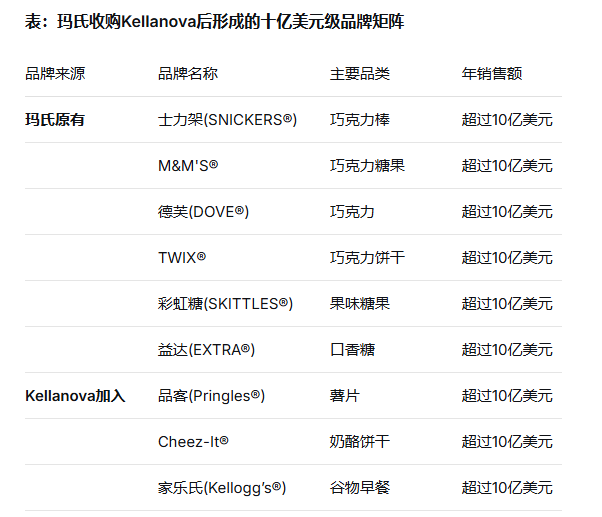
Core Insights - Mars Inc. has completed the acquisition of Kellanova, the parent company of Pringles, for a total consideration of $35.9 billion, marking one of the largest deals in the global packaged food sector in the past decade [1][2][10] - This acquisition sets a new record for Mars in terms of merger and acquisition scale, with the deal being finalized after 16 months and requiring approvals from 28 global regulatory bodies [2][11] Financial Overview - The acquisition price of $83.50 per share represents a 44% premium over Kellanova's weighted average stock price over the previous 30 trading days, significantly higher than the industry average [2][11] - Post-acquisition, Mars' snack business revenue is expected to rise to approximately $36 billion, with the combined entity featuring nine brands that each generate over $1 billion in annual sales [3][12] Market Positioning - The merger will create a complementary product portfolio, combining Mars' strengths in sweet snacks with Kellanova's expertise in savory snacks and breakfast foods, enhancing market coverage [3][12] - Following the acquisition, Mars will become the third-largest player in the global snack industry, with a combined market share of 26% alongside PepsiCo and Mondelez [6][15] Business Structure Changes - The acquisition will shift Mars' business structure, with the snack segment's revenue increasing from $17.92 billion (33% of total revenue) to $36 billion (45% of total revenue), while the pet care segment's share will decrease from 60% to approximately 48% [7][16] - The integration of Kellanova will also expand Mars' health and nutrition product offerings, including RXBAR and Nutri-Grain energy bars [4][12] Regional Impact - In China, which accounted for 18% of Mars' 2024 sales, the acquisition will allow for better integration of Kellanova's products into Mars' established distribution network [8][17] - Kellanova's Pringles brand holds a 10% market share in China's snack market, and local production is expected to begin by 2026, potentially reducing prices by 20% [8][17] Integration Challenges - Despite the strategic significance of the acquisition, Kellanova has faced challenges, with a 0.2% year-over-year increase in organic sales and a 4.1% decline in adjusted operating profit in the first three quarters of 2025 [9][18] - Mars plans to increase Kellanova's R&D budget by 30% and retain its core management team to navigate the integration process [9][18]