小米巨省电空调

Search documents
小米之“惑”
Jing Ji Guan Cha Wang· 2025-11-14 14:03
Core Viewpoint - Xiaomi is facing a significant trust crisis due to misleading marketing practices and legal disputes, which could harm its brand reputation and consumer trust in the long run [1][4][7]. Group 1: Marketing and Brand Image - Recent allegations suggest that Xiaomi's "giant energy-saving" air conditioner label misleads consumers, as it does not reflect actual performance metrics [1]. - Xiaomi's dual brand identity as both a cost-effective internet retail brand and a high-end product service brand creates confusion in its market positioning [5][10]. - The company's marketing strategies, including the use of "hunger marketing," have drawn criticism for potentially misleading consumers and creating a negative perception [23][24]. Group 2: Legal and Regulatory Challenges - Xiaomi has faced legal challenges, including a lawsuit from a car owner regarding misleading advertising, which has been interpreted as an attempt to complicate consumer rights [1]. - Reports indicate that Xiaomi has been targeted by regulatory scrutiny for its marketing practices, with potential new regulations on false advertising being discussed [14]. Group 3: Financial Performance and Market Sentiment - According to a report from Goldman Sachs, Xiaomi has become a consensus short target among hedge funds, with its stock price dropping nearly 30% since June due to rising chip costs and declining profit margins [3]. - The company has seen a significant increase in consumer complaints, particularly in its home appliance sector, indicating growing dissatisfaction with product quality [26]. Group 4: Product Development and Innovation - Xiaomi's strategy of maintaining low profit margins on hardware has been a double-edged sword, as it struggles to compete in high-end markets where quality and innovation are paramount [9][12]. - The company has made strides in chip development, with its self-developed 3nm chip "Xuanjie O1" entering mass production, but it still relies heavily on external suppliers for critical components [25]. Group 5: Industry Position and Competitive Landscape - Xiaomi's approach of aggressive pricing and market entry has raised concerns about its impact on industry standards and the long-term viability of competitors [31][32]. - The company is caught in a struggle between being perceived as a low-cost provider and a premium brand, which complicates its competitive strategy in various sectors, including smartphones and electric vehicles [12][30].


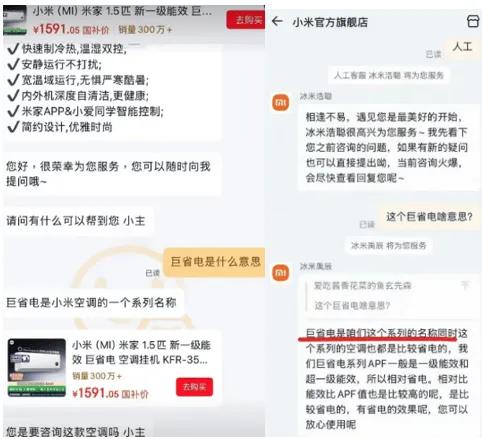
“巨省电”只是空调名?小米回应
Xin Hua Ri Bao· 2025-10-31 02:20
Core Viewpoint - The controversy surrounding Xiaomi's "Giant Energy Saving" air conditioning series has sparked discussions about the accuracy of product naming versus performance metrics, with mixed consumer feedback on its effectiveness [1][3][5]. Group 1: Product Naming and Performance - Users reported that "Giant Energy Saving" is merely a product series name and not an indicator of performance, leading to significant debate [1]. - Some consumers expressed dissatisfaction with the cooling performance of the "Giant Energy Saving" air conditioners, while others claimed they were indeed energy-efficient and quiet [3]. - Xiaomi's product manager clarified that the naming convention is not unique to Xiaomi, as other brands like Midea and TCL also use similar naming strategies for their air conditioning series [5]. Group 2: Sales Performance - In the first quarter of this year, Xiaomi's air conditioners, refrigerators, and washing machines ranked fourth in national sales, with sales revenue growth exceeding 100% year-on-year, particularly a remarkable 184.4% increase in washing machine sales [5].
小米高管回应巨省电质疑,称产品名副其实远超国标
Xin Lang Ke Ji· 2025-10-30 01:13
Core Viewpoint - Xiaomi's recent launch of its first major appliance factory and the clarification regarding its "giant energy-saving" product line, emphasizing that the name represents product positioning rather than a literal claim of energy savings [1] Group 1: Product Positioning and Efficiency - The "giant energy-saving" series is part of a broader product lineup that includes health-oriented and airflow-focused models, with each name reflecting its specific capabilities [1] - The energy efficiency ratings for the "giant energy-saving" series exceed national standards, with an EPF of 5.27 compared to the national standard of 5.0, and a target of 5.6 for ultra-high efficiency [1] - AI technology is utilized to enhance energy efficiency, achieving approximately 30% lower energy consumption compared to traditional PID control methods during startup [1] Group 2: Competitive Landscape - The competitive environment in the home appliance sector is described as heated, with other companies allegedly misrepresenting Xiaomi's claims, indicating a sense of urgency among competitors [1] - Xiaomi's management expresses confidence in their product capabilities and dismisses competitors' criticisms as unfounded, suggesting that the company's stability contrasts with the perceived anxiety of rival firms [1]