小语言模型(SLM)

Search documents
马来西亚中华总商会人工智能组主任:中企出海促东南亚产业升级
2 1 Shi Ji Jing Ji Bao Dao· 2025-12-30 04:59
Group 1: AI's Impact on ASEAN and Malaysia - The AI industry is projected to contribute 10% to 18% growth in ASEAN's GDP by 2030, creating over $1 trillion in potential value [1] - Malaysia views AI as a core path to national modernization, enhancing quality of life and improving efficiency for businesses [4][5] - Traditional industries are expected to be reshaped and upgraded through AI integration rather than being simply eliminated [4][5] Group 2: Malaysia's AI Development Strategy - Malaysia plans to establish a National AI Office in December 2024 to promote the AI ecosystem and develop relevant policies [3] - The AI Office will collaborate with the Ministry of Investment, Trade and Industry to implement AI technologies across various sectors [3] - The government has allocated funds in the 2023 budget to support technology education, aiming to prepare the workforce for AI applications [5] Group 3: Collaboration with China - Malaysia and China have a strong trade relationship, with China being Malaysia's largest trading partner for 16 consecutive years [6] - The two countries are expected to deepen cooperation in emerging technologies, including AI, with Malaysia aiming to be among the top 20 AI economies by 2030 [5][6] - Chinese tech companies have successfully entered the Malaysian market, providing various services and products that enhance local development [9] Group 4: AI in Traditional Industries - AI is seen as essential for enhancing sectors like services, agriculture, and logistics, which will not be replaced but rather empowered by technology [5] - The integration of AI can lead to new business models and structural changes in traditional industries, especially in labor-intensive sectors [5] - A proposed "AI scoring system" could help evaluate foreign labor, showcasing AI's potential to create self-regulating mechanisms in the workforce [5] Group 5: China's AI Industry - China is recognized for having a complete AI industry chain, driving the sector towards high-end development [7] - The rapid advancements in AI in China are characterized by speed, strong implementation, and high cost-effectiveness [7] - China's AI ecosystem is extensive, covering data, chips, models, and applications, contributing to its robust growth [7]
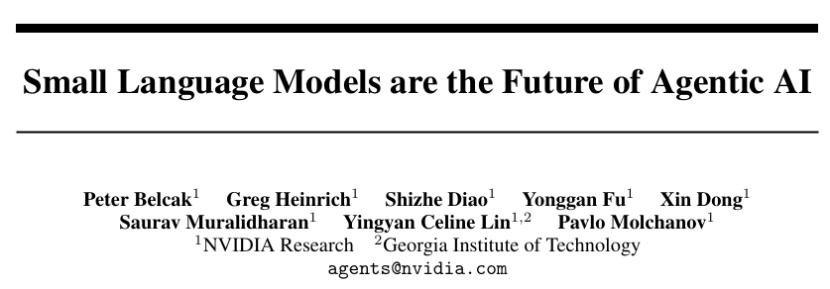
英伟达最新研究:小模型才是智能体的未来
3 6 Ke· 2025-08-05 09:45
Core Viewpoint - Small Language Models (SLMs) are considered the future of AI agents, as they are more efficient and cost-effective compared to large language models (LLMs) [1][3]. Group 1: Advantages of SLMs - SLMs are powerful enough to handle most repetitive and specialized tasks within AI agents [3]. - They are inherently better suited for the architecture of agent systems, being flexible and easy to integrate [3]. - Economically, SLMs significantly reduce operational costs, making them a more efficient choice for AI applications [3]. Group 2: Market Potential - The AI agent market is projected to grow from $5.2 billion in 2024 to $200 billion by 2034, with over half of enterprises already utilizing AI agents [5]. - Current AI agent tasks are often repetitive, such as "checking emails" and "generating reports," making the use of LLMs inefficient [5]. Group 3: SLM Characteristics - SLMs can be deployed on standard consumer devices, such as smartphones and laptops, and have fast inference speeds [9]. - Models with fewer than 1 billion parameters are classified as SLMs, while larger models typically require cloud support [9]. - SLMs are likened to a "portable brain," balancing efficiency and ease of iteration, unlike LLMs which are compared to "universe-level supercomputers" with high latency and costs [9]. Group 4: Performance Comparison - Cutting-edge small models like Phi-3 and Hymba can perform tasks comparable to 30B to 70B large models while reducing computational load by 10-30 times [11]. - Real-world tests showed that 60% of tasks in MetaGPT, 40% in Open Operator, and 70% in Cradle could be replaced by SLMs [11]. Group 5: Barriers to Adoption - The primary reason for the limited use of SLMs is path dependency, with significant investments (up to $57 billion) in centralized large model infrastructure [12]. - There is a strong industry bias towards the belief that "bigger is better," which has hindered the exploration of small models [12]. - SLMs lack the marketing hype that large models like GPT-4 have received, leading to fewer attempts to explore more cost-effective options [13].