
居家养老

Search documents
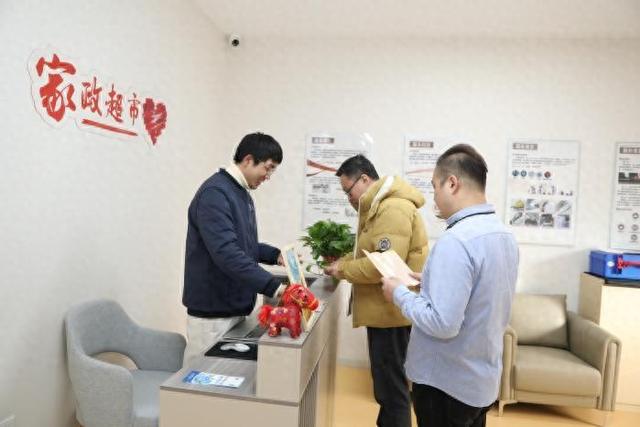
北京西城推进家政进社区 首家“家政超市”试运行
Xin Lang Cai Jing· 2026-01-23 08:34
Group 1 - The first "home service supermarket" in Xicheng District, Beijing, began trial operation on January 23, 2023, as part of a collaboration between the Xicheng District Commerce Bureau and the Chunshe Street Office to enhance community services for the elderly and children [1][2] - The project aims to create a new model of home service by integrating resources from the government and private sector, focusing on community needs and improving service delivery through a coordinated mechanism [1][2] - The home service supermarket is located at the Chunshe Street Party-Mass Service Center and operates on weekdays from 9:00 AM to 5:00 PM, providing a range of services tailored to local residents [1][2] Group 2 - The collaboration between the Xicheng District Commerce Bureau and Chunshe Street Office is designed to address pain points in the home service industry, ensuring that policy benefits reach both service providers and consumers effectively [2] - The service offerings from Bangban Company include comprehensive care services such as patient care, home elderly care, and daily housekeeping, along with personalized projects like maternal and infant care, forming a complete service chain [2] - To ensure quality, all service personnel undergo a three-tier verification process, including identity checks, health examinations, and skill certifications, along with professional training and insurance coverage [2] Group 3 - The successful launch of the home service supermarket is a significant step in building a "15-minute convenient living circle" in Xicheng District, with plans for further expansion of home services across various streets [2] - The Xicheng District Commerce Bureau plans to deepen collaboration and optimize existing service models, promoting the integration of home services with supermarkets and convenience stores to create a comprehensive service network [2] - To provide additional benefits to residents, the platform will offer online consumption vouchers and discounts at the Bangban home service supermarket around the Spring Festival [4]

北京全市已建成155家区域养老服务中心
Xin Lang Cai Jing· 2026-01-17 23:54
Core Insights - Beijing has initiated the construction of regional elderly care service centers in 2024, with 155 centers completed so far, covering 104 streets and towns with significant aging populations [1] - These centers serve approximately 2.554 million elderly individuals, accounting for 49.6% of the city's permanent elderly population [1] - Among the elderly, 365,000 individuals aged 80 and above, referred to as "old elderly," represent 56.3% of the city's "old elderly" population [1] - In 2025, the regional elderly care service centers provided services to 1.247 million elderly individuals, including meal assistance, home care, elderly education, and integrated medical care [1] - The number of "old elderly" served in 2025 was 365,000 [1] - This year, the city plans to establish an additional 20 regional elderly care service centers [1]
北京已建成152家区域养老服务中心,覆盖207万老年人
Bei Jing Shang Bao· 2025-12-11 08:30
Group 1 - The core viewpoint of the article highlights Beijing's efforts in enhancing its elderly care services through the establishment of a comprehensive three-tiered elderly care service network over the past five years [1] Group 2 - Beijing has built 152 regional elderly care service centers, covering 2.07 million elderly individuals, with 293,000 being "old elderly" (aged 80 and above), representing 44% of the total elderly population in the city [1] - The city has integrated 413 elderly care stations and 1,022 professional service providers to offer various services such as meal assistance, care for the elderly, home-based care, and integrated medical and nursing services [1] - A guideline for nursing bed capacity in elderly care institutions has been introduced to enhance the professional care capabilities for "old elderly," resulting in the establishment of 622 elderly care institutions with a total of 110,000 beds, of which 68% are nursing beds [1]