
巡天空间望远镜

Search documents
我国在巡天空间望远镜科学仿真研究上取得进展
Xin Hua She· 2026-01-08 08:15
Core Viewpoint - The Chinese research team has made progress in the scientific data simulation for the Chinese Space Station's Survey Space Telescope, preparing for significant scientific achievements upon its launch [1] Group 1: Telescope Features and Capabilities - The Survey Space Telescope is a fourth-generation survey telescope with a 2-meter aperture, designed for large field of view, high image quality, and wide spectral range [1] - It is expected to make significant scientific discoveries in various fields of astrophysics, including cosmology, galaxies, the Milky Way, stars, and planets [1] Group 2: Research and Simulation Efforts - The research team has developed an end-to-end observation simulation suite to ensure the reliability and timeliness of scientific outputs from the telescope [1] - This simulation includes pixel-level high-quality simulations of observational data, which will be used for comprehensive performance evaluation of the telescope [1] Group 3: Operational Context - The Survey Space Telescope is a crucial component of the Chinese Space Station and will operate in a long-term independent flight while conducting survey observations [1] - It will periodically dock with the space station for resupply and maintenance upgrades [1]
【新华社】“观天”预演!巡天空间望远镜科学仿真研究取得进展
Xin Hua She· 2026-01-08 01:55
Core Insights - China's research team has made progress in the scientific data simulation for the Chinese Space Station's Surveying Space Telescope, preparing for future scientific achievements after its launch [1][2] - The Surveying Space Telescope, a key component of China's manned space program, features a 2-meter aperture and is expected to make significant discoveries in various astrophysical fields [1] Group 1 - The telescope is part of the fourth generation of survey telescopes, entering the era of big data astronomy with the construction and operation of similar international telescopes [1] - A comprehensive end-to-end observation simulation suite has been developed to ensure the reliability and timeliness of scientific outputs from the telescope [1] Group 2 - The work provides a clear expectation for China's capability in direct imaging observations of exoplanets, offering important technical support for scientific outputs in this frontier field [2] - The results demonstrate the performance of the main survey module and its auxiliary modules, ensuring reliable data for the development and testing of the data processing system before launch [2]
中国在巡天空间望远镜科学仿真研究上取得进展
Ren Min Wang· 2026-01-08 01:17
Core Insights - The Chinese research team has made progress in the scientific data simulation for the Chinese space station's survey space telescope, preparing for its future launch and potential original scientific achievements [1] Group 1: Telescope Overview - The survey space telescope is a fourth-generation survey telescope with a 2-meter aperture, designed as a large space astronomical facility under China's manned space program [1] - It features a wide field of view, high image quality, and broad wavelength capabilities, aiming for significant scientific discoveries in cosmology, galaxies, the Milky Way, stars, and planets [1] Group 2: Research and Simulation - Conducting scientific simulations before the telescope's launch is crucial for achieving major scientific objectives [1] - The research team has developed an end-to-end observation simulation suite for the telescope's main optical system and various observation terminals, achieving high-quality pixel-level simulation of observational data [1] Group 3: Operational Details - The survey space telescope will be an integral part of the Chinese space station, operating in a long-term independent flight while conducting survey observations [1] - It will periodically dock with the space station for resupply and maintenance upgrades [1]
“观天”预演!巡天空间望远镜科学仿真研究取得进展
Xin Hua She· 2026-01-07 07:01
Core Viewpoint - The Chinese research team has made significant progress in the scientific data simulation for the Chinese space station's survey space telescope, laying the groundwork for future scientific achievements after its launch [1][2]. Group 1: Scientific Advancements - The survey space telescope is part of China's manned space program and features a 2-meter aperture, large field of view, high image quality, and wide wavelength range, which are expected to lead to major scientific discoveries in various astrophysical fields [1]. - The research team has developed an end-to-end observation simulation suite to ensure the reliability and timeliness of scientific outputs from the telescope, achieving pixel-level high-quality simulation of observational data [1]. Group 2: Technical Support and Future Prospects - The work provides a clear expectation for China's future capabilities in direct imaging observations of exoplanets, offering important technical support for scientific outputs in this cutting-edge field [2]. - The results of the research are expected to provide reliable data support for the development and testing of the data processing system prior to the telescope's launch, as well as for scientific operations post-launch [2].
NASA发文称:卫星光污染或威胁空基天文学研究
Ke Ji Ri Bao· 2025-12-14 01:09
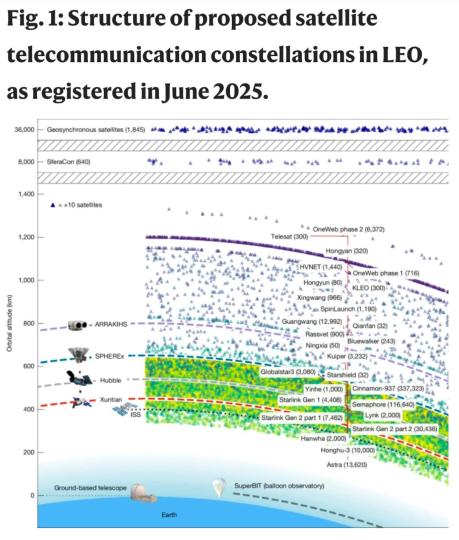
Core Insights - A recent analysis by NASA indicates that global ground-based astronomy research may face significant threats from satellite light pollution over the next decade, with approximately 96% of images from low Earth orbit observations potentially affected [1][2] Group 1: Satellite Impact on Astronomy - The number of satellites in orbit has surged to 15,000, up from just 75 in 2019, primarily due to decreased launch costs [2] - Ground-based observations, such as those from NASA's Webb Telescope, may be disrupted by reflected light from these satellites, rendering images unusable for research [2] - Previous studies have focused on the impact of satellites on ground-based astronomy, but the effects on space telescopes have been largely overlooked [2] Group 2: Future Projections and Solutions - NASA's Ames Research Center simulated the field of view changes for four space telescopes at an altitude of 800 kilometers as satellite numbers increase, including NASA's Webb and SPHEREx, ESA's ARRAKIHS, and China's planned survey space telescope [2] - It is projected that 560,000 satellites will be operational in the future, potentially polluting 39.6% of images from the Webb Telescope and 96% of images from the other three telescopes [2] - The average number of satellites observed by the Webb Telescope is estimated to be 2.14, while SPHEREx may see 5.64, ARRAKIHS 69, and the survey telescope 92 [2] - A potential solution proposed is to deploy satellites in orbits lower than those of the telescopes, although this could negatively impact the Earth's ozone layer [2]


国际最新研究:卫星光污染严重威胁空基天文望远镜观测宇宙
Zhong Guo Xin Wen Wang· 2025-12-07 06:17
Core Insights - The increasing number of satellites in Earth's orbit is significantly impacting ground-based astronomical observations, with a recent study warning that about 96% of images from low Earth orbit space telescopes may be affected by satellite light pollution in the next decade [1][4] - The number of satellites has surged from 75 in 2019 to 15,000 currently, primarily due to reduced launch costs, which poses a threat to the effectiveness of space telescopes like NASA's James Webb Telescope [1][4] Summary by Sections - **Impact on Space Telescopes** - The study highlights that the light pollution from satellites could render images from space telescopes unusable for research purposes [1] - It is noted that previous research has focused on the effects of satellites on ground-based astronomy, while the impact on space telescopes has been largely overlooked [1] - **Current and Future Satellite Projections** - The research indicates that there are currently 15,000 satellites in orbit, with projections suggesting that this number could rise to 560,000 in the future [4] - The anticipated increase in satellites could lead to 39.6% of images from the James Webb Telescope being polluted, while other telescopes like SPHEREx, ARRAKIHS, and a proposed Chinese survey telescope could see 96% of their images affected [4] - **Observational Data** - The average number of satellites observed by various telescopes is projected as follows: James Webb Telescope (2.14), SPHEREx (5.64), ARRAKIHS (69), and the survey telescope (92) [4] - **Potential Solutions** - A suggested solution to mitigate the impact of satellite light pollution is to deploy satellites in orbits lower than those of space telescopes, although this could have adverse effects on the Earth's ozone layer [4]
郝敏:中国光学突围历史照见芯片前路
Huan Qiu Wang Zi Xun· 2025-07-20 23:12
Core Viewpoint - The recent shifts in the U.S. chip policy towards China reflect a complex interplay of competition and cooperation, driven by China's technological advancements and the need for U.S. companies to maintain market presence in China [1][4]. Group 1: U.S. Policy Changes - In April, the U.S. government prohibited NVIDIA from selling the H20 chip to China, but by July, the export approval was granted, indicating a reconsideration of the initial ban [1]. - The U.S. aims to balance its national security concerns with the economic necessity of engaging with the Chinese market, as losing access could accelerate China's technological independence [1][4]. Group 2: China's Technological Progress - China's progress in the optical instrument manufacturing sector serves as a historical parallel to its current advancements in the chip industry, showcasing resilience in the face of external restrictions [2][3]. - The development of competitive technologies in China, such as those from Huawei and Cambrian, indicates a growing capability to meet domestic demands while preparing for international expansion [4]. Group 3: Implications for the Industry - The concept of "marginal regulatory effect" suggests that as China develops comparable products, U.S. restrictions may ease to protect market interests, highlighting a dual focus on national security and economic gain [4]. - The approval of NVIDIA's H20 chip sales to China is seen as beneficial for both parties, allowing for resource optimization and mutual benefits in the tech landscape [4]. Group 4: Future Outlook - Despite external pressures, China's commitment to self-reliance and technological innovation remains strong, with ongoing developments in various fields such as space exploration and quantum communication [5]. - The trajectory of China's technological advancements suggests a future characterized by significant achievements and contributions to global technology [5].
