巡田无人机

Search documents
“AI侦察兵”守护万亩农田
Xin Hua Ri Bao· 2026-01-27 21:52
Core Insights - The article highlights the advancements in smart agriculture through the use of drones and AI technology in Sheyang, Jiangsu Province, showcasing significant efficiency improvements in crop management [1][2] Group 1: Technology Implementation - The deployment of 7 drones in the Su Keng Agricultural Development Smart Agriculture Technology Park has increased efficiency in field monitoring by 3 to 5 times compared to traditional manual methods [1] - Drones equipped with advanced sensors capture spectral information from crops, enabling precise identification of growth anomalies and generating detailed "health reports" for field management [1] Group 2: Agricultural Innovation - The integration of a comprehensive platform, referred to as "one map, one cloud, one network," supports a closed-loop system for farming operations, enhancing resource utilization and crop yield [2] - Continuous investment in scientific innovation and collaboration with academic institutions has led to the establishment of key laboratories and innovation consortia, focusing on AI agriculture and unmanned farming technologies [2] Group 3: Future Outlook - The company aims to further enhance agricultural productivity by deepening the integration of AI and smart equipment, positioning itself as a benchmark in the industry and contributing to food security [2]

给农业装上“AI大脑”
Jing Ji Ri Bao· 2025-10-12 21:44
Core Insights - The first Smart Agriculture Innovation Competition showcased advancements in agricultural technology, including targeted spraying robots and drones, highlighting the potential for future agricultural development [1] - The State Council's recent document emphasizes the integration of artificial intelligence in agricultural production management and risk prevention, aiming to enhance farmers' operational capabilities [1] Group 1: Achievements in Smart Agriculture - Significant progress has been made in the full-process intelligence of agricultural production, such as the transition to molecular design breeding through whole-genome selection, resulting in improved disease resistance, salt and alkali tolerance, yield, and quality of new varieties [1] - The integration of artificial intelligence and the Internet of Things enables comprehensive monitoring of pest conditions and crop growth, facilitating precise management and decision-making across the agricultural supply chain [1] Group 2: Challenges in Agricultural AI - Challenges include the lag in the comprehensive layout of the agricultural AI industry chain, the distance to scale and industrialization, and the need for breakthroughs in key technologies [1] - Issues such as difficulties in agricultural data collection, insufficient integration and sharing, and varying data quality contribute to the "data island" phenomenon, hindering the efficient evolution of AI models [1] Group 3: Strategic Recommendations - A systematic approach is needed for agricultural intelligence, focusing on both horizontal expansion in breeding, planting, and aquaculture, and vertical integration in production processing, storage logistics, and digital marketing [2] - The promotion of collaboration between academia and industry is essential to overcome bottlenecks in new materials and high-end agricultural machinery, enhancing the development and application of intelligent perception and automation control technologies [2] Group 4: Data Sharing and Policy Support - Breaking down "data islands" is crucial for the development of AI agricultural models, necessitating high-quality agricultural data that is interconnected and shared [3] - The establishment of unified standards and agricultural data sharing platforms by relevant authorities can help reduce barriers to agricultural data utilization [3] - Comprehensive policy support and innovation in talent cultivation are required to facilitate the transition to smart agriculture, including optimizing industry policies and creating a favorable environment for agricultural stakeholders [3]
给农业插上科技的翅膀——2025年首届智慧农业创新大赛扫描
Xin Hua She· 2025-09-30 11:42
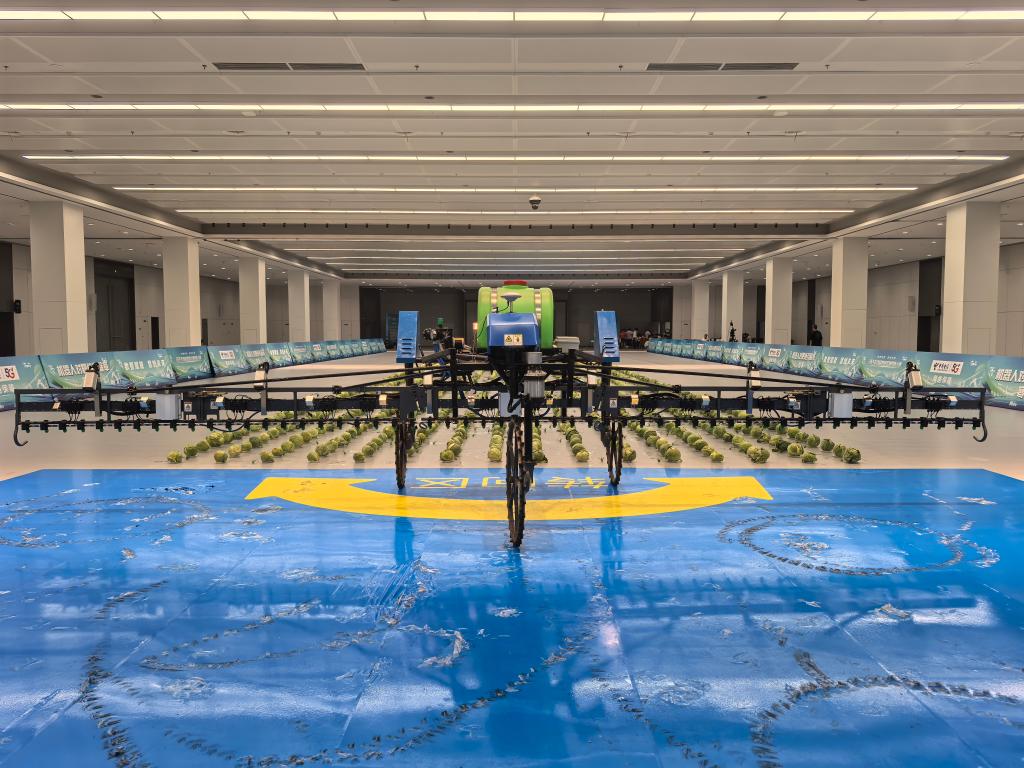
Core Insights - The event showcased innovations in smart agriculture, featuring robots and drones designed to enhance efficiency in farming tasks such as weeding, transporting, and monitoring crops [1][6] - The competition attracted 55 teams from 26 companies and 17 research institutions, highlighting the growing interest and investment in agricultural technology [1] Group 1: Weeding Robots - The targeted spraying weeding robot developed by Anhui Hefei Duojia Agricultural Technology Co., Ltd. can operate on 1 acre of land in under 1 minute, reducing pesticide usage by 30% to 80% compared to traditional methods [3] - The robot features an online mixing technology and dual spraying system, improving pesticide utilization and minimizing environmental pollution [3] Group 2: Transport Robots - The smart transport unmanned vehicle from Zhejiang Hangzhou Shennongshi Robot Co., Ltd. integrates various self-developed technologies, enabling it to navigate and avoid obstacles autonomously [5] - The new generation greenhouse transport robot GHBOT-02, developed by Beijing Agricultural College, utilizes low-cost 2D laser radar technology, reducing hardware costs by over 90% compared to traditional 3D laser radar [5] Group 3: Monitoring Drones - Drones demonstrated capabilities in quickly measuring field areas and identifying crops, providing data analysis and recommendations for farmers [6] - The drones can complete monitoring tasks for 50-60 acres in about 10 minutes, significantly improving efficiency compared to manual labor [6] Group 4: Future of Smart Agriculture - The event served as a platform to showcase China's achievements in smart agriculture and promote the digital transformation of the agricultural sector [6] - Experts predict that the future of smart agriculture will focus on automation, precision, and intelligence, contributing to the modernization of agriculture [6]


迈向更智能更高效的农业生产
Jing Ji Ri Bao· 2025-09-25 22:07
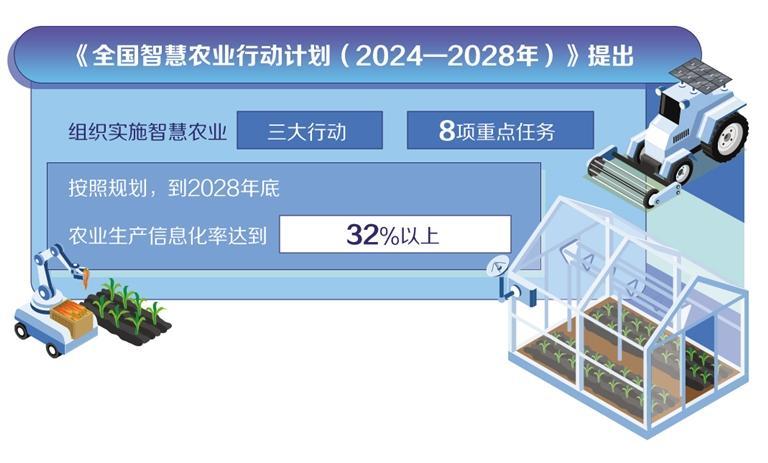
Core Insights - The application of artificial intelligence (AI) in agriculture is rapidly advancing, with various innovations such as four-legged robots for smart farming and automated pollination robots being introduced [2][3] - The Chinese government has issued policies to accelerate the digital transformation of agriculture, emphasizing the integration of AI in breeding systems and agricultural management [2][4] Group 1: Current Developments in Smart Agriculture - Companies are utilizing AI technologies, such as drones and sensors, to enhance crop monitoring and pest control, leading to a reduction in pesticide costs by 10% to 20% [3] - The implementation of the "National Smart Agriculture Action Plan (2024-2028)" aims to promote smart agriculture through policy support, technology innovation, and service enhancement [4][6] Group 2: Benefits of AI in Agriculture - AI applications in agriculture are automating repetitive tasks like pesticide spraying and harvesting, which traditionally relied on human labor [4] - The use of IoT data allows farmers to make precise decisions regarding fertilization, irrigation, and crop management, thereby reducing costs and increasing efficiency [4][6] Group 3: Challenges Facing AI Adoption - There are significant challenges in data acquisition and sharing, with issues such as data fragmentation and lack of standardization hindering model training and application [7] - High costs of technology implementation and insufficient infrastructure in rural areas limit the widespread adoption of AI solutions [7] Group 4: Future Trends and Recommendations - By 2028, it is expected that the integration of information technology in agriculture will significantly enhance productivity and efficiency, with a target of achieving over 32% informationization in agricultural production [8] - The development of customized AI solutions tailored to the needs of smallholders is recommended to facilitate technology adoption and improve agricultural outcomes [9]