常设回购便利(SRF)

Search documents
“美联储三把手”:联储可能很快开始重启购债,以便管理流动性
Hua Er Jie Jian Wen· 2025-11-12 20:24
Core Viewpoint - The Federal Reserve may soon need to restart bond purchases as a technical measure to maintain control over short-term interest rates, according to John Williams, President of the New York Fed [1][2]. Group 1: Federal Reserve's Strategy - Williams indicated that the next step in the Fed's balance sheet strategy will involve assessing when reserves reach a sufficient level, at which point asset purchases will begin to maintain adequate reserve levels [2]. - He emphasized that determining when the system reaches sufficient reserves is an "imprecise science" and that multiple market indicators will be closely monitored to assess reserve demand [2][3]. - The Fed's balance sheet has decreased from a peak of $9 trillion in 2022 to approximately $6.6 trillion currently due to quantitative tightening (QT) measures [3]. Group 2: Market Conditions and Concerns - Recent volatility in the short-term financing market has raised concerns on Wall Street, prompting warnings from major investment banks that ongoing funding pressures may force the Fed to take more rapid actions, including potentially restarting asset purchases [2][3]. - The effectiveness of the Standing Repo Facility (SRF) has been highlighted, with Williams encouraging banks to utilize this tool without fear of negative stigma [3]. Group 3: Impact of Stablecoins - Stephen Miran, a Fed governor, noted that the growth of stablecoins could potentially lower the Fed's benchmark interest rate by 0.4 percentage points and increase demand for U.S. Treasury securities and other dollar-denominated liquid assets [4]. - Miran's independent estimates suggest that the impact of stablecoins could account for 30%-60% of savings during the period from 2000 to 2010 [4].
美联储洛根:美联储仍有空间压降超额准备金 预计银行9月将使用SRF缓解流动性压力
Sou Hu Cai Jing· 2025-08-25 18:52
Core Viewpoint - The Dallas Fed President Logan indicated that the Federal Reserve still has room to reduce excess reserves and expects banks to utilize the Standing Repo Facility (SRF) next month to alleviate any liquidity pressures [1] Group 1: Federal Reserve Actions - The SRF tool is designed to prevent liquidity shortages by allowing eligible institutions to quickly convert their holdings of U.S. Treasuries into cash, thereby reducing the need for Federal Reserve intervention in emergencies [1] - Logan expressed optimism about the market's use of the SRF during the June quarter-end and anticipates similar usage in September if necessary [1] Group 2: Banking System and Reserve Management - As reserves in the banking system decline, it is crucial for the Federal Reserve and other central banks to avoid expanding their balance sheets due to short-term demand for reserves from banks, as this could lead to a "continuously expanding" balance sheet risk [1]
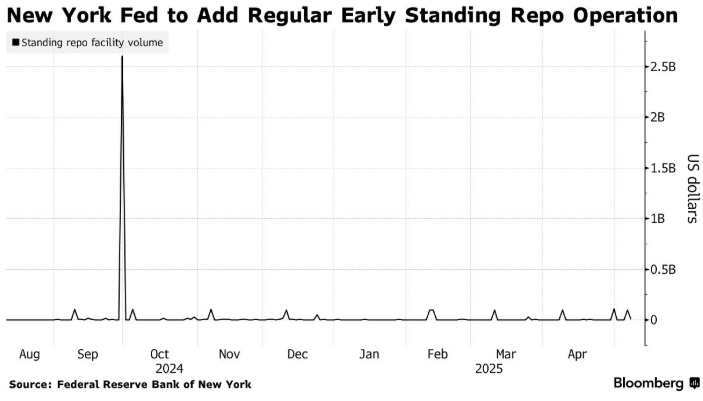
继放缓缩表步伐后 美联储再出招护航金融市场流动性:拟将“早期回购”常态化
智通财经网· 2025-05-09 14:33
Core Viewpoint - The New York Federal Reserve plans to incorporate early settlement operations of a key liquidity support tool into its regular schedule to enhance and strengthen this liquidity tool, supporting stable financial market operations [1] Group 1: Federal Reserve Actions - The Federal Open Market Committee (FOMC) agreed in March to "significantly slow" the pace of balance sheet reduction to prevent excessive liquidity withdrawal from the market [1] - The New York Fed's recent normalization of early repurchase operations is seen as a measure to ensure market stability and liquidity, especially in light of volatility in the U.S. Treasury market due to tariff policies [1][6] - The Fed is expanding the liquidity "insurance layer" in financial markets to prevent short-term funding mismatches and liquidity shortages during high yield fluctuations [1][7] Group 2: Market Reactions and Concerns - The global financial market's renewed focus on the Standing Repo Facility (SRF) follows significant volatility in the U.S. Treasury market triggered by new trade policies [5] - Concerns about market movements due to trade policy uncertainty have led to a "real and significant" deterioration in financial market liquidity, although the repo market has shown resilience [5][6] - The New York Fed had already begun providing additional daily repo operations before the recent market volatility, aiming to prevent repo market rates from exceeding the Fed's target range [6] Group 3: Future Implications - The adjustments in monetary policy reflect the Fed's intention to add safety measures against potential funding mismatches in a high-rate environment, avoiding a repeat of the 2019 liquidity crisis [7] - The FOMC noted that while reserves remain high at approximately $3 trillion, certain indicators are nearing buffer limits, necessitating caution to avoid approaching critical points similar to those in 2019 [7] - If the 10-year Treasury yield exceeds 5% again, the Fed may consider pausing balance sheet reduction or even targeted expansion to stabilize the financial market's benchmark interest rate corridor [7]