
广州东至新塘五六线

Search documents
中国第一经济强省,完成了这项重大任务!
3 6 Ke· 2025-12-24 03:25
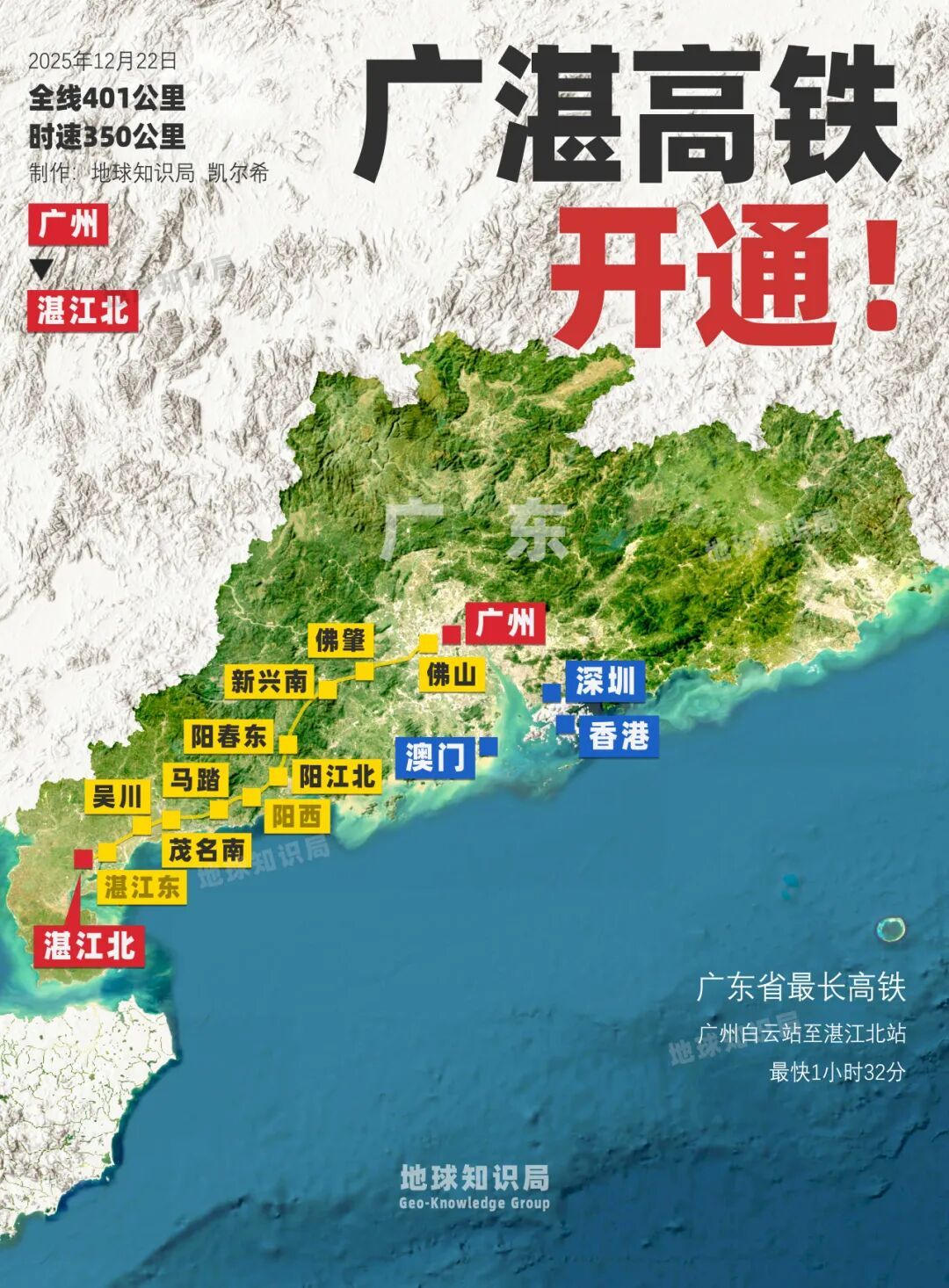
Core Viewpoint - The opening of the Guang-Zhan High-Speed Railway significantly enhances economic connectivity between the Greater Bay Area and the western Guangdong region, reducing travel time from Guangzhou to Zhanjiang to just one and a half hours [1][7]. Group 1: Project Overview - The Guang-Zhan High-Speed Railway is the longest high-speed rail line in Guangdong Province, measuring 401 kilometers in length [3]. - It operates at a maximum speed of 350 kilometers per hour and was built as a single-phase project [3][4]. - This railway is the highest standard, longest, and largest investment railway project ever constructed in Guangdong Province [4]. Group 2: Operational Details - The first train, G9785, departed from Guangzhou Baiyun Station at 10:30 AM, marking the official opening of the railway [4]. - Initially, up to 64 high-speed trains will operate daily, with travel times from Guangzhou Baiyun to Zhanjiang North and Maoming South being 1 hour 32 minutes and 1 hour 20 minutes, respectively [5]. - The new line reduces the travel time from Guangzhou to Zhanjiang by 61 minutes compared to the previous route via Jiangmen [5]. Group 3: Infrastructure and Connectivity - The railway connects seven cities: Guangzhou, Foshan, Zhaoqing, Yunfu, Yangjiang, Maoming, and Zhanjiang, with seven stations opening initially [4]. - Future connections include the ongoing construction of the Foshan-Zhaoqing station, which will serve as a high-speed station for the upcoming Pearl River Delta Hub (Guangzhou New Airport) [4][9]. - The Guang-Zhan High-Speed Railway will also link with the under-construction Hezhou-Zhanjiang high-speed railway and the planned Zhanjiang-Haikou high-speed railway, enhancing regional connectivity [9][10]. Group 4: Engineering Challenges - The railway features a high bridge-tunnel ratio of 76.7%, traversing complex geological conditions, including karst, soft soil, and expansive soil [4]. - Significant engineering feats include the Zhujiang Four-Line Super Bridge and the Zhanjiang Bay underwater tunnel, which set records for the longest single-bore underwater tunnel in China [4].

广东时速200公里及以上的高铁运营里程达3411公里
Nan Fang Ri Bao Wang Luo Ban· 2025-12-23 07:46
Core Viewpoint - The opening of the Guangzhou-Zhanjiang high-speed railway and the Shantou South to Shantou section of the Shantou-Shanwei high-speed railway marks a significant milestone in Guangdong's railway development, enhancing connectivity and supporting the economic growth of the Guangdong-Hong Kong-Macao Greater Bay Area [1][2][3] Group 1: High-Speed Railway Development - The Guangzhou-Zhanjiang high-speed railway (GZ-HSR) is a national-level trunk railway with a total length of 401 kilometers and a bridge-tunnel ratio of 76.7% [2] - The GZ-HSR features the longest underwater tunnel in China, contributing to the goal of achieving "350 km/h high-speed rail access for every city" in Guangdong [2] - With the new lines, Guangdong's railway operating mileage reaches 6,433 kilometers, with high-speed rail mileage of 3,411 kilometers, ranking first in the country [3] Group 2: Economic Impact - The GZ-HSR enhances the transportation network, allowing for efficient connections between the Greater Bay Area and the western and eastern regions of Guangdong, thus facilitating economic integration [4][5] - The railway's opening alleviates pressure on existing transport routes, improving overall transportation efficiency and supporting the logistics needs of the burgeoning industries in the western Guangdong region [4][7] - The GZ-HSR is expected to boost the blue economy in Zhanjiang, enhancing the port's radiation capacity and enabling faster delivery of high-value products to major markets [7] Group 3: Tourism and Cultural Integration - The opening of the GZ-HSR is anticipated to promote tourism by connecting cultural and tourism resources along the route, fostering deeper integration of agriculture, culture, and tourism [8] - Travel agencies are leveraging the new railway to develop rich travel experiences and cross-regional products, enhancing interaction between the Greater Bay Area and western Guangdong's tourism markets [8]
广州到汕头湛江1.5小时左右 未来将形成沿海“高铁环线”
Nan Fang Du Shi Bao· 2025-12-23 02:51
Core Viewpoint - The simultaneous opening of the Guangzhang High-Speed Railway and the Shanshan High-Speed Railway marks a significant milestone in Guangdong's transportation infrastructure, reducing travel time between major cities and supporting the coastal economic belt and regional development strategy [2][10][11] Group 1: Infrastructure Development - The Guangzhang High-Speed Railway spans approximately 401 kilometers with a design speed of 350 km/h, featuring complex engineering such as the Zhanjiang Bay underwater tunnel, which is the longest and deepest of its kind in China [3][11] - The Shanshan High-Speed Railway, specifically the section from Shantou South to Shantou, is about 19.8 kilometers long and connects multiple cities in the eastern Guangdong region, enhancing access to the Guangdong-Hong Kong-Macao Greater Bay Area [4][10] Group 2: Economic Impact - The new rail connections significantly reduce travel times, with the fastest journey from Guangzhou to Zhanjiang taking about 1.5 hours and from Shantou to Guangzhou taking around 2 hours, injecting new vitality into the local economy [5][10] - The high-speed rail network is expected to facilitate the movement of people, goods, and capital, transforming the economic landscape of Guangdong by promoting regional integration and collaboration [7][19] Group 3: Strategic Importance - The completion of these railways represents a critical "link" in the national high-speed rail network, enhancing connectivity between the Greater Bay Area and other regions, and positioning Guangdong as a strategic hub for economic development [11][13] - The railways are anticipated to foster a new economic corridor, shifting from a traditional transportation axis to a dynamic economic zone that supports urban renewal and industrial upgrades [14][18] Group 4: Future Developments - Future plans include the construction of additional rail lines and enhancements to existing infrastructure, aiming to achieve comprehensive high-speed rail coverage across Guangdong by 2027, thereby realizing the goal of "city-to-city" connectivity at 350 km/h [20][21] - The ongoing development of the rail network is expected to create modern logistics and business hubs around key stations, further integrating urban areas and enhancing economic collaboration [18][20]
