
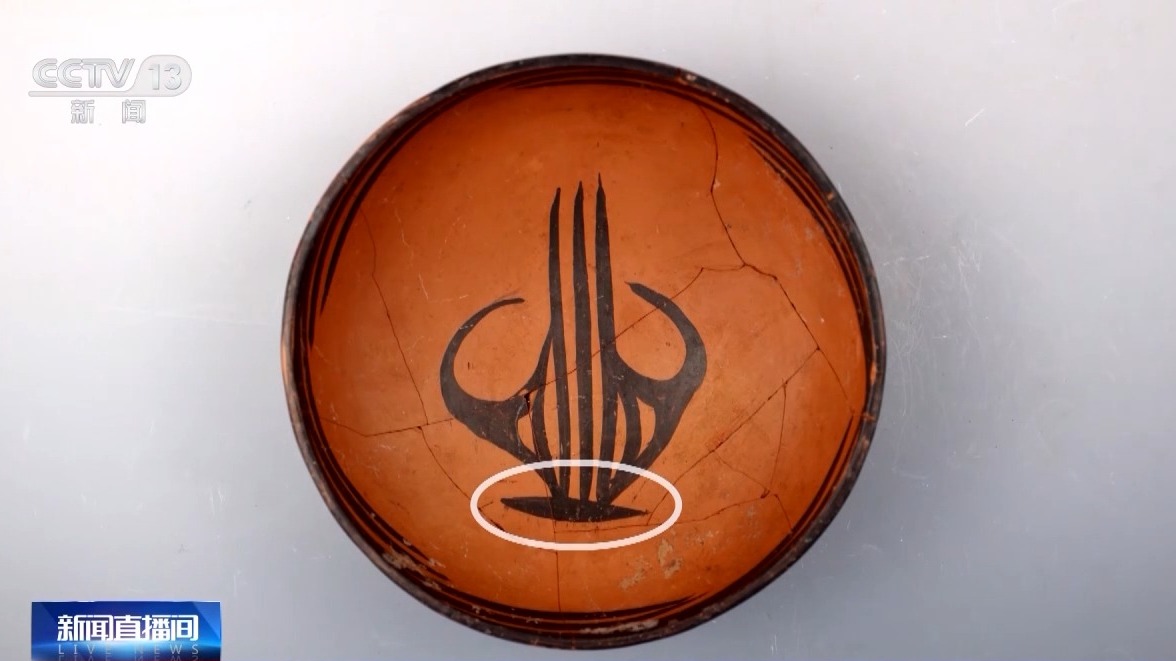
彩陶钵

Search documents
来自5000年前的“表情包” 马家窑文化最新出土彩陶亮相
Yang Shi Xin Wen· 2025-09-17 02:57
Core Viewpoint - The article highlights the opening of a new archaeological exhibition in China, showcasing the latest discoveries from the Majiayao culture in Gansu, aimed at making archaeological artifacts accessible to the public more quickly [1][16]. Group 1: Exhibition Details - The exhibition features newly unearthed Majiayao culture painted pottery, with the first display being a "painted bowl" found in a pit at the Shiwa site in Gansu [1]. - The exhibition is planned to last for three months, and visitors can reserve free tickets online [16]. Group 2: Archaeological Findings - A notable artifact is a painted pottery bottle with a nearly complete human face motif, characterized by wide-open eyes and a "tear drop" [5]. - The mysterious prehistoric "crying face" may symbolize the ancestors' wishes for fertility and sustenance from the land [6]. - The painted pottery exhibits unique features, such as asymmetrical designs, which are rare in Majiayao culture artifacts [8]. Group 3: Cultural Significance - The Majiayao culture, dating back 5,500 to 4,000 years, represents a peak in prehistoric Chinese painted pottery, evolving from the Yangshao culture [12]. - The presence of classic Yangshao triangular patterns in the newly discovered pottery indicates the diverse and integrated evolution of Chinese civilization [14]. - The Majiayao culture had a significant influence, extending from Xinjiang in the west to Sichuan and Yunnan in the south, and reaching Ningxia in the north [14].

快来看精美的红山文物:玉猪龙玉凤女神头像……|博物馆巡游
Jing Ji Guan Cha Bao· 2025-07-10 00:58
Core Viewpoint - The "Dragon Soars China: Hongshan Culture Ancient Civilization Special Exhibition" is currently being held at the Shanghai Museum, showcasing 310 cultural relics from 20 cultural institutions, including 68 first-class and 39 second-class relics [1] Group 1: Cultural Significance - The Hongshan culture, which thrived from approximately 4700 to 2900 BC in the Liao River basin, is recognized for its advanced primitive agriculture, animal husbandry, and unique burial mounds and goddess temple relics [1] - The culture is particularly noted for its exceptional jade craftsmanship, exemplified by the "First Dragon of China," which is described as having a smooth surface and intricate carvings achieved through complex techniques without metal tools [1] Group 2: Artifacts - In addition to jade artifacts, pottery is a significant component of the Hongshan culture, featuring simple yet representative designs such as zigzag patterns and cloud motifs, reflecting the aesthetic preferences and technical skills of the time [2] - A variety of artifacts are displayed, including jade items like the jade pig dragon, jade phoenix, and various pottery forms such as painted pots and jars [4][5][6][7]