
抗干扰芯片和天线

Search documents
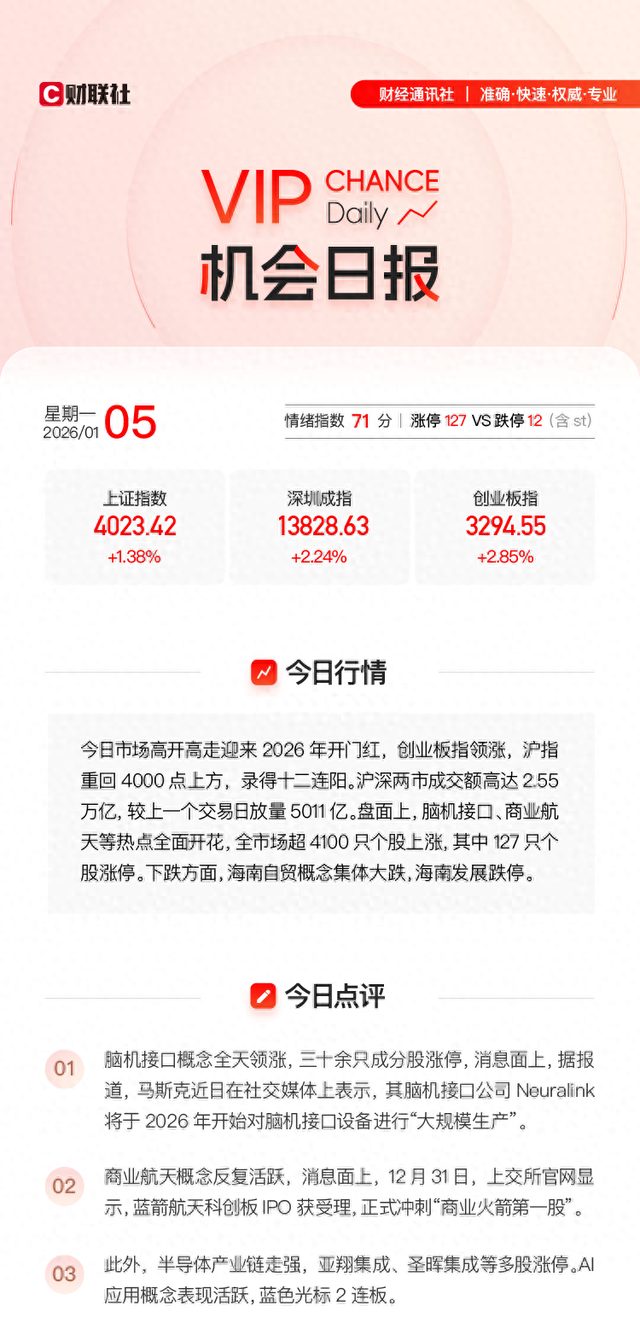
VIP机会日报指数迎2026年开门红 脑机接口概念大涨 栏目前瞻解读 提及2家公司双双20cm涨停
Xin Lang Cai Jing· 2026-01-05 10:11
Group 1: Brain-Computer Interface - Neuralink, founded by Elon Musk, plans to start large-scale production of brain-computer interface devices in 2026 [5] - The brain-computer interface industry is expected to accelerate commercialization, with companies like Xiangyu Medical and Mylande experiencing significant stock price increases [9][10] - Analysts predict that the market size of the brain-computer interface industry will exceed $10 billion by 2030 [10] Group 2: Commercial Aerospace - Blue Arrow Aerospace has received approval for its IPO on the Sci-Tech Innovation Board, aiming to become the first publicly listed commercial rocket company in China [14] Group 3: Robotics - Morgan Stanley forecasts that China will ship 14,000 humanoid robots this year, with annual growth expected to double in the coming years, potentially exceeding 1 million units by 2034 [25] - The first full-body force-controlled humanoid robot, Q1, is set to be released, indicating a rapid acceleration in product iteration and market application [25] Group 4: AI Applications - Meta has announced the acquisition of AI agent company Manus to enhance its AI innovation efforts, with the integration of Manus into Meta's core consumer products [27] - The demand for AI applications is rapidly expanding, as indicated by the significant increase in token consumption, reflecting a shift from concept validation to revenue generation [30] - Tax Friend Co., mentioned in relation to AI applications, saw its stock price rise significantly following the announcement of expected AI application growth in early 2026 [30][31]


北斗星通(002151.SZ):公司本身具备抗干扰基数和相关产品
Ge Long Hui· 2025-12-30 01:17
Core Viewpoint - The company, Beidou Star Communication (002151.SZ), indicates that the recent navigation failure incident in Nanjing has heightened user awareness regarding anti-jamming capabilities, potentially increasing demand for its anti-jamming chips and antennas. However, the high cost of current anti-jamming technologies may limit their application to specific scenarios, with large-scale civilian use unlikely in the short term [1]. Group 1 - The company possesses anti-jamming capabilities and relevant products [1] - The navigation failure incident has led to increased user focus on anti-jamming capabilities [1] - Demand for anti-jamming chips and antennas may rise as a result of heightened awareness [1] Group 2 - Current anti-jamming technologies and products are still relatively expensive [1] - The application of these technologies may be restricted to specific use cases [1] - Large-scale civilian adoption of anti-jamming solutions is unlikely in the near term [1]