
挂轨机器人

Search documents
新年新场景:机器人“新同事”今日上岗
Yang Shi Wang· 2026-01-09 14:58
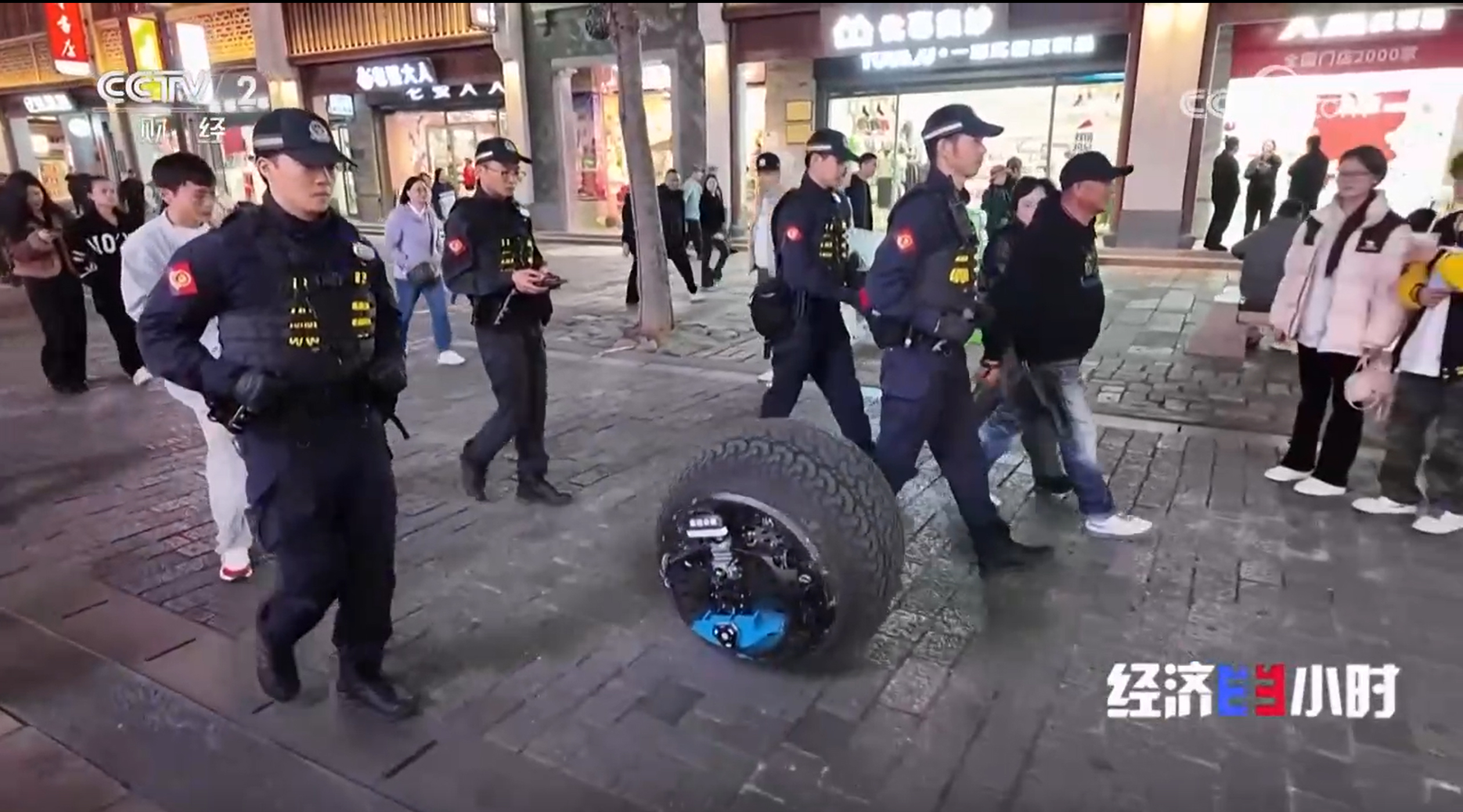
Core Insights - The year 2025 is anticipated to be a pivotal year for the commercialization of embodied intelligence, with numerous intelligent robots transitioning from laboratories to real-world applications [1][9] - The development of spherical robots, which can perform various tasks such as amphibious rescue and chemical plant inspections, showcases the advancements in robotics technology [3][4] Industry Developments - The spherical robot, weighing over 150 kilograms and with a diameter of 0.8 meters, can roll at speeds of up to 35 kilometers per hour and is designed for multiple applications [3][4] - The research team led by Wang You at Zhejiang University has successfully commercialized a previously abandoned foreign technology into the world's only spherical robot [4][7] - The robot's stability and control have been significantly improved, achieving a stable speed of 13.8 meters per second (approximately 50 kilometers per hour) through advanced algorithms and design modifications [7] Market Expansion - The application scenarios for spherical robots have expanded to airports, oil fields, and ports, indicating a growing global market presence [9] - The Chinese robot industry has seen substantial growth, with the number of large-scale enterprises increasing from 531 in 2020 to 1,289 by the end of 2024, and revenue rising from 106.1 billion to 237.9 billion yuan [14] Technological Innovations - Intelligent inspection robots are being utilized in hazardous environments, enhancing safety and efficiency in operations [10][12] - The development of a four-legged robot capable of carrying up to 150 kilograms and operating in extreme conditions demonstrates significant advancements in robotics [12] - Medical service robots, such as "Xiao Yi," are becoming integral in healthcare settings, assisting nurses in patient care and contributing to China's emergence as a leading market for medical robots [14][15] Future Outlook - The integration of robotics with artificial intelligence is expected to accelerate technological iterations, leading to a future where embodied intelligence becomes a fundamental part of daily life [15]


湖南小东江水电站智能巡检系统 通过验收
Zhong Guo Dian Li Bao· 2025-11-03 02:07
Core Viewpoint - The successful acceptance and operation of the multi-dimensional intelligent inspection system at the Xiaodongjiang Hydropower Station marks the beginning of the intelligent inspection era for the facility [1] Group 1: System Overview - The multi-dimensional intelligent inspection system is based on AI deep learning algorithms and integrates various subsystems including video monitoring, robotic inspection, infrared monitoring, and tailwater restricted area control [1] - The system achieves comprehensive perception, precise identification, real-time alarm, and trend warning for equipment status, environmental parameters, harmful gases, and specific issues like "leakage" in hydropower stations [1] Group 2: Operational Functionality - During daily operations, staff can set inspection plans, allowing inspection robots to automatically follow predefined paths and points to conduct inspections [1] - The system transmits real-time images and various monitoring data back to the central platform for image recognition, status analysis, and anomaly judgment, ultimately generating inspection reports and sending warning information [1] Group 3: Robotic Capabilities - The system features a quadruped wheeled intelligent robot capable of navigating areas such as the turbine layer and water supply chamber to perform tasks like equipment status checks, meter readings, and abnormal sound monitoring [1] - Track-mounted robots deployed in critical areas like the 10 kV room and 400 V room can conduct status checks on important equipment such as switch cabinets and excitation transformers, as well as infrared temperature measurements and partial discharge detection, creating a comprehensive monitoring network for both internal and external equipment status [1]