数据云(Data Cloud)

Search documents
人工智能风险冲击下,Salesforce股价处于历史低位
Xin Lang Cai Jing· 2025-12-03 11:44
Core Viewpoint - Salesforce's stock price has fallen to its historical lowest level, with investor concerns about artificial intelligence undermining the company's growth prospects [1][2] Group 1: Stock Performance and Market Sentiment - Salesforce's stock has declined by 30% year-to-date, making it the second-largest decliner in the Dow Jones Industrial Average and among the top 25 decliners in the S&P 500 [1] - The company's market capitalization has dropped to its lowest level since its IPO in 2004, with a forward P/E ratio of less than 19, significantly below its 10-year average of 47 and the S&P 500 average of about 22 [2] - Despite predictions of double-digit revenue growth in the coming years, Wall Street remains skeptical about whether the upcoming earnings report will change the cautious market sentiment [1][2] Group 2: AI Concerns and Competitive Landscape - Concerns persist that products from native AI companies like OpenAI may weaken demand for Salesforce's services and its pricing power [2][3] - Salesforce has its own AI product, Agentforce, but investor confidence in its financial contribution remains low, raising doubts about the company's ability to thrive in the AI era [3] - The broader SaaS sector has also faced pressure, with a 12% decline in the sector tracked by Morgan Stanley in 2025 due to fears of AI disruption [3] Group 3: Future Projections and Analyst Opinions - Salesforce is projected to see an 11% net profit growth and an 8.8% revenue growth for the current fiscal year, with expectations of acceleration in these metrics over the next three fiscal years [4] - Some analysts believe current market fears are overblown, suggesting that the SaaS sector is undervalued by 30% to 40% relative to its fundamentals [4] - The average target price for Salesforce over the next 12 months is approximately $325, indicating a potential upside of nearly 40% from the current price of $235 [4] Group 4: Importance of Services and Market Complexity - The sentiment towards SaaS companies has become quite harsh, but some services are deemed "critical" for businesses, suggesting that Salesforce may be one of the companies worth monitoring [5][6] - The outlook for the sector remains complex, with companies needing time to demonstrate resilience against AI disruptions or to emerge as winners in the AI era [6]

SaaS 的下一站是 Agentforce ?Salesforce 押注 AI 工作流革命
3 6 Ke· 2025-05-23 02:28
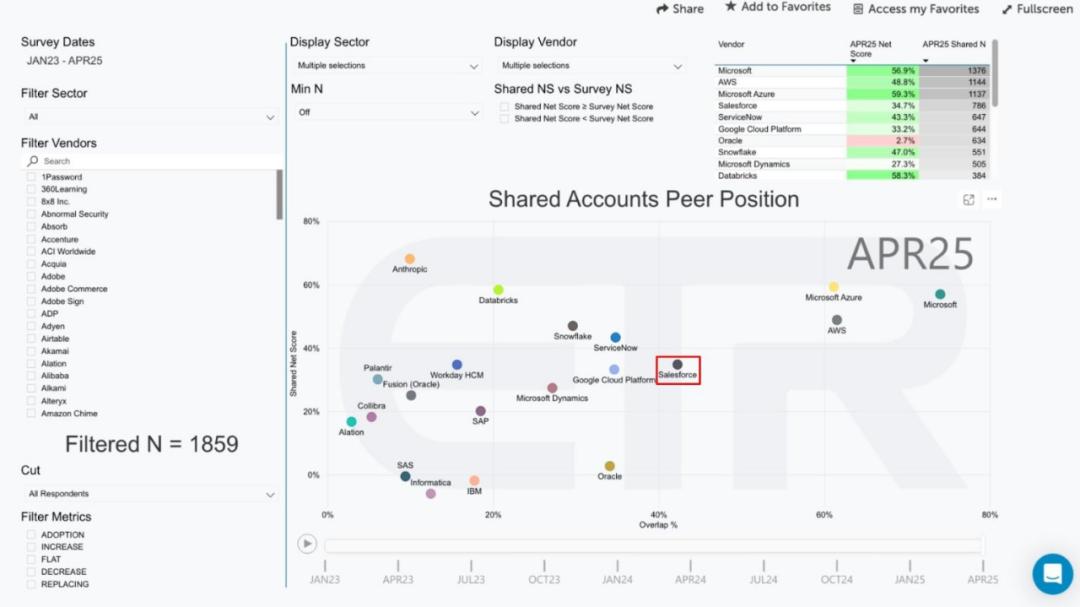
Group 1 - Marc Benioff, CEO of Salesforce, envisions a transformative era for enterprise software driven by AI agents and unified data architecture, transitioning from Software as a Service (SaaS) to Service as Software [1][2] - The "digital workforce" revolution is expected to be more disruptive than the cloud and mobile waves of 15 years ago, fundamentally redefining application functionalities [2] - Salesforce's Agentforce and Data Cloud strategies are central to its agentic vision, positioning the company as a potential "pure software hyperscaler" [2] Group 2 - Agentforce is a new AI-driven enterprise agent platform that integrates autonomous or semi-autonomous software assistants into all Salesforce applications, aiming to enhance human productivity [3][4] - Benioff claims that embedding these agents into workflows could lead to a 50% productivity increase across departments, a significant rise from a previously stated 30% [4] - Early customer deployments, such as Disney's use of AI agents for optimizing theme park operations, demonstrate the practical viability of this vision [4] Group 3 - The concept of "agent fluidity" allows AI agents to seamlessly operate across datasets and applications, exemplifying the Service as Software model [5] - Salesforce's Data Cloud serves as a unified real-time data platform, aggregating internal and external data sources into a comprehensive business state map [8][9] - The integration of Data Cloud with core applications like Tableau enhances the effectiveness of AI agents by providing unified real-time data and metadata frameworks [10] Group 4 - Salesforce's strategy emphasizes data fluidity, allowing for federated data integration without requiring all data to be migrated to Salesforce's storage [11][12] - Collaborations with third-party data platforms like Snowflake and Databricks enhance the capabilities of Data Cloud, allowing real-time data queries and integration [12][13] - This open integration strategy positions Salesforce as a key player in modern data architecture, avoiding the pitfalls of data silos [30] Group 5 - Salesforce aims to become the first pure software hyperscaler, leveraging its SaaS platform to achieve scale without the capital-intensive model of traditional hyperscalers [19][20] - The company anticipates reaching an annual revenue of approximately $50 billion this fiscal year, with a focus on maintaining healthy free cash flow [20] - By embedding agents, workflows, and federated datasets into daily operations, Salesforce seeks to establish itself as a neutral orchestration layer in heterogeneous environments [20][21] Group 6 - The competitive landscape includes major players like Microsoft, which poses a significant challenge to Salesforce's ambitions in the AI space [23][24] - Salesforce's strategy of integrating rather than competing with data infrastructure providers like Snowflake and AWS allows it to avoid direct confrontations while enhancing its offerings [29][30] - The company is experiencing strong market response to its AI-driven agents, with over 5,000 organizations deploying the technology shortly after its launch [6][32] Group 7 - Salesforce's ambitious goal is to drive overall productivity improvements exceeding 50% through AI agents, with plans to embed AI capabilities across its entire customer base [35][36] - The next 12 to 24 months are critical for validating Salesforce's strategy and its ability to redefine the cloud economy through software alone [35][36] - If successful, Salesforce could reshape the perception of cloud leaders and establish itself as the preferred platform for enterprise-level AI [34][36]