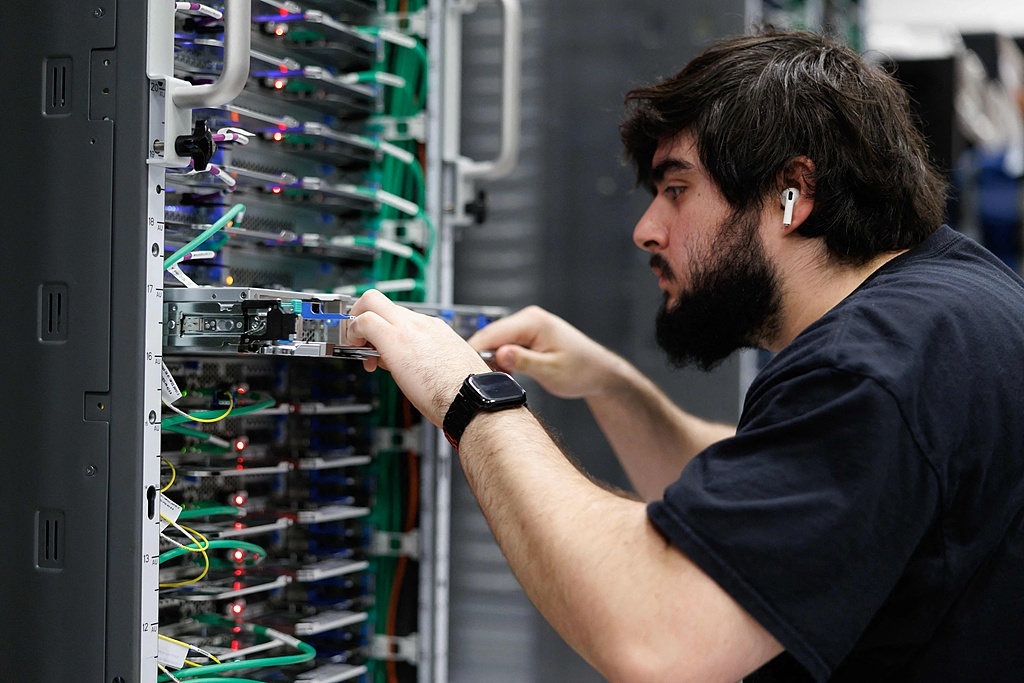
新型中央处理器(CPU)

Search documents
英伟达“万亿预期”能否打动市场
Xin Lang Cai Jing· 2026-03-18 04:52
Core Insights - Nvidia remains at the center of the global AI competition, with its annual GTC conference highlighting its efforts to maintain dominance amid increasing competition and a valuation of $5 trillion [1] - The company is accelerating its technology development, introducing a new CPU and AI system to enhance response speed, indicating a shift from reliance on GPUs to a broader technology integration [2] - Nvidia's stock price rose by 1.2% following optimistic revenue forecasts, projecting $1 trillion in sales from its latest AI processors by 2027, despite a recent decline in stock performance [3] Industry Dynamics - Nvidia is focusing on solidifying its position in the "inference computing" sector as the AI industry shifts from model training to commercial application, with competitors emerging to challenge its market share [4] - The market is increasingly interested in cost-effective inference hardware, with companies like Meta developing their own chips and CPUs showing potential as lower-cost alternatives to GPUs [4][5] - Significant capital is flowing into the inference technology sector, leading to the emergence of competitive startups and new industry standards [6] Geopolitical Challenges - Nvidia faces geopolitical challenges, particularly from U.S. trade restrictions affecting its growth potential in China, where local companies like Huawei and Cambricon are emerging as strong competitors [6]

AI产业重心转向“推理”,英伟达“万亿预期”能否打动市场?
Huan Qiu Shi Bao· 2026-03-17 22:53
Core Insights - The article discusses the competitive landscape surrounding Nvidia in the AI chip market, particularly in the context of its recent GTC conference and the emergence of new challengers in the AI inference space. Group 1: Nvidia's Position and Innovations - Nvidia's founder Jensen Huang unveiled a new CPU and an AI system based on Groq's technology aimed at enhancing AI system response times, indicating a shift from solely relying on GPUs [3] - The new architecture, which includes a language processing unit (LPU) as a co-processor, is designed to significantly improve performance in AI inference tasks compared to previous GPU architectures [3] - Nvidia is accelerating its technology development and integrating various technologies to maintain its competitive edge in the AI market [3] Group 2: Market Dynamics and Financial Projections - Nvidia anticipates that its new AI processors could generate $1 trillion in sales by 2027, with a previous estimate of $500 billion from Blackwell and Rubin architecture chips by 2026 [4] - Following these optimistic projections, Nvidia's stock rose by 1.2% after initially increasing by 4%, reflecting a temporary alleviation of market concerns regarding its growth prospects [4] - The shift in the AI industry focus from model training to commercial application (inference) is prompting a growing interest in more cost-effective inference hardware [4] Group 3: Competitive Landscape - Despite holding approximately 90% of the market share, Nvidia faces increasing competition as companies like Meta accelerate their development of in-house chips to reduce dependency on Nvidia [5] - The emergence of lower-cost alternatives, such as Amazon's Trainium and Inferentia chips, highlights the growing interest in inference-focused AI hardware [5][6] - New startups are developing specialized chips that are cheaper and more efficient than GPUs, contributing to a competitive environment that could challenge Nvidia's dominance [6] Group 4: Geopolitical Challenges - Nvidia's growth potential is constrained by geopolitical factors, particularly U.S. government restrictions on sales to China, which could accelerate the development of local competitors like Huawei and Cambricon [6] - While Nvidia currently maintains a strong position in the AI hardware sector, the increasing number of products in the inference space suggests that future competition may center around pricing strategies [6]