
推理计算

Search documents
英伟达“万亿预期”能否打动市场
Xin Lang Cai Jing· 2026-03-18 04:52
Core Insights - Nvidia remains at the center of the global AI competition, with its annual GTC conference highlighting its efforts to maintain dominance amid increasing competition and a valuation of $5 trillion [1] - The company is accelerating its technology development, introducing a new CPU and AI system to enhance response speed, indicating a shift from reliance on GPUs to a broader technology integration [2] - Nvidia's stock price rose by 1.2% following optimistic revenue forecasts, projecting $1 trillion in sales from its latest AI processors by 2027, despite a recent decline in stock performance [3] Industry Dynamics - Nvidia is focusing on solidifying its position in the "inference computing" sector as the AI industry shifts from model training to commercial application, with competitors emerging to challenge its market share [4] - The market is increasingly interested in cost-effective inference hardware, with companies like Meta developing their own chips and CPUs showing potential as lower-cost alternatives to GPUs [4][5] - Significant capital is flowing into the inference technology sector, leading to the emergence of competitive startups and new industry standards [6] Geopolitical Challenges - Nvidia faces geopolitical challenges, particularly from U.S. trade restrictions affecting its growth potential in China, where local companies like Huawei and Cambricon are emerging as strong competitors [6]

AI产业重心转向“推理” 芯片巨头面临对手“合围” 英伟达“万亿预期”能否打动市场
Huan Qiu Wang Zi Xun· 2026-03-18 02:22
Core Insights - Nvidia remains at the center of the AI competition as it seeks to solidify its dominance amid increasing competition and a shift towards AI inference technology [1][4] - The company has ambitious revenue projections, expecting its latest AI processors to generate $1 trillion in sales by 2027 [3] Group 1: Product Developments - Nvidia unveiled a new CPU and an AI system based on Groq's technology to enhance AI response times, marking a significant advancement in AI inference infrastructure [2] - The new architecture features a Language Processing Unit (LPU) designed to accelerate the inference process of large language models, showcasing a notable performance leap over previous GPU architectures [2] Group 2: Market Dynamics - Despite holding approximately 90% of the market share, Nvidia faces increasing competition as companies like Meta accelerate their in-house chip development to reduce reliance on Nvidia's expensive GPUs [4][6] - The shift from AI model training to inference has led to a growing interest in more cost-effective and efficient inference hardware, with competitors like Amazon and Microsoft launching alternative AI chips [5][6] Group 3: Financial Performance - Nvidia's stock rose by 1.2% following optimistic revenue forecasts, although it has seen a cumulative decline of 3.4% year-to-date prior to the GTC conference [3] Group 4: Geopolitical Challenges - Nvidia faces significant geopolitical challenges, particularly from U.S. trade restrictions affecting sales to China, which could accelerate the development of local competitors like Huawei and Cambricon [6]
AI产业重心转向“推理”,英伟达“万亿预期”能否打动市场?
Huan Qiu Shi Bao· 2026-03-17 22:53
Core Insights - The article discusses the competitive landscape surrounding Nvidia in the AI chip market, particularly in the context of its recent GTC conference and the emergence of new challengers in the AI inference space. Group 1: Nvidia's Position and Innovations - Nvidia's founder Jensen Huang unveiled a new CPU and an AI system based on Groq's technology aimed at enhancing AI system response times, indicating a shift from solely relying on GPUs [3] - The new architecture, which includes a language processing unit (LPU) as a co-processor, is designed to significantly improve performance in AI inference tasks compared to previous GPU architectures [3] - Nvidia is accelerating its technology development and integrating various technologies to maintain its competitive edge in the AI market [3] Group 2: Market Dynamics and Financial Projections - Nvidia anticipates that its new AI processors could generate $1 trillion in sales by 2027, with a previous estimate of $500 billion from Blackwell and Rubin architecture chips by 2026 [4] - Following these optimistic projections, Nvidia's stock rose by 1.2% after initially increasing by 4%, reflecting a temporary alleviation of market concerns regarding its growth prospects [4] - The shift in the AI industry focus from model training to commercial application (inference) is prompting a growing interest in more cost-effective inference hardware [4] Group 3: Competitive Landscape - Despite holding approximately 90% of the market share, Nvidia faces increasing competition as companies like Meta accelerate their development of in-house chips to reduce dependency on Nvidia [5] - The emergence of lower-cost alternatives, such as Amazon's Trainium and Inferentia chips, highlights the growing interest in inference-focused AI hardware [5][6] - New startups are developing specialized chips that are cheaper and more efficient than GPUs, contributing to a competitive environment that could challenge Nvidia's dominance [6] Group 4: Geopolitical Challenges - Nvidia's growth potential is constrained by geopolitical factors, particularly U.S. government restrictions on sales to China, which could accelerate the development of local competitors like Huawei and Cambricon [6] - While Nvidia currently maintains a strong position in the AI hardware sector, the increasing number of products in the inference space suggests that future competition may center around pricing strategies [6]

“AI牛市叙事”再掀巨浪! 黄仁勋抛出万亿美元AI宏图,英伟达扬帆起航冲6万亿美元市值
Zhi Tong Cai Jing· 2026-03-17 06:12
Core Insights - Nvidia's CEO Jensen Huang presented a vision for AI computing infrastructure at the GTC conference, projecting that revenue in the AI chip sector could reach at least $1 trillion by 2027, significantly higher than the previous estimate of $500 billion by 2026 [1][13] - Analysts from firms like Goldman Sachs and Morgan Stanley are optimistic about Nvidia's stock price, predicting it could surpass $5 trillion in market capitalization again, with some estimates reaching as high as $8.8 trillion [1][10] - The shift from AI training to AI inference is emphasized, with Nvidia positioning itself as a comprehensive provider of AI infrastructure rather than just a GPU supplier [4][9] Revenue Projections - Nvidia's revenue opportunity in AI infrastructure has been revised upwards to at least $1 trillion by 2027, reflecting strong demand for its Blackwell and Vera Rubin architectures [1][13] - The average target price from Wall Street analysts suggests Nvidia's market cap could exceed $6 trillion in the next 12 months, with a bullish target of $8.8 trillion [1][10] Technological Developments - Nvidia introduced a new CPU and a set of AI inference infrastructure systems based on Groq's technology, indicating a strategic move to strengthen its position in the inference computing space [2][14] - The integration of various components such as CPU, GPU, LPU, and networking into a unified platform is a significant development, enhancing the efficiency and performance of AI operations [6][11] Market Positioning - Nvidia is transitioning from being a dominant player in AI training to becoming a key player in AI inference, focusing on metrics like cost per token and energy efficiency [4][10] - The company is redefining data centers as "AI factories," emphasizing the importance of optimizing the entire system rather than just individual components [5][11] Competitive Landscape - The competition in the AI inference market is intensifying, with Nvidia facing challenges from custom AI ASICs developed by companies like Google [2][14] - Nvidia's strategy includes leveraging its unique approach to commercializing inference, which could solidify its leadership in the AI infrastructure market [14][15] Future Outlook - The demand for AI infrastructure is expected to remain strong, with Nvidia's projections alleviating concerns about potential peaks in AI capital expenditures [10][15] - Analysts believe that Nvidia's comprehensive approach to AI infrastructure will enable it to maintain a competitive edge in the evolving landscape of AI technology [14][15]
英伟达正式发布LPU,CPU重磅更新:GPU不再是GTC唯一主角
半导体行业观察· 2026-03-16 22:10
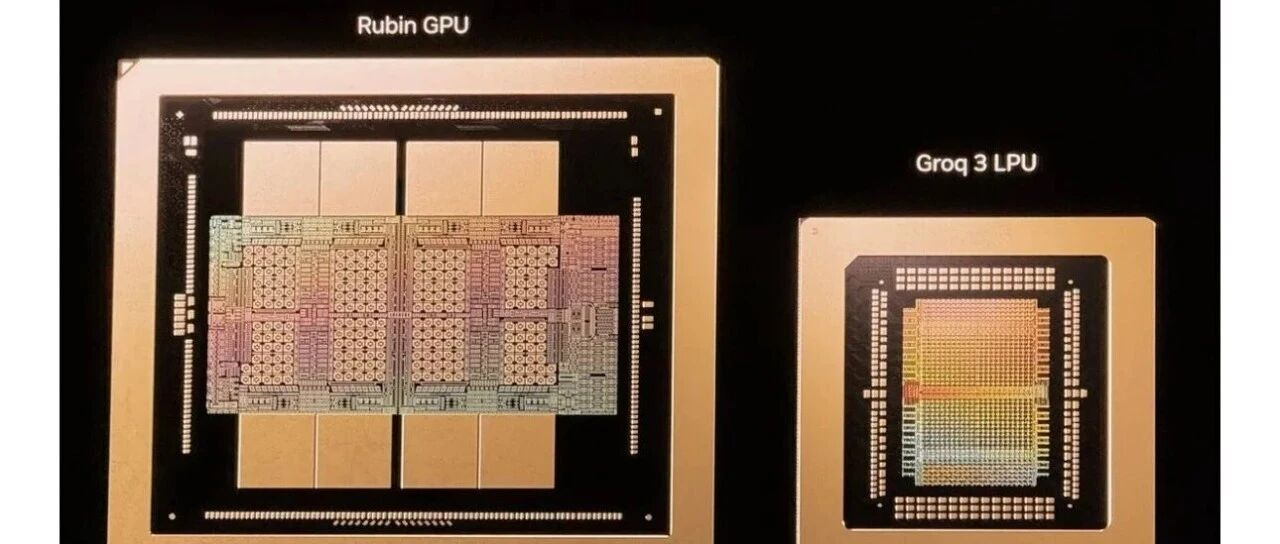
Core Insights - Nvidia's CEO Jensen Huang outlined the company's vision to maintain its leadership in the AI boom, predicting a $1 trillion order backlog within the next year [1][5] - Huang emphasized that the development of AI is still in its early stages, likening the current transformation to the personal computer and internet revolutions [4][5] Product Announcements - Nvidia introduced several new chips and systems at GTC 2026, including the Groq 3 LPU, which enhances AI model interactivity with low latency and high throughput [6][7] - The Groq 3 LPU features 500 MB of integrated SRAM, providing 150 TB/s bandwidth, significantly surpassing traditional HBM memory [9] - Nvidia plans to build a Groq 3 LPX rack containing 256 Groq 3 LPUs, offering 128 GB of SRAM and 40 PB/s inference acceleration bandwidth [11] CPU Developments - The new 88-core Vera CPU was unveiled, claiming a 50% performance increase over standard CPUs, with a focus on AI workloads [16][19] - Vera CPU architecture supports high memory bandwidth, achieving 1.2 TB/s, which is double that of its predecessor, Grace [22] - The Vera CPU is designed to compete directly with AMD and Intel in the CPU market, marking Nvidia's entry into direct CPU sales [18][19] Market Position and Challenges - Nvidia's revenue surged from $27 billion in 2022 to $216 billion last year, with a market capitalization reaching $4.5 trillion [42] - Despite strong quarterly reports, Nvidia's stock has faced volatility due to concerns about the sustainability of the AI boom [43][45] - The company is encountering competition from tech giants like Google and Meta, which are developing their own processors [46][56] Future Outlook - Huang envisions 2026 as a pivotal year for inference capabilities in AI, emphasizing the importance of efficient processing for AI applications [50] - Nvidia is shifting focus from GPUs to inference computing solutions, as evidenced by Meta's deployment of Nvidia's Vera CPUs without GPUs [56] - The company is also exploring new computing solutions that utilize multiple CPUs independent of GPUs, indicating a strategic pivot in its product offerings [57]
英伟达将发布重磅芯片
半导体芯闻· 2026-02-28 10:08
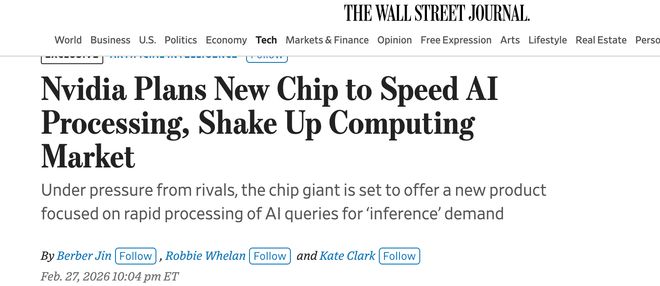
Core Viewpoint - Nvidia is set to launch a new processor tailored for OpenAI and other clients to build faster and more efficient tools, which could significantly transform its business and reshape the AI competition landscape [1] Group 1: Nvidia's New Processor - Nvidia is designing a new system for "inference" computing, allowing AI models to respond to queries, with a debut planned at the upcoming GTC developer conference [1] - OpenAI has agreed to become one of the largest customers for this new processor, marking a significant win for Nvidia [1] - The new processor will utilize chips designed by the startup Groq, which employs a different architecture known as "language processing units" that are highly efficient for inference tasks [3] Group 2: Market Dynamics and Competition - Nvidia has historically dominated the GPU market, controlling over 90% of the market share, but is now facing pressure to produce chips that can more efficiently drive AI applications as the market shifts towards inference [2][3] - Competitors like Google and Amazon have developed chips that rival Nvidia's flagship systems, increasing the demand for new types of chips capable of handling complex AI tasks [1][2] - OpenAI has also signed a significant agreement with Amazon for the use of its Trainium chips, indicating a diversification of its hardware partnerships [2] Group 3: Cost and Efficiency Challenges - Companies building AI agents have found Nvidia's GPUs to be costly and energy-intensive, prompting the need for lower-cost, more efficient inference chips [3] - OpenAI's recent partnership with Cerebras, which provides a chip focused on inference that is reportedly faster than Nvidia's GPUs, highlights the competitive landscape [3] - Nvidia's CEO has claimed that their GPUs are market leaders in both training and inference, but the shift in demand towards inference has created new challenges [2] Group 4: Strategic Shifts - Nvidia is expanding its collaboration with Meta Platforms to include large-scale deployment of pure CPU architectures, indicating a strategic shift away from solely relying on GPUs [5] - The company is adapting to the needs of large clients who find certain AI workloads run more efficiently on CPUs rather than GPUs [5]
英伟达(NVDA.US)据悉开发AI推理芯片 OpenAI或成最大客户
智通财经网· 2026-02-28 09:05
Group 1 - Nvidia plans to launch a new processor specifically designed for AI research companies like OpenAI to help them build faster and more efficient tools [1] - The new inference computing system is expected to be unveiled at the upcoming Nvidia GTC developer conference next month and will integrate chips designed by the startup Groq [1] - OpenAI has agreed to become one of the largest customers for this new processor, marking a significant win for Nvidia [1] Group 2 - Nvidia currently dominates the GPU market, controlling over 90% of the market share, with its Hopper, Blackwell, and Rubin series GPUs being industry benchmarks for training large AI models [2] - There is increasing pressure on Nvidia to develop more efficient chips for AI applications as the market focus shifts from training to inference, with many companies finding Nvidia's GPUs costly and energy-intensive [2] - OpenAI recently signed a multi-billion dollar computing partnership with Cerebras, which offers chips focused on inference that are claimed to be faster than Nvidia's GPUs [2] Group 3 - Google poses a significant challenge to Nvidia with its development of Tensor Processing Units (TPUs) aimed at replacing GPUs [3] - To strengthen its competitive position, Nvidia agreed to pay $20 billion for key technology licensing from Groq and hired its executive team, marking one of Silicon Valley's largest talent acquisitions [3] - Groq's chips utilize a different architecture known as Language Processing Units, which are highly efficient in inference tasks, although Nvidia has not disclosed how it will utilize Groq's technology [3]
英伟达被曝将推出新芯片以优化人工智能处理速度
Huan Qiu Wang Zi Xun· 2026-02-28 08:33
Core Insights - Nvidia is planning to launch a new processor aimed at helping clients like OpenAI build faster and more efficient AI systems, focusing on AI inference computing to optimize response capabilities of AI models [1][2] Group 1: Product Development - The new system being developed by Nvidia is specifically designed for inference computing, which is expected to significantly enhance the efficiency of AI models when handling complex tasks [2][3] - This new platform is anticipated to be officially unveiled at the Nvidia GTC developer conference next month in San Jose and will utilize chips designed by the startup Groq [2][3] Group 2: Client Needs and Market Dynamics - OpenAI has expressed dissatisfaction with Nvidia's existing hardware regarding response speed for specific types of queries, such as software development and AI interactions, and is seeking new hardware solutions to meet approximately 10% of its inference computing needs [2][3] - OpenAI had previously explored collaboration opportunities with chip startups like Cerebras and Groq to accelerate inference computing capabilities, but discussions with Groq were interrupted due to Nvidia's recent $20 billion licensing agreement with Groq [2][3]
英伟达封死了ASIC的后路?
半导体行业观察· 2025-12-29 01:53
Core Viewpoint - NVIDIA aims to dominate the inference stack with its next-generation Feynman chip by integrating LPU units into its architecture, leveraging a licensing agreement with Groq for LPU technology [1][18]. Group 1: NVIDIA's Strategy and Technology Integration - NVIDIA plans to integrate Groq's LPU units into its Feynman GPU architecture, potentially using TSMC's hybrid bonding technology for stacking [1][3]. - The LPU modules are expected to enhance inference performance significantly, with Groq's LPU set to debut in 2028 [5]. - The Feynman core will utilize a combination of logic and compute chips, achieving high density and bandwidth while maintaining cost efficiency [6]. Group 2: Inference Market Dynamics - The AI industry's computational demands have shifted towards inference, with major companies like OpenAI and Google focusing on building robust inference stacks [9]. - Google’s Ironwood TPU is positioned as a competitor to NVIDIA, emphasizing the need for low-latency execution engines in large-scale data centers [9][10]. - Groq's LPU architecture is designed specifically for inference workloads, offering deterministic execution and on-chip SRAM for reduced latency [10][14]. Group 3: Licensing Agreement and Market Position - NVIDIA's agreement with Groq is framed as a non-exclusive licensing deal, allowing NVIDIA to integrate Groq's low-latency processors into its AI Factory architecture [18][21]. - This strategy is seen as a way to circumvent antitrust scrutiny while acquiring valuable talent and intellectual property from Groq [19][21]. - The transaction is viewed as a significant achievement for NVIDIA, positioning LPU as a core component of its AI workload strategy [16][21].
Broadcom(AVGO) - 2025 Q2 - Earnings Call Transcript
2025-06-05 22:02
Financial Data and Key Metrics Changes - Total revenue for Q2 fiscal year 2025 was a record $15 billion, up 20% year on year, driven by strength in AI semiconductors and VMware [6][17] - Consolidated adjusted EBITDA was $10 billion, reflecting a 35% year on year increase [7][18] - Gross margin was 79.4%, better than guidance due to product mix [17] Business Line Data and Key Metrics Changes - Semiconductor revenue reached $8.4 billion, growing 17% year on year, with AI semiconductor revenue exceeding $4.4 billion, up 46% year on year [8][19] - Infrastructure software revenue was $6.6 billion, up 25% year on year, driven by the transition of enterprise customers to the full VCF software stack subscription [13][20] Market Data and Key Metrics Changes - AI networking revenue grew over 170% year on year, representing 40% of AI revenue [8][9] - Non-AI semiconductor revenue was $4 billion, down 5% year on year, but showed sequential growth in broadband, enterprise networking, and service storage [12][24] Company Strategy and Development Direction - The company is focused on sustaining growth in AI semiconductor revenue, forecasting $5.1 billion for Q3, up 60% year on year [11][24] - Continued investment in R&D for leading-edge AI semiconductors is a priority, with a disciplined integration of VMware contributing to growth [20][21] Management's Comments on Operating Environment and Future Outlook - Management expressed confidence in the growth trajectory of AI semiconductor revenue into fiscal year 2026, driven by increased demand for inference alongside training [11][94] - The company is cautious about external factors such as export controls, indicating uncertainty in the current environment [108][110] Other Important Information - Free cash flow for the quarter was $6.4 billion, representing 43% of revenue, impacted by increased interest expenses from debt related to the VMware acquisition [21] - The company repurchased $4.2 billion worth of shares and paid $2.8 billion in dividends during the quarter [23][102] Q&A Session Summary Question: Insights on AI growth and inference - Management indicated increased deployment of XPUs and networking, contributing to confidence in sustained growth rates [28][29] Question: AI business growth trajectory - Management confirmed expectations of maintaining a 60% year on year growth rate into fiscal year 2026 based on improved visibility [33][34] Question: Networking performance and Tomahawk's role - Strong demand for AI networking was noted, with Tomahawk switches expected to drive future acceleration [40][42] Question: VMware subscription model conversion status - Management stated that the conversion process is more than halfway through, with about a year to a year and a half remaining [112][113]
