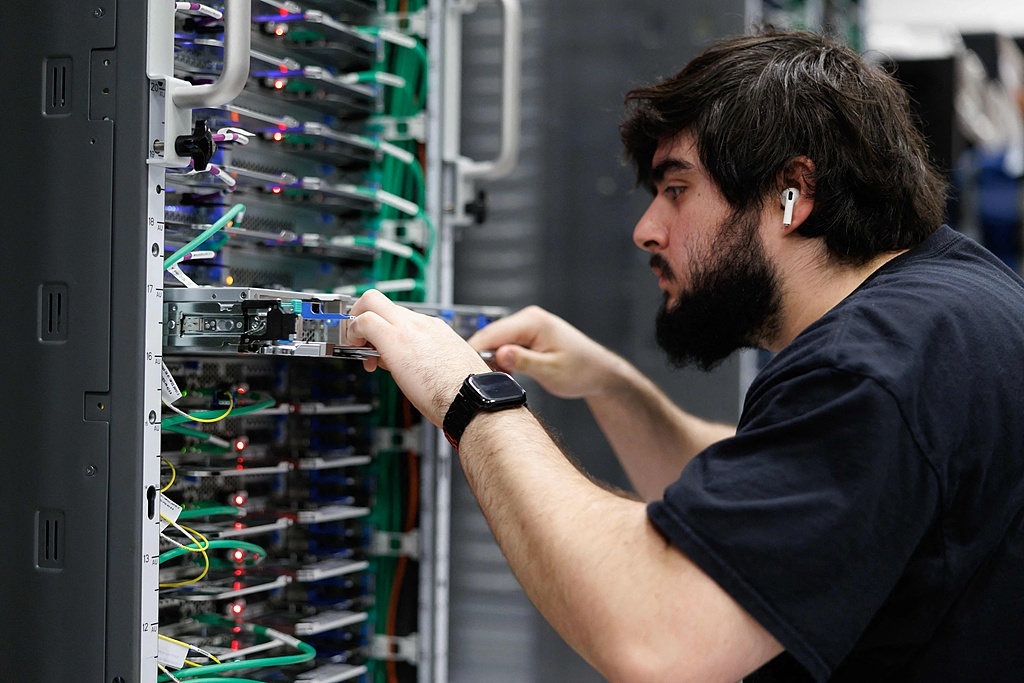
Trainium与Inferentia系列芯片

Search documents
算力博弈升级 英伟达抛出“万亿预期”
Bei Jing Shang Bao· 2026-03-18 14:35
Core Insights - Nvidia remains at the center of the global AI competition, with its annual GTC conference highlighting its significant role in the industry amidst increasing competition and market scrutiny regarding its $5 trillion valuation [1] Group 1: Nvidia's Innovations and Predictions - Nvidia's CEO Jensen Huang introduced OpenClaw, an open-source project that he claims is set to revolutionize AI, likening its impact to that of Linux [4] - The Vera Rubin platform, a massive supercomputer consisting of seven chips and five racks, was unveiled, marking a pivotal moment for Agentic AI and signaling a major infrastructure build-out [5] - Nvidia forecasts that its chip revenue will reach $1 trillion by 2027, doubling its previous estimate of $500 billion for 2026, emphasizing the need for improved cost-effectiveness in its offerings [5] Group 2: Market Reactions and Stock Performance - Following Huang's optimistic predictions, Nvidia's stock initially rose by 4% but closed with a modest gain of 1.2%, reflecting ongoing market concerns about its growth prospects and the potential "AI bubble" [6] Group 3: Strategic Shifts and Collaborations - Nvidia is transitioning from a chip manufacturer to an AI infrastructure company, with plans to collaborate with Uber on deploying AI-driven autonomous taxi fleets in major cities by 2028 [7] - The company is focusing on selling standards and ecosystems rather than just raw computing power, leveraging generative models and 3D graphics engines to enhance its product offerings [8] Group 4: Competitive Landscape and Challenges - Despite holding a 90% market share, Nvidia faces increasing competition as companies like Meta develop their own chips, and new entrants focus on creating cost-effective alternatives for AI inference [9] - The AI hardware landscape is evolving, with a growing emphasis on inference capabilities, prompting cloud giants and startups to invest heavily in developing competitive AI chips [9][10] Group 5: China Market Dynamics - Nvidia's importance in the Chinese market remains significant, with potential annual demand for AI processors estimated in the hundreds of billions [10] - Recent policy changes have allowed Nvidia to restart production of the H200 processor for the Chinese market, with Huang noting an increase in demand and the resumption of supply chain operations [11]



英伟达“万亿预期”能否打动市场
Xin Lang Cai Jing· 2026-03-18 04:52
Core Insights - Nvidia remains at the center of the global AI competition, with its annual GTC conference highlighting its efforts to maintain dominance amid increasing competition and a valuation of $5 trillion [1] - The company is accelerating its technology development, introducing a new CPU and AI system to enhance response speed, indicating a shift from reliance on GPUs to a broader technology integration [2] - Nvidia's stock price rose by 1.2% following optimistic revenue forecasts, projecting $1 trillion in sales from its latest AI processors by 2027, despite a recent decline in stock performance [3] Industry Dynamics - Nvidia is focusing on solidifying its position in the "inference computing" sector as the AI industry shifts from model training to commercial application, with competitors emerging to challenge its market share [4] - The market is increasingly interested in cost-effective inference hardware, with companies like Meta developing their own chips and CPUs showing potential as lower-cost alternatives to GPUs [4][5] - Significant capital is flowing into the inference technology sector, leading to the emergence of competitive startups and new industry standards [6] Geopolitical Challenges - Nvidia faces geopolitical challenges, particularly from U.S. trade restrictions affecting its growth potential in China, where local companies like Huawei and Cambricon are emerging as strong competitors [6]
AI产业重心转向“推理” 芯片巨头面临对手“合围” 英伟达“万亿预期”能否打动市场
Huan Qiu Wang Zi Xun· 2026-03-18 02:22
Core Insights - Nvidia remains at the center of the AI competition as it seeks to solidify its dominance amid increasing competition and a shift towards AI inference technology [1][4] - The company has ambitious revenue projections, expecting its latest AI processors to generate $1 trillion in sales by 2027 [3] Group 1: Product Developments - Nvidia unveiled a new CPU and an AI system based on Groq's technology to enhance AI response times, marking a significant advancement in AI inference infrastructure [2] - The new architecture features a Language Processing Unit (LPU) designed to accelerate the inference process of large language models, showcasing a notable performance leap over previous GPU architectures [2] Group 2: Market Dynamics - Despite holding approximately 90% of the market share, Nvidia faces increasing competition as companies like Meta accelerate their in-house chip development to reduce reliance on Nvidia's expensive GPUs [4][6] - The shift from AI model training to inference has led to a growing interest in more cost-effective and efficient inference hardware, with competitors like Amazon and Microsoft launching alternative AI chips [5][6] Group 3: Financial Performance - Nvidia's stock rose by 1.2% following optimistic revenue forecasts, although it has seen a cumulative decline of 3.4% year-to-date prior to the GTC conference [3] Group 4: Geopolitical Challenges - Nvidia faces significant geopolitical challenges, particularly from U.S. trade restrictions affecting sales to China, which could accelerate the development of local competitors like Huawei and Cambricon [6]
AI产业重心转向“推理”,英伟达“万亿预期”能否打动市场?
Huan Qiu Shi Bao· 2026-03-17 22:53
Core Insights - The article discusses the competitive landscape surrounding Nvidia in the AI chip market, particularly in the context of its recent GTC conference and the emergence of new challengers in the AI inference space. Group 1: Nvidia's Position and Innovations - Nvidia's founder Jensen Huang unveiled a new CPU and an AI system based on Groq's technology aimed at enhancing AI system response times, indicating a shift from solely relying on GPUs [3] - The new architecture, which includes a language processing unit (LPU) as a co-processor, is designed to significantly improve performance in AI inference tasks compared to previous GPU architectures [3] - Nvidia is accelerating its technology development and integrating various technologies to maintain its competitive edge in the AI market [3] Group 2: Market Dynamics and Financial Projections - Nvidia anticipates that its new AI processors could generate $1 trillion in sales by 2027, with a previous estimate of $500 billion from Blackwell and Rubin architecture chips by 2026 [4] - Following these optimistic projections, Nvidia's stock rose by 1.2% after initially increasing by 4%, reflecting a temporary alleviation of market concerns regarding its growth prospects [4] - The shift in the AI industry focus from model training to commercial application (inference) is prompting a growing interest in more cost-effective inference hardware [4] Group 3: Competitive Landscape - Despite holding approximately 90% of the market share, Nvidia faces increasing competition as companies like Meta accelerate their development of in-house chips to reduce dependency on Nvidia [5] - The emergence of lower-cost alternatives, such as Amazon's Trainium and Inferentia chips, highlights the growing interest in inference-focused AI hardware [5][6] - New startups are developing specialized chips that are cheaper and more efficient than GPUs, contributing to a competitive environment that could challenge Nvidia's dominance [6] Group 4: Geopolitical Challenges - Nvidia's growth potential is constrained by geopolitical factors, particularly U.S. government restrictions on sales to China, which could accelerate the development of local competitors like Huawei and Cambricon [6] - While Nvidia currently maintains a strong position in the AI hardware sector, the increasing number of products in the inference space suggests that future competition may center around pricing strategies [6]