新型硅碳

Search documents
GGII:2026新型硅碳将实现超100%增长
高工锂电· 2026-02-07 11:16
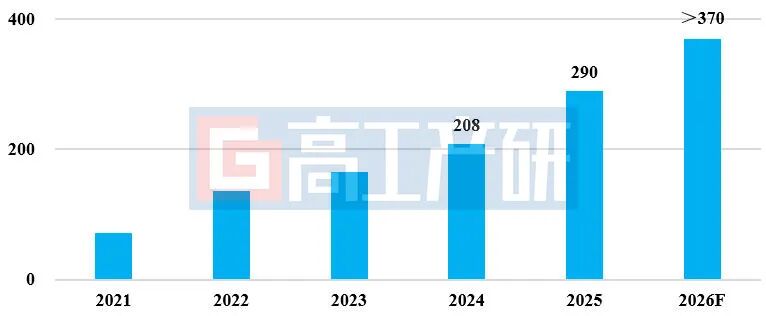
Core Viewpoint - The Chinese anode materials industry is expected to maintain high growth, with projected shipments exceeding 3.7 million tons in 2026, representing a year-on-year increase of over 28% [3][5]. Group 1: Industry Overview - In 2025, the anode materials industry in China is projected to continue its high growth trend, with total shipments reaching 2.9 million tons, a year-on-year increase of 39% [4]. - The industry landscape is significantly differentiated, with leading companies experiencing robust production and sales, while small and medium enterprises often engage in contract manufacturing, with some leading firms having over 30% of their production outsourced [4]. Group 2: Shipment Structure - In 2025, artificial graphite will dominate the market, with shipments reaching 2.67 million tons, a year-on-year increase of 49%, accounting for 92.7% of total anode material shipments [8]. - Natural graphite is expected to continue its decline, with shipments of 210,000 tons, a year-on-year decrease of 18.8%, representing less than 8% of the market share [8]. Group 3: Emerging Trends - Silicon-based composite materials are anticipated to be a growth highlight, with shipments expected to increase by over 65% in 2025, including over 2,000 tons of new silicon-carbon pure powder [10]. - The application of silicon-based composite materials has expanded in the digital sector, while the power sector is still in the verification phase due to material consistency issues [10]. Group 4: Technical Iteration - The technical iteration of anode materials in 2025 will closely align with downstream battery product demands, with differentiated upgrades in energy storage and power sectors [12]. - In the energy storage sector, artificial graphite's performance metrics are expected to improve, with specific capacity advancing from 350 mAh/g to 353-355 mAh/g, and bulk density increasing from 1.6 g/cm³ to 1.65 g/cm³ [12]. Group 5: Future Development Trends - The supply of petroleum coke with low sulfur content is expected to tighten, leading to a price increase for anode materials, with an anticipated price rise of 10-20% [15]. - High-rate products are projected to become mainstream, with over 50% penetration of ≥4C artificial graphite in power lithium batteries [15]. - New silicon-carbon shipments are expected to double year-on-year, with potential for mass application in the power sector [15]. - Leading anode companies are expected to operate at full capacity, necessitating large-scale outsourcing, while smaller firms may seek direct supply relationships with battery manufacturers to enhance customer loyalty [15].


GGII:2025年中国负极材料出货290万吨!快充、硅基材料成新引擎
智通财经网· 2026-02-06 11:46
Core Insights - The Chinese anode materials industry is expected to maintain high growth, with a projected shipment volume of 2.9 million tons in 2025, representing a year-on-year increase of 39% [1] - The industry landscape is becoming increasingly polarized, with leading companies experiencing robust sales while smaller firms often engage in contract manufacturing, with some top firms having over 30% of their production as integrated contract manufacturing [1] - For 2026, the industry is anticipated to continue its growth trajectory, with shipments expected to exceed 3.7 million tons, reflecting a year-on-year growth of over 28% [1] Shipment Structure - Artificial graphite is expected to solidify its dominant position, with a shipment volume of 2.67 million tons in 2025, marking a 49% increase and accounting for 92.7% of total anode material shipments [2] - Natural graphite is projected to decline, with a shipment volume of 210,000 tons in 2025, down 18.8%, representing less than 8% of the total, primarily due to a shift towards artificial graphite by overseas battery clients and a shrinking domestic application market [2] Growth Highlights - Silicon-based composite materials are emerging as a growth highlight, with shipments expected to increase by over 65% in 2025, including over 2,000 tons of new silicon-carbon pure powder, translating to more than 15,000 tons of silicon-based composite materials [5] - In the digital sector, silicon-based composite materials have achieved widespread application, while in the power sector, they are still in the verification stage due to consistency issues [5] Technological Advancements - The technological iteration of anode materials is closely aligned with downstream battery product demands, with differentiated upgrades in energy storage and power sectors [6] - In the energy storage sector, artificial graphite is expected to enhance performance metrics to meet the needs of new high-capacity energy storage cells, with specific improvements in capacity and density [6] - The power sector is witnessing a surge in fast-charging products, with over 80% of artificial graphite used in power lithium batteries being ≥2C fast-charging products, and over 40% being ≥4C fast-charging products [6] Future Trends - The supply of low-sulfur petroleum coke is expected to tighten, leading to price increases for anode materials, with an anticipated price rise of 10-20% [7] - High-rate products are projected to become mainstream, with the penetration rate of ≥4C artificial graphite in power lithium batteries expected to exceed 50% [7] - New silicon-carbon shipments are expected to grow by over 100%, with potential for mass application in the power sector [7] - Leading anode companies are expected to operate at full capacity, necessitating large-scale outsourcing, while smaller firms may seek direct supply relationships with battery manufacturers or pursue mergers to enhance competitiveness [7]
GGII:2025H1中国负极材料出货量129万吨
高工锂电· 2025-08-03 11:26
Core Viewpoint - The article discusses the current state and future outlook of China's anode material industry, highlighting significant growth in production and evolving product structures, while also addressing market dynamics and pricing trends [5][11]. Group 1: Industry Overview - The anode material industry in China is experiencing a recovery, with a projected shipment volume exceeding 260 million tons in 2025, representing a year-on-year growth of over 25% [5]. - In the first half of 2025, the shipment volume of anode materials reached 1.29 million tons, marking a 37% increase year-on-year, although this growth rate is lower than that of other major materials due to high inventory levels from the previous year [5][11]. Group 2: Product Structure Analysis - In the first half of 2025, artificial graphite shipments accounted for 91% of total anode material shipments, with a volume of 1.17 million tons, reflecting a 47% year-on-year increase [6]. - Natural graphite shipments, however, saw a decline of 23% year-on-year, totaling 106,000 tons, primarily due to competition from artificial graphite [6]. Group 3: Pricing Trends - In the first quarter of 2025, the price of anode-grade coke increased by over 40% compared to the previous quarter, but began to decline in the second quarter, with minimal impact on overall anode prices [9]. - The price of natural graphite has slightly decreased due to pressure from artificial graphite [9]. Group 4: Technological Developments - New generation large-capacity products are driving improvements in the capacity of artificial graphite, with several battery companies achieving a capacity increase from 350 mAh/g to 353-355 mAh/g [11]. - The industry is also seeing advancements in fast-charging capabilities, with penetration rates exceeding 15% for fast-charging products [11]. Group 5: Market Dynamics - The anode material industry is currently facing structural overcapacity, with the top five companies operating at over 70% capacity utilization, while smaller firms struggle with order shortages [11]. - It is anticipated that the head companies will rely on small and medium enterprises for processing and their own expansion to meet future capacity needs, with an overall gradual increase in industry capacity utilization expected [11].