
快充

Search documents
年销百万辆的吉利、零跑,电池选择策略“突变”
高工锂电· 2026-03-17 10:19
Core Viewpoint - The competition in the power battery sector has entered a dual-track era, with companies like BYD focusing on fast charging and integrated energy solutions, while others like Geely and Leap Motor are emphasizing battery system integration and cost efficiency [3][4][30]. Group 1: BYD's Strategy - BYD has launched its second-generation blade battery, which can charge from 10% to 70% in 5 minutes and from 20% to 97% in under 12 minutes in low-temperature conditions [3]. - The company plans to expand its "flash charging" network to 20,000 charging stations by 2026, with approximately 2,000 located along highways [3]. - BYD aims to create a new industry barrier by bundling batteries, vehicles, and charging networks together, focusing on high charging rates, energy density, and new materials [4]. Group 2: Geely's Approach - Geely is integrating its battery business into a platform called Jiayao Tongxing, which consolidates various battery assets and aims to achieve a production capacity of 70 GWh by 2027 [9]. - This integration signifies a shift in Geely's approach, treating batteries as a core internal capability rather than merely an external procurement item [10]. - Geely's recent developments, such as the Shen Dun Jin Zhuang hybrid battery, emphasize a balanced approach to safety, charging speed, and longevity, while also being shareable across different brands within the group [15][17]. Group 3: Leap Motor's Model - Leap Motor adopts a manufacturing-centric philosophy, using only three types of battery cells and two intelligent driving solutions across its vehicle lineup [21]. - The company plans to achieve annual sales of 4 million vehicles in the next decade and is expanding globally through partnerships with Stellantis and FAW [22]. - Leap Motor's strategy focuses on integrating battery production with overall vehicle cost structures, emphasizing platformization and cost control [23][24]. Group 4: Industry Trends and Future Outlook - The industry is witnessing a clear bifurcation, with BYD pushing for fast charging and energy networks, while Geely and Leap Motor focus on internalizing battery capabilities and cost efficiency [30][52]. - The importance of high-pressure lithium iron phosphate (LFP) batteries is increasing, transitioning from a conceptual stage to a critical manufacturing challenge [34][36]. - The competition is shifting from merely having high-performance products to the ability to consistently produce and deliver these products at scale [39][40].




电动化下半场:“低温”大战开启
高工锂电· 2026-03-15 09:57
Core Viewpoint - The electric vehicle industry is entering a critical phase where low-temperature performance of batteries is essential for various applications, leading to intense competition among major players like CATL, BYD, and Guoxuan High-Tech [3][4]. Group 1: Low-Temperature Solutions - Major battery manufacturers are focusing on low-temperature solutions, with BYD's second-generation blade battery achieving fast charging in under 12 minutes at -30°C, while CATL's sodium-ion battery allows for immediate charging without preheating [4][6]. - The competition is not just about battery performance but also about creating a comprehensive ecosystem that includes charging infrastructure and vehicle compatibility [9][10]. Group 2: Charging Infrastructure and Market Dynamics - The future of fast charging infrastructure, particularly in northern markets, is crucial for the growth of electric vehicles, with BYD planning to expand its fast-charging stations significantly [7][8]. - The penetration of 800V high-voltage platforms is expected to exceed 10% by 2025, with a projected sales volume of nearly 1.5 million units, indicating a shift towards higher voltage systems in the market [7][8]. Group 3: Material Innovations - The introduction of lithium iron phosphate (LFP) and manganese iron phosphate (LMFP) materials is set to redefine the competitive landscape, with BYD's advancements in low-temperature performance potentially disrupting the dominance of ternary materials [11][12]. - CATL's M3P battery, which utilizes manganese iron phosphate, is already being deployed in various vehicle models, showcasing the trend towards multi-material strategies in battery technology [13]. Group 4: Commercial Vehicle Applications - CATL's sodium-ion battery is being integrated into commercial vehicles, demonstrating its capability to operate effectively in extreme cold conditions, thus expanding the application range of low-temperature batteries [14][15].



GGII:快充、硅基材料将成锂电负极新引擎
高工锂电· 2026-02-19 12:24
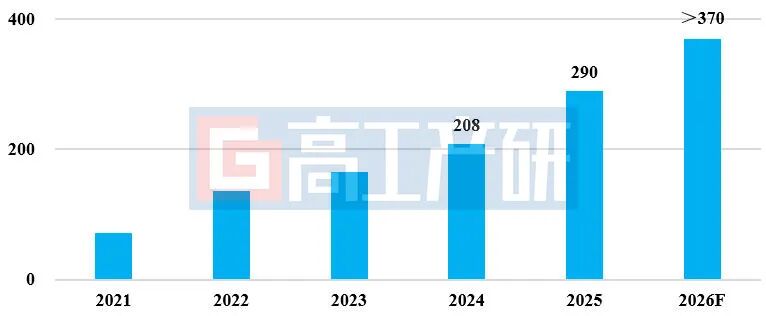
Core Viewpoint - The article discusses the growth and trends in the Chinese anode materials market, highlighting significant increases in production and shifts in material types, particularly the dominance of artificial graphite and the emergence of silicon-based materials as new growth drivers [4][5][8]. Group 1: Market Growth and Projections - The anode materials shipment volume in 2026 is expected to exceed 3.7 million tons, representing a year-on-year growth of over 28% [4]. - In 2025, the shipment volume for China's anode materials industry is projected to reach 2.9 million tons, with a year-on-year increase of 39% [5]. - The market is characterized by a significant divide between leading companies, which are experiencing robust sales, and smaller firms that are increasingly engaging in contract manufacturing, with some leading companies outsourcing over 30% of their production [5]. Group 2: Shipment Structure and Material Trends - Artificial graphite is expected to maintain its dominant position, with a shipment volume of 2.67 million tons in 2025, marking a 49% increase and accounting for 92.7% of total anode material shipments [8]. - Natural graphite is projected to continue its decline, with a shipment volume of 210,000 tons in 2025, down 18.8% year-on-year, primarily due to a shift by overseas battery clients towards artificial graphite [8]. - Silicon-based composite materials are anticipated to be a highlight of industry growth, with shipments expected to increase by over 65% in 2025, including over 20,000 tons of new silicon-carbon pure powder [11]. Group 3: Technological Developments and Market Dynamics - The development of anode materials in 2025 will closely align with downstream battery product demands, with differentiated upgrades in energy storage and power sectors [12]. - In the energy storage sector, artificial graphite's performance metrics are expected to improve, with specific capacity increasing from 350 mAh/g to between 353-355 mAh/g [12]. - The power sector is witnessing a surge in fast-charging products, with over 80% of artificial graphite used in power lithium batteries being ≥2C fast-charging products, and over 40% being ≥4C fast-charging products [12]. Group 4: Future Trends and Market Strategies - In 2026, the anode materials market is expected to see tighter supply of low-sulfur petroleum coke, leading to a price increase of 10-20% for anode materials [13]. - High-rate products are projected to become mainstream, with the penetration rate of ≥4C artificial graphite in power lithium batteries exceeding 50% [13]. - New silicon-carbon shipments are expected to double year-on-year, with potential for mass application in the power sector [13].

GGII:2025年中国负极材料出货290万吨!快充、硅基材料成新引擎
智通财经网· 2026-02-06 11:46
Core Insights - The Chinese anode materials industry is expected to maintain high growth, with a projected shipment volume of 2.9 million tons in 2025, representing a year-on-year increase of 39% [1] - The industry landscape is becoming increasingly polarized, with leading companies experiencing robust sales while smaller firms often engage in contract manufacturing, with some top firms having over 30% of their production as integrated contract manufacturing [1] - For 2026, the industry is anticipated to continue its growth trajectory, with shipments expected to exceed 3.7 million tons, reflecting a year-on-year growth of over 28% [1] Shipment Structure - Artificial graphite is expected to solidify its dominant position, with a shipment volume of 2.67 million tons in 2025, marking a 49% increase and accounting for 92.7% of total anode material shipments [2] - Natural graphite is projected to decline, with a shipment volume of 210,000 tons in 2025, down 18.8%, representing less than 8% of the total, primarily due to a shift towards artificial graphite by overseas battery clients and a shrinking domestic application market [2] Growth Highlights - Silicon-based composite materials are emerging as a growth highlight, with shipments expected to increase by over 65% in 2025, including over 2,000 tons of new silicon-carbon pure powder, translating to more than 15,000 tons of silicon-based composite materials [5] - In the digital sector, silicon-based composite materials have achieved widespread application, while in the power sector, they are still in the verification stage due to consistency issues [5] Technological Advancements - The technological iteration of anode materials is closely aligned with downstream battery product demands, with differentiated upgrades in energy storage and power sectors [6] - In the energy storage sector, artificial graphite is expected to enhance performance metrics to meet the needs of new high-capacity energy storage cells, with specific improvements in capacity and density [6] - The power sector is witnessing a surge in fast-charging products, with over 80% of artificial graphite used in power lithium batteries being ≥2C fast-charging products, and over 40% being ≥4C fast-charging products [6] Future Trends - The supply of low-sulfur petroleum coke is expected to tighten, leading to price increases for anode materials, with an anticipated price rise of 10-20% [7] - High-rate products are projected to become mainstream, with the penetration rate of ≥4C artificial graphite in power lithium batteries expected to exceed 50% [7] - New silicon-carbon shipments are expected to grow by over 100%, with potential for mass application in the power sector [7] - Leading anode companies are expected to operate at full capacity, necessitating large-scale outsourcing, while smaller firms may seek direct supply relationships with battery manufacturers or pursue mergers to enhance competitiveness [7]
两轮车“高端时代”将断崖式结束?
高工锂电· 2026-02-04 10:46
Core Viewpoint - The electric two-wheeler market is shifting from high-end "consumer upgrade" growth to a focus on durability, range, and cost efficiency, as highlighted in the latest IPO prospectus of Tailin [3] Group 1: Market Dynamics - The high-end segment of the electric two-wheeler market in China experienced a compound annual growth rate (CAGR) of 72.1% from 2020 to 2024, but this is expected to drop to 14.8% from 2025 to 2029. In contrast, the basic configuration segment is projected to recover from a growth rate of 1.2% to 4.7% [5] - Despite overall market growth, the incremental demand is shifting towards more price-sensitive consumers, focusing on essential commuting needs rather than premium features [5] - Tailin's sales data reflects this trend, with approximately 7.83 million units sold in the first three quarters of 2025, up from 6.05 million in the same period of 2024, while the average selling price for electric bicycles increased from approximately 1,274 yuan to 1,394 yuan [5] Group 2: Revenue and Profitability - Tailin's battery business accounted for 20.4% of total revenue, generating approximately 3.034 billion yuan, but the gross margin fell to 1.0%, down from 1.6% in 2023 and 1.3% in 2024 [3][5] - In contrast, the gross margin for electric bicycles improved to 17.7%, and for electric motorcycles, it rose to 18.1% during the same period [3] Group 3: Distribution Strategy - Tailin's revenue is heavily reliant on its dealer network, with 97.4% of sales coming from dealers and only 2.6% from direct sales. Online sales significantly decreased to approximately 2.4 million yuan, down from about 8.94 million yuan in 2024 [7] - The company operates a robust offline network with 5,597 dealers and over 27,000 retail stores in mainland China, alongside 412 dealers and over 300 retail stores overseas [7] Group 4: Battery Business Insights - Tailin's battery business is positioned as a complementary product to vehicles, despite its low profitability. The company employs a "locking strategy" with battery encryption software to control access and ensure safety [9] - The battery's low margin is offset by its role as a channel control and risk management tool, rather than a direct profit generator [10] Group 5: International Expansion Challenges - Tailin sees opportunities in Southeast Asian markets driven by policy support, such as subsidies and restrictions on fuel motorcycles. Vietnam's planned restrictions on fossil fuel motorcycles by 2026 are viewed as a significant policy trigger for electric two-wheeler adoption [11] - In contrast, Europe presents challenges due to market fragmentation and stringent regulatory requirements, making it less favorable for Tailin's expansion compared to other regions [12]

2025年负极市场盘点:全球负极出货306.15万吨,同比增长49%
鑫椤锂电· 2026-01-27 08:24
Core Viewpoint - The global lithium battery production is projected to reach 2297 GWh in 2025, representing a year-on-year growth of 48.5%, driven by the increasing penetration of new energy vehicles and the rapid expansion of the energy storage market [2][3]. Lithium Battery Market Overview - The global anode material production is expected to reach 3.115 million tons in 2025, with a year-on-year increase of 43.7%. China's share in the anode material market has risen to 99.0% from 98.5% the previous year [3]. - Global sales volume of anode materials is projected at 3.0615 million tons, with China accounting for 98.4% [3]. Market Concentration - The concentration ratio (CR3) for global anode materials is 49.5%, remaining stable compared to the previous year. The CR6 ratio has slightly increased to 73.0% from 72.7%, indicating a slight rise in market concentration [5]. Key Players in the Anode Material Market - BETTERRY continues to lead the anode material industry for the sixteenth consecutive year due to its technological advantages and strong customer relationships. Other notable players include Shanghai Shanshan, which has seen a steady increase in market share, and companies like Zhongke Xingcheng and Shangtai Technology, which are gaining market presence [8]. - Companies such as Guangdong Kaijin and Jiangxi Zicheng are also making strides, with Zicheng focusing on profitable sales strategies [8]. Artificial Anode Material Trends - The penetration rate of artificial anode materials is expected to rise to 93% in 2025, with Shanghai Shanshan maintaining its leading position. The market for natural graphite, particularly overseas, is declining in both production and market share [11]. Silicon Anode Market Insights - The global silicon anode production is projected to reach 8600 tons in 2025, marking a 67% year-on-year increase. Key players in the domestic market include BETTERRY, Zhejiang Licheng, and others [15]. - The demand for silicon-based anodes is driven by the growth in consumer electronics and the increasing application in power batteries, particularly in new markets such as low-altitude economy and humanoid robots [16]. Future Market Outlook - The anode material market in 2026 is expected to follow three main trends: bottom recovery, technological upgrades, and accelerated international expansion. The rapid growth of the energy storage market will support demand alongside the power market [19]. - Key opportunities include the expansion of fast-charging anodes and the emergence of sodium batteries, which will create new demand for hard carbon anodes [20].

电力设备与新能源行业周观察:太空光伏开辟增量空间,看好产业链发展机遇
HUAXI Securities· 2026-01-25 12:58
Investment Rating - Industry Rating: Recommended [5] Core Insights - The humanoid robot industry is accelerating towards mass production, driven by cost reduction demands and domestic suppliers' advantages in key components like precision transmission parts and electronic skin [15][16] - The sodium battery released by CATL showcases cost and performance advantages, with significant price increases in lithium carbonate impacting lithium battery costs, while sodium batteries are expected to achieve scale applications [19][20] - Domestic energy storage installations are experiencing substantial growth, with a diverse revenue structure and economic viability, benefiting leading companies in system integration and inverters [23] - The photovoltaic industry is poised for growth due to dual applications in ground and space, with HJT technology becoming a key direction for overseas expansion, enhancing global market potential [26][31] - China's wind power equipment exports are surging, with significant opportunities for leading companies in both domestic and overseas markets, supported by technological parity and cost advantages [27][40] - The electric equipment sector is entering a super boom cycle, driven by overseas demand and advancements in AI and smart grid technologies, with companies that possess strong channel resources and technical capabilities expected to benefit [42][43] Summary by Sections Humanoid Robots - The humanoid robot industry is seeing rapid industrialization, with major tech companies entering the market and expected mass production of Tesla's Optimus robot by the end of next year [15][16] - Key components suppliers in the T-chain are likely to benefit from the anticipated production ramp-up [16][17] Electric Vehicles - CATL's sodium battery demonstrates significant advantages in cost and performance, with the price of lithium carbonate impacting battery costs, while sodium batteries are expected to see widespread adoption [19][20] Renewable Energy - Domestic energy storage installations are on a growth trajectory, with leading companies in system integration and inverters set to benefit from the expanding market [23] - The photovoltaic sector is expected to grow due to advancements in HJT technology and increased global demand for solar installations [26][31] Wind Power - China's wind power equipment exports are increasing, with leading companies poised to capitalize on both domestic and international opportunities [27][40] Electric Equipment & AIDC - The electric equipment sector is entering a favorable cycle, with companies that have strong technical capabilities and market presence expected to benefit from increased overseas demand [42][43]



电力设备与新能源行业周观察:全球电网设备共振迎超级周期,英国AR7海风落地规模超预期
HUAXI Securities· 2026-01-18 13:35
Investment Rating - Industry rating: Recommended [4] Core Insights - The report highlights the upcoming release of the T-chain and Optimus V3 humanoid robots, indicating a potential acceleration in mass production driven by cost reduction needs and domestic suppliers' advantages in precision components and electronic skin [1][14] - The report anticipates a 28.2% year-on-year growth in new energy vehicle sales by 2025, with a penetration rate expected to reach 47.9% [2][17] - The development of commercial aerospace is accelerating, presenting new opportunities for space photovoltaics, with significant cost implications for satellite power systems [3][24] - The UK AR7 auction results indicate a significant increase in offshore wind power capacity, providing greater overseas market opportunities for domestic wind power companies [6][25] Summary by Sections Humanoid Robots - The humanoid robot industry is experiencing rapid development, with major tech companies entering the market and a focus on domestic suppliers for key components [1][14] - Companies like Zhejiang Rongtai and others are expected to benefit from the growing demand for humanoid robots and their components [1][16] New Energy Vehicles - New energy vehicle sales are projected to reach 1,662.6 million units in 2025, with a significant increase in market penetration [2][18] - The report emphasizes the importance of technological advancements and cost optimizations in sustaining growth in the new energy vehicle sector [2][19] New Energy - The report notes the potential for space photovoltaics to create new growth opportunities within the photovoltaic industry, particularly with advancements in technology [3][24] - Companies with relevant product and equipment layouts are expected to benefit from the growth in space photovoltaic applications [3][24] Power Equipment & AIDC - TSMC's capital expenditure plan for 2026 is projected to reach $56 billion, reflecting strong demand in AI and overseas power equipment markets [7][42] - The report anticipates a significant increase in investment in the power grid, with a projected total of 4 trillion yuan during the 14th Five-Year Plan period [8][43]
新能源车ETF(159806)飘红,新能源汽车销量有望延续高景气趋势
Mei Ri Jing Ji Xin Wen· 2026-01-16 06:23
Core Viewpoint - The Chinese automotive industry is expected to achieve record production and sales, with significant growth in the new energy vehicle (NEV) sector, driven by strong domestic demand and supportive government policies [1]. Industry Summary - According to the China Association of Automobile Manufacturers, by 2025, China's automotive production and sales are projected to exceed 34 million units, setting a new historical high [1]. - In 2025, NEV production and sales are expected to reach 16.626 million and 16.49 million units, respectively, reflecting year-on-year growth of 29% and 28.2% [1]. - NEVs accounted for over 50% of new car sales in the domestic market [1]. - The automotive export market remains resilient, with total exports exceeding 7 million units, including 2.615 million NEVs [1]. Policy Impact - The vehicle trade-in subsidy policy for 2026 has been implemented as scheduled, maintaining the upper limit for subsidies per vehicle. The subsidy for mass-market models priced below 200,000 yuan will decrease, while support for mid-to-high-end models priced above 200,000 yuan will continue, potentially boosting automotive market consumption [1]. Market Trends - With the recovery in demand and trends in intelligence, connectivity, and fast charging, product iterations in the NEV sector are expected to maintain a high growth trend [1]. ETF Overview - The New Energy Vehicle ETF (159806) tracks the CS New Energy Vehicle Index (399976), which selects listed companies involved in lithium batteries, charging stations, and new energy vehicles to reflect the overall performance of the NEV sector [1]. - The CS New Energy Vehicle Index focuses on the NEV industry, covering sectors such as battery materials, upstream materials, motor control, and charging stations, showcasing the characteristics of technological innovation and market competitiveness within the industry [1].
天赐材料:预计今年LiFSI的整体添加比例可达到2.2%
Zheng Quan Ri Bao Wang· 2025-11-21 09:12
Core Viewpoint - The company Tianqi Materials (002709) anticipates an overall addition ratio of LiFSI to reach 2.2% this year, with expectations to increase to 3% next year due to rising demand for high-performance formulations such as fast charging [1] Group 1 - The company expects the addition ratio of LiFSI to reach 2.2% this year [1] - The demand for high-performance formulations, particularly fast charging, is expected to drive further increases in the addition ratio [1] - The company projects that the addition ratio will reach 3% next year [1]
