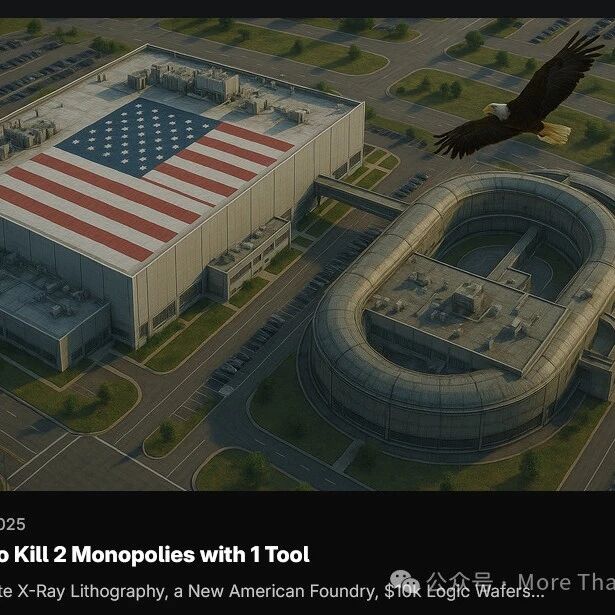
新型X射线光刻(XRL)工具

Search documents
SemiAnalysis--X射线光刻能否颠覆ASML+TSMC芯片制造格局?
傅里叶的猫· 2025-10-30 12:33
Core Viewpoint - The article discusses the potential disruption in the semiconductor industry brought by Substrate, a startup aiming to innovate chip manufacturing through its new X-ray lithography (XRL) technology, which promises significant cost reductions and performance improvements compared to existing methods [5][10][30]. Group 1: Industry Context - The semiconductor manufacturing industry has been dominated by inertia, with leading companies hesitant to deviate from established technologies despite rising costs and slowing scaling speeds [5][7]. - Current lithography tools, such as EUV, are highly profitable, making companies reluctant to abandon existing systems, which creates opportunities for innovative newcomers like Substrate [7][10]. Group 2: Substrate's Technology - Substrate aims to provide technological support for next-generation wafer fabs, focusing on significantly lowering the production costs of advanced logic wafers through its proprietary XRL tools [8][10]. - The XRL technology claims to overcome historical challenges associated with X-ray lithography, such as optical system and light source issues, and has demonstrated impressive performance metrics, including a resolution comparable to High-NA EUV [10][12]. Group 3: Performance Metrics - Substrate's XRL tool reportedly achieves single-exposure capabilities for 2nm and 1nm nodes, with a patterning accuracy of 1.6nm and a critical dimension uniformity (CDU) of 0.25nm [10][12]. - The company asserts that its technology can reduce production costs by 50% compared to current methods, although this claim requires further validation [10][13]. Group 4: Market Implications - If successful, Substrate's XRL technology could reshape the lithography landscape, providing a cost-effective alternative to existing high-cost tools, thus enhancing design flexibility and potentially increasing transistor density [16][18]. - The global lithography equipment market is projected to reach approximately $50 billion by 2030, and Substrate's technology could capture significant market share if it achieves mass production [18][30]. Group 5: Strategic Goals - Substrate's long-term vision includes establishing its own wafer fabrication facility, integrating XRL technology into a complete end-to-end chip manufacturing process [14][24]. - The company aims to contribute to the localization of chip manufacturing in the U.S., addressing concerns over reliance on foreign production, particularly from Taiwan [23][24]. Group 6: Challenges Ahead - Despite the promising technology, Substrate faces significant hurdles, including the need for larger exposure field sizes, equipment stability, and full-process validation to ensure compatibility across multiple layers [28][29]. - The transition from laboratory technology to commercial production is complex and may take several years, with industry experts noting that achieving mass production could take until around 2030 [29][30].