EUV工具

Search documents
未知机构:我们美国半导体团队的同事在近期4QCY2-20260224
未知机构· 2026-02-24 02:25
Summary of Conference Call Notes Industry Overview - The conference call focused on the semiconductor industry, particularly the European semiconductor companies ASML, ASMI, and BESI, in light of strong spending on advanced logic, foundry, and memory chips [1][2]. Key Points and Arguments Semiconductor Spending Forecasts - The U.S. semiconductor team revised their forecasts for wafer fabrication equipment (WFE) spending for 2026, 2027, and 2028 to $124 billion, $132 billion, and $144 billion, respectively, reflecting year-on-year growth of +20%, +21%, and +9% [1]. - DRAM WFE spending is projected to grow by +25%, +18%, and +5% for the same years, with revised estimates of $38 billion and $40 billion [2]. - Foundry WFE spending is expected to increase by +28%, +25%, and +10%, with new estimates of $45 billion, $51 billion, and $59 billion [2]. ASML Insights - ASML is positioned to benefit from strong demand in advanced storage applications, with a 4Q25 order volume of approximately €1.3 billion, primarily driven by storage orders [3]. - The company is expected to receive additional orders from TSMC as they ramp up capacity for their N2 node, leveraging ASML's EUV tools [3]. - The transition to more complex architectures will enhance ASML's benefits in both logic and storage applications [3]. ASMI Insights - ASMI is seen as a beneficiary of strong demand in advanced logic and foundry, particularly with TSMC's N2 node capacity expansion [4]. - The company’s single-wafer ALD tools are critical for the GAA transition, which is expected to provide incremental benefits starting in 2026 [4]. - ASMI is also recognized for its reliable AI opportunities in the storage sector, particularly with its high-k metal gate tools for HBM devices [4]. BESI Insights - BESI is viewed positively due to the strong capital expenditure data in advanced logic and foundry, supplying HB tools to TSMC and Intel [5]. - The shift towards chiplet-based designs among AI accelerator manufacturers positions BESI as a key beneficiary, as their HB tools offer cost-effective and precise packaging solutions [5]. - The strong spending outlook for advanced storage, such as HBM, is also favorable for BESI's HB and TCB tools [5]. Ratings and Price Targets - ASML: Buy rating with a 12-month target price based on a 37x CY27 P/E ratio; risks include EUV delays and adverse market share changes [6]. - ASMI: Buy rating with a 12-month target price based on a 25x EV/EBITDA multiple for 2H CY26 and 1H CY27; risks include semiconductor cycle deterioration and high customer concentration [7]. - BESI: Buy rating with a 12-month target price based on a 28x EV/EBITDA multiple for CY27; risks include customer spending cyclicality and increased competition [8].
阿斯麦的"巅峰时刻"!大摩:先进制程扩产潮下,2027年或迎最强盈利增长
硬AI· 2026-01-16 14:06
Core Viewpoint - Morgan Stanley predicts that ASML is at the beginning of its strongest profit cycle, with 2027 expected to be a peak year for profitability, projecting sales of approximately €46.8 billion and EBIT of €19.7 billion, with a gross margin of 56.2% [1][4]. Group 1: Drivers of Profit Explosion - The profit surge is driven by three main engines: strong demand from advanced logic foundries, large-scale capacity expansion in the DRAM memory sector, and better-than-expected demand performance [3][4]. - ASML's target price has been significantly raised from €1000 to €1400, maintaining its "Overweight" rating and "Top Pick" status [3][4]. Group 2: Advanced Logic Foundry Demand - TSMC's substantial increase in capital expenditure is a key catalyst, with guidance for 2026 capital spending set at $52-56 billion, a 32% year-on-year increase, with 70-80% allocated to advanced processes [7]. - Morgan Stanley has raised its EUV equipment procurement expectations for TSMC from about 20 units to 29 for 2026, and from 28 to 40 for 2027 [8][10]. Group 3: DRAM Market Dynamics - The DRAM market is experiencing unprecedented demand, with prices for HBM and general DRAM rising to near-historic levels due to capacity shortages [11][15]. - This trend is expected to last for at least 1-2 quarters, leading to significant capacity investments in DRAM manufacturing, thereby increasing demand for ASML's EUV and DUV tools [15][16]. Group 4: Demand Performance - Demand from leading memory chip manufacturers remains strong, with expectations that ASML's upcoming financial report will reflect better-than-previously guided demand [18][20]. - For Q4, ASML is expected to report orders of €7.27 billion, surpassing Q3's €5.4 billion, including 19 EUV low-NA tools primarily from TSMC [21]. Group 5: Financial Projections - For 2027, ASML is projected to achieve approximately €46.8 billion in sales, with system sales of €36.87 billion and IBM sales of €9.9 billion, alongside a gross margin increase to 56.2% [26][27]. - Morgan Stanley maintains ASML as a top stock pick, applying a 31x P/E valuation with a target price of €1400, and suggests a bull case scenario could see the target price reach €2000 based on an EPS of €50 and a 40x P/E [27].


阿斯麦的"巅峰时刻"!大摩:先进制程扩产潮下,2027年或迎最强盈利增长
Hua Er Jie Jian Wen· 2026-01-16 08:25
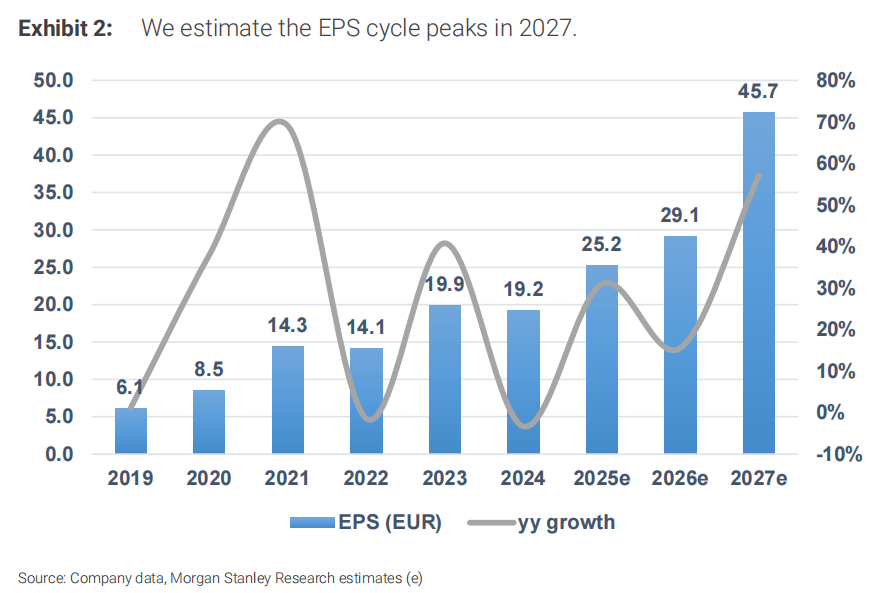
Core Viewpoint - Morgan Stanley states that ASML is at the beginning of its strongest profit cycle ever, driven by the AI wave pushing advanced process and memory chip capacity expansion, with 2027 expected to be a peak year for profit growth [1][3]. Group 1: Financial Projections - ASML's sales for the fiscal year 2027 are projected to reach approximately €46.8 billion, with EBIT expected to hit €19.7 billion and a gross margin increase to 56.2% [1][15]. - The expected earnings per share (EPS) for 2027 is €45.74, a 35% increase from the previous estimate of €33.94, and a 57% year-over-year growth compared to the anticipated €29.12 for 2026 [1][15]. - Morgan Stanley has raised ASML's target price from €1,000 to €1,400, maintaining an "Overweight" rating and "Top Pick" status [3]. Group 2: Demand Drivers - The profit surge is primarily driven by strong demand from advanced logic foundries, significant capacity expansion in the DRAM memory sector, and better-than-expected demand performance [3][13]. - TSMC's capital expenditure guidance for 2026 is set at $52-56 billion, a 32% year-over-year increase, with 70-80% allocated to advanced processes, which is a key catalyst for ASML [5]. - TSMC's EUV tool procurement expectations for 2026 have been raised from approximately 20 to 29 units, and for 2027 from 28 to 40 units [5][7]. Group 3: DRAM Market Dynamics - The DRAM market is experiencing unprecedented demand, with strong price momentum driven by regular server CPU demand and large cloud service providers' AI needs for 2026-27 [8][10]. - The scarcity of capacity has led to record price increases for HBM and general DRAM, which is expected to last for at least 1-2 quarters, prompting large-scale capacity construction in the DRAM manufacturing sector [10][11]. Group 4: Upcoming Financial Results - ASML is set to release its Q4 financial results on January 28, 2026, with expected orders of €7.27 billion, significantly higher than €5.4 billion in Q3, including 19 EUV low-NA tools [14]. - The anticipated sales for Q4 are €9.675 billion, at the high end of the guidance range, with a year-over-year growth of 4% [14]. - The gross margin for Q4 is expected to be 51.8%, close to the guidance midpoint, with a sequential increase of 20 basis points [14].
SemiAnalysis--X射线光刻能否颠覆ASML+TSMC芯片制造格局?
傅里叶的猫· 2025-10-30 12:33
Core Viewpoint - The article discusses the potential disruption in the semiconductor industry brought by Substrate, a startup aiming to innovate chip manufacturing through its new X-ray lithography (XRL) technology, which promises significant cost reductions and performance improvements compared to existing methods [5][10][30]. Group 1: Industry Context - The semiconductor manufacturing industry has been dominated by inertia, with leading companies hesitant to deviate from established technologies despite rising costs and slowing scaling speeds [5][7]. - Current lithography tools, such as EUV, are highly profitable, making companies reluctant to abandon existing systems, which creates opportunities for innovative newcomers like Substrate [7][10]. Group 2: Substrate's Technology - Substrate aims to provide technological support for next-generation wafer fabs, focusing on significantly lowering the production costs of advanced logic wafers through its proprietary XRL tools [8][10]. - The XRL technology claims to overcome historical challenges associated with X-ray lithography, such as optical system and light source issues, and has demonstrated impressive performance metrics, including a resolution comparable to High-NA EUV [10][12]. Group 3: Performance Metrics - Substrate's XRL tool reportedly achieves single-exposure capabilities for 2nm and 1nm nodes, with a patterning accuracy of 1.6nm and a critical dimension uniformity (CDU) of 0.25nm [10][12]. - The company asserts that its technology can reduce production costs by 50% compared to current methods, although this claim requires further validation [10][13]. Group 4: Market Implications - If successful, Substrate's XRL technology could reshape the lithography landscape, providing a cost-effective alternative to existing high-cost tools, thus enhancing design flexibility and potentially increasing transistor density [16][18]. - The global lithography equipment market is projected to reach approximately $50 billion by 2030, and Substrate's technology could capture significant market share if it achieves mass production [18][30]. Group 5: Strategic Goals - Substrate's long-term vision includes establishing its own wafer fabrication facility, integrating XRL technology into a complete end-to-end chip manufacturing process [14][24]. - The company aims to contribute to the localization of chip manufacturing in the U.S., addressing concerns over reliance on foreign production, particularly from Taiwan [23][24]. Group 6: Challenges Ahead - Despite the promising technology, Substrate faces significant hurdles, including the need for larger exposure field sizes, equipment stability, and full-process validation to ensure compatibility across multiple layers [28][29]. - The transition from laboratory technology to commercial production is complex and may take several years, with industry experts noting that achieving mass production could take until around 2030 [29][30].
ASML:如何应对贸易战
半导体芯闻· 2025-06-10 09:52
Core Viewpoint - ASML is facing significant challenges due to geopolitical tensions and trade policies, which could impact its market position and the global semiconductor supply chain [1][4][6]. Group 1: Geopolitical Challenges - The CEO of ASML, Christophe Fouquet, has expressed concerns about the uncertainty brought by U.S. trade policies, including tariffs that could increase the cost of ASML's essential lithography machines [1][2]. - The Dutch government has been involved in discussions regarding the export restrictions on ASML's equipment to China, which complicates trade negotiations [1][4]. - ASML's unique position as the sole manufacturer of complex lithography machines makes it a target in the ongoing tech trade war between the U.S. and China [1][4]. Group 2: Business Performance and Projections - ASML reported a record revenue of €28.3 billion (approximately $32.3 billion) last year and anticipates sales could reach between €44 billion to €60 billion by 2030 [6]. - Despite the growth in demand for AI chips, concerns remain about the sustainability of this demand and the high costs associated with ASML's machines, which are priced at around $400 million each [6][8]. - The company's stock has seen a decline of about 25% over the past year, reflecting market uncertainties [6]. Group 3: Supply Chain and Innovation - ASML's advanced lithography machines utilize extreme ultraviolet (EUV) technology, which is critical for manufacturing microchips, and require components from hundreds of international suppliers [5][8]. - The company is actively lobbying for more support from the EU and Dutch government to mitigate the impacts of U.S.-China trade tensions on the semiconductor industry [4][8]. - There are concerns that U.S. export bans could inadvertently strengthen China's domestic semiconductor capabilities, as Chinese companies are investing heavily in developing their own lithography technology [9][11].