新疆褐牛

Search documents
“媒体+”贯通南北,大湾区百亿消费力驱动牛产业升级新格局
Nan Fang Nong Cun Bao· 2025-12-20 15:34
Core Insights - The article discusses the transformation of the beef industry in China, particularly focusing on the Guangdong-Hong Kong-Macao Greater Bay Area, which is becoming a key driver for upgrading the beef industry through a consumption power of over 100 billion yuan [6][7][12]. Group 1: Market Demand and Trends - The Greater Bay Area accounts for 10% of China's total beef consumption, with Guangdong province consuming over 1 million tons annually, and the Bay Area alone consuming over 800,000 tons [12][13]. - The average price for beef hot pot in the Greater Bay Area has increased from 85 yuan in 2020 to 128 yuan in 2025, with a 120% increase in the order rate for high-end cuts [14][15]. - The market for Chaozhou beef hot pot is projected to reach 48.18 billion yuan in 2024 and is expected to exceed 50 billion yuan in 2025 [16]. Group 2: Supply Chain and Collaboration - The article highlights the role of "media+" in bridging the gap between supply and demand, facilitating the integration of production and sales through various platforms [4][25]. - Media initiatives include offline tasting events and comprehensive reporting on beef production practices, enhancing brand recognition and connecting producers with Bay Area businesses [27][29]. - The media's involvement has also led to improvements in cold chain logistics, reducing circulation losses and enhancing product freshness [31][34]. Group 3: Standardization and Quality Improvement - The demand for high-quality beef in the Greater Bay Area is pushing for standardization and regulation in the beef supply chain [37]. - The Guangdong Beef Industry Development Promotion Association has introduced a standard evaluation system for beef, which serves as a "pass" for quality beef entering the Bay Area market [38][39]. - The media's promotion of these standards is fostering a virtuous cycle of production and procurement based on quality, enhancing regional collaboration [42][44]. Group 4: Future Prospects and Globalization - The collaboration driven by "media+" is optimizing resource allocation in the beef industry, with the Greater Bay Area leading the way in market-driven initiatives [49]. - The ongoing media empowerment is expected to strengthen long-term mechanisms for brand building, technology sharing, and market expansion, positioning quality beef as a nationally recognized brand [52][54]. - The Greater Bay Area's global hub status is anticipated to facilitate the export of domestic beef to international markets, contributing to rural revitalization and high-quality industrial development [54].


牛羊买卖的“牵线人”(新职·新知㉜)
Ren Min Ri Bao Hai Wai Ban· 2025-11-23 23:27
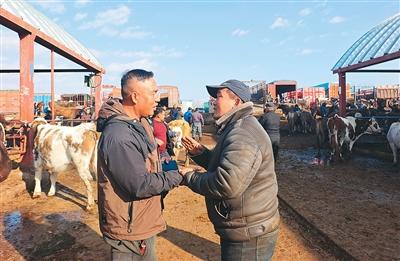
Core Insights - The article highlights the emergence of "livestock brokers" as a recognized profession in China, particularly in the Xinjiang region, where the Huanggong Bazaar serves as the largest livestock trading market with a history of over a century [1][9]. Group 1: Market Overview - Huanggong Bazaar can handle a daily trading volume of up to 15,000 livestock, making it a central hub for livestock transactions in Xinjiang [1]. - The market has a weekly trading schedule, with peak activity on Wednesdays, attracting up to 30,000 visitors [4]. - The annual trading volume at Huanggong Bazaar exceeds 1 million livestock, with an annual transaction value surpassing 6 billion yuan [9]. Group 2: Role of Livestock Brokers - Livestock brokers like Ma Jun facilitate transactions, handling around 7,000 livestock annually and generating monthly transaction values exceeding 3 million yuan during peak seasons [2][4]. - Brokers have adapted to modern demands by utilizing social media platforms to promote livestock, significantly increasing their client base and transaction speed [4][5]. - Trust and credibility are essential for brokers, as they often need to compensate clients for unsatisfactory livestock quality, which helps build long-term relationships [6]. Group 3: Technological Integration - The market is moving towards digital management, allowing for online transactions and data integration, which enhances transaction security and efficiency [9]. - The introduction of features like video calls for livestock viewing reflects a shift from traditional negotiation methods to more transparent and efficient practices [8]. Group 4: Market Structure and Functionality - Huanggong Bazaar spans 630 acres and includes various functional areas such as inspection zones and financial services, facilitating a comprehensive trading environment [8]. - The market's organization into specific trading zones for different livestock types streamlines the buying process for customers [7].