
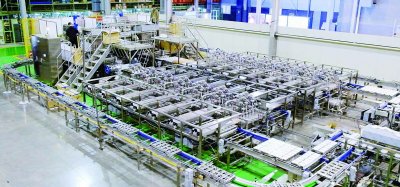
无菌米饭生产线

Search documents
江苏南京:“钢厨师”日做20万份米板 小芯片“种”出人体皮肤
Nan Jing Ri Bao· 2025-11-14 00:17
Core Viewpoint - The 2025 Young Industrial Technology Innovation and Green Development Conference in Nanjing showcased advancements in light industry, emphasizing the shift from traditional manufacturing to intelligent manufacturing driven by technological innovation [1][3]. Group 1: Technological Innovations - Nanjing's light industry is transitioning towards intelligent manufacturing, with companies like Le Ying Technology adopting high-pressure instant sterilization technology for rice production, achieving sterilization in just 45 seconds [3][4]. - Le Ying Technology's automated rice production line can produce 12,000 boxes of rice per hour, totaling 200,000 servings daily, with only six employees required for operation, significantly reducing labor costs compared to traditional methods [5]. - The company reported a 13.83% year-on-year increase in export revenue, with six production lines exported to Japan alone [5]. Group 2: Industry Growth - The number of large-scale light industry enterprises in China increased from 108,700 in 2020 to 140,000 by October this year, with an average annual growth rate of 6.4% [10]. - The average annual revenue growth for these enterprises stands at 4.22% [10]. Group 3: Product Development and Precision - Le Hui International's digital factory in Nanjing achieves a filling accuracy of less than 0.5 grams for bottled beverages, utilizing advanced technology for precise control [6][7]. - The introduction of automated welding robots has reduced welding time by 50% and decreased defect rates by over 70%, enhancing product quality and efficiency [7][8]. Group 4: Biotech Innovations - Jiangsu Aiwei Biotechnology's organ-on-a-chip technology allows for the cultivation of human skin tissue in a controlled environment, facilitating cosmetic safety evaluations and drug testing [9][10]. - This technology offers a cost-effective and standardized solution for drug development and precision medicine [9].


技术赋能、市场织网、营销突围
Nan Jing Ri Bao· 2025-05-13 03:05
Group 1: Overview of Nanjing's Foreign Trade Resilience - Nanjing's foreign trade enterprises are demonstrating strong resilience and vitality amidst global trade uncertainties by leveraging technological innovation, market diversification, and flexible marketing strategies [1] - Companies are striving for high-quality development and aiming to create an upward growth curve despite challenges [1] Group 2: Nanjing Leiying Technology Co., Ltd. - Nanjing Leiying Technology's sterile rice production line, weighing 107 tons and valued at 50 million yuan, is being exported to Japan, showcasing the company's advanced technology and innovation [2] - The company has seen a 13.83% year-on-year increase in export value as of April, successfully expanding into Southeast Asia, the Middle East, and Africa [2] - Leiying Technology's product line includes various central kitchen equipment, and the demand for such equipment has surged due to the trend of centralized kitchen supply chains [2] Group 3: Nanjing High-Speed Gear Manufacturing Co., Ltd. - Nanjing High-Speed Gear's export value reached 462 million yuan from January to April, marking a 7.4% increase, with an expected annual export value of over 1.34 billion yuan, a 20% growth compared to last year [4][5] - The company has maintained its leading position in the global wind power gearbox market, with a market share of one-third of new installations [4] - Nanjing High-Speed Gear has invested over 100 million yuan in quality information technology and has made significant advancements in research and development [4] Group 4: Nanjing Meihua Textile Co., Ltd. - Nanjing Meihua Textile achieved an export value of 18 million USD in the first quarter, reflecting a 10% year-on-year growth [6] - The company has diversified its product offerings from bedding to various home textile products, establishing a flexible supply chain that meets customer demands [6][7] - Meihua Textile has expanded its market reach beyond the U.S. to Europe and South America, increasing its domestic sales proportion from 5% to 30% [7]