星云平台

Search documents
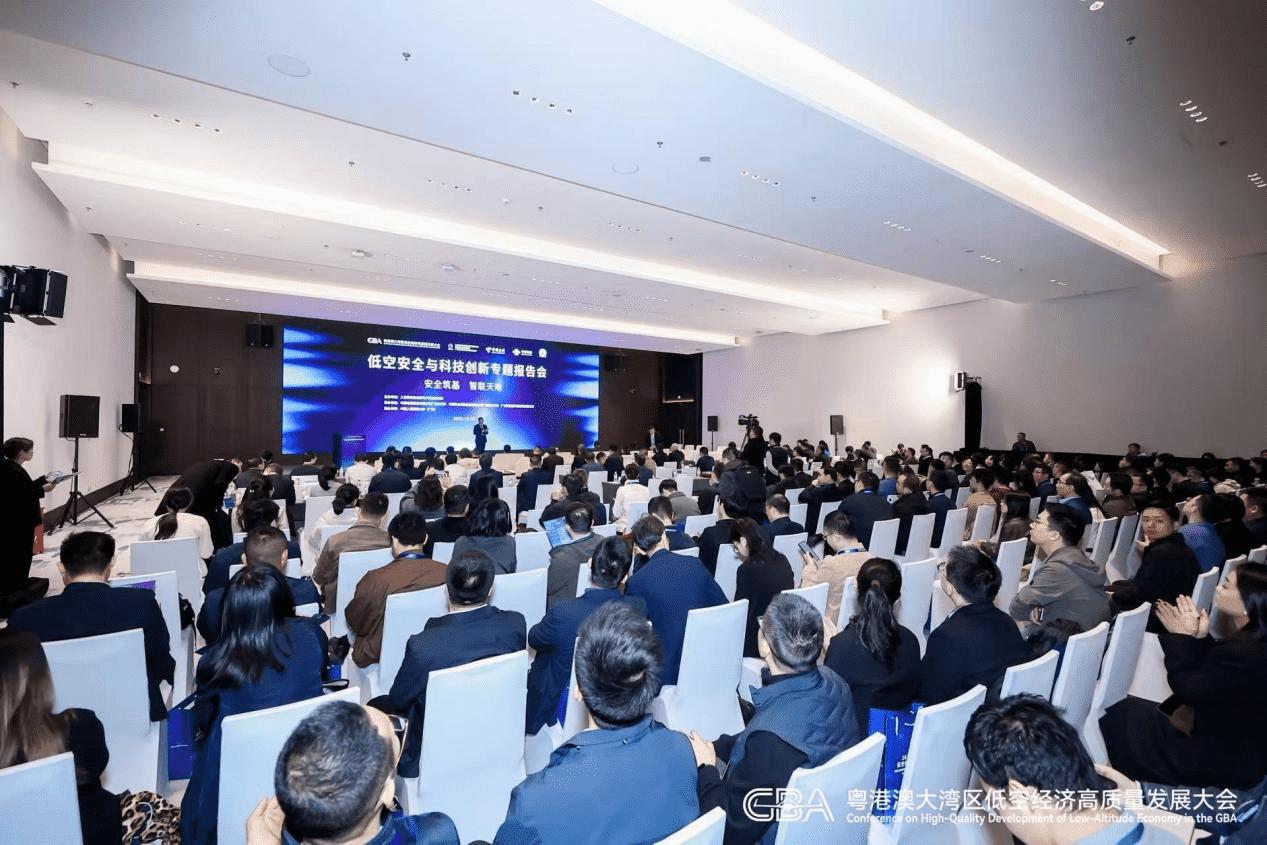
低空安全与科技创新专题报告会召开 共绘低空经济安全发展新蓝图
Zhong Guo Jin Rong Xin Xi Wang· 2025-12-26 00:37
Group 1 - The 2025 Guangdong-Hong Kong-Macao Greater Bay Area Low Altitude Economy High-Quality Development Conference focused on low altitude safety and technological innovation, gathering over 200 representatives from government, industry, academia, and research [1][2] - Safety is emphasized as the foundation for the large-scale and normalized development of the low altitude economy, with challenges in air defense, public safety, flight safety, and information security becoming increasingly prominent [2][5] - The conference highlighted the importance of low altitude infrastructure, including communication, navigation, and monitoring services, as key components for ensuring flight safety [9][11] Group 2 - China Unicom's Guangdong branch is developing a low altitude intelligent network, covering nearly 10,000 square kilometers, which plays a crucial role in network security for drone applications in the province [5] - China Telecom is focusing on cloud-network integration and intelligent governance in low altitude safety, utilizing core technologies like 5G-A and artificial intelligence to create a comprehensive safety system [7] - The release of the "Haizhu District Low Altitude Safety Public Awareness Manual" aims to simplify complex low altitude flight rules for the public, enhancing compliance and community governance [13][15] Group 3 - The conference featured discussions on collaborative mechanisms for low altitude safety and the construction of a public flight route safety assurance system, with experts providing actionable insights [15] - The Ministry of Industry and Information Technology's Electronic Fifth Research Institute aims to deepen technological advancements and promote the integration of safety systems to support the high-quality development of the low altitude economy [15]

冲刺“机器人大脑第一股” 仙工智能再度递表港交所主板
Zheng Quan Shi Bao Wang· 2025-11-28 06:06
Core Viewpoint - The company XianGong Intelligent has submitted its application for listing on the Hong Kong Stock Exchange for the second time this year, with CICC as its sole sponsor, highlighting its strong market position in the robotics sector and its innovative "robot brain" control system [1] Company Overview - XianGong Intelligent focuses on intelligent robotics, providing integrated solutions for development, acquisition, and usage of robots based on its leading control system technology [1] - The company has ranked first in robot controller sales for two consecutive years (2023-2024) according to ZhiShi Consulting [1] Product Offering - Over 2000 robot models have been deployed through the company's platform, covering more than 20 sub-industries including 3C, automotive, automation equipment, new energy, semiconductor, engineering machinery, and biomedicine [2] - The Nebula system offers over 1000 robot models equipped with SRC series controllers, including various types such as wheeled humanoid robots, multi-legged robotic dogs, lifting robots, and cleaning robots [2] - The product portfolio emphasizes industrial deployment of Autonomous Mobile Robots (AMR) and humanoid robots, which differ fundamentally from commercial service robots due to their precision and adaptability to challenging industrial environments [2] Financial Performance - Revenue figures for XianGong Intelligent are as follows: 184 million RMB in 2022, 249 million RMB in 2023, 339 million RMB in 2024, and 158 million RMB for the first half of 2025 [2] - Gross profit for the same periods was 86.29 million RMB, 122 million RMB, 156 million RMB, and 71.69 million RMB, with corresponding gross margins of 46.8%, 49.2%, 45.9%, and 45.4% [2] - The company reported losses of 32.26 million RMB, 47.70 million RMB, 42.31 million RMB, and 50.59 million RMB for the respective years and half-year period [3] Recent Developments - At the Asia International Logistics Exhibition held from October 28 to 31, the company showcased several new products, including advanced intelligent robots and an upgraded Nebula platform [3]

持续深耕工业场景 仙工智能携多款具身机器人新品亮相亚洲物流展
Zheng Quan Shi Bao Wang· 2025-10-31 11:48
Core Insights - The article highlights the participation of XianGong Intelligent at the CeMAT ASIA 2025 exhibition in Shanghai, showcasing various new products including intelligent robots and control systems [1] Product Launches - XianGong Intelligent introduced the X1-PRO robot featuring a bending structure and omnidirectional chassis, capable of 45° bending operations and supporting a standard load of 6kg, with a dual-arm short-term load capacity of 16kg [1] - The X2-PRO robot, developed in collaboration with Stardust Intelligent, is designed for industrial applications and features 25 degrees of freedom, combining a rope-driven upper body and an omnidirectional mobile platform [2] Modular Design and Applications - The X2-PRO's modular design allows for flexible configuration and easy maintenance, enabling rapid adaptation in various industrial scenarios such as warehousing and logistics [2] - A new humanoid robot demonstrated smooth interaction and task execution, showcasing the core capabilities of XianGong's control system and the dexterity of the Stardust rope-driven body [2] New Robotic Products - XianGong Intelligent also presented new robotic dogs, capable of navigating complex environments with features like 3D autonomous navigation and AI-enhanced decision-making [2] - The D1-W series robotic dog offers a high-strength body with IP54 protection, suitable for diverse indoor and outdoor applications, while the D2-W series includes patrol capabilities with integrated thermal imaging and audio-visual alert systems [3] Competitive Advantages - XianGong's robotic dogs are noted for their integrated controllers and ease of use, allowing factory clients to seamlessly combine them with other XianGong products without needing to learn different operating systems [3] Strategic Development - The company is implementing a "dual flywheel" strategy to accelerate the deployment of humanoid robots and embodied intelligence, aiming to create a comprehensive ecosystem from core components to application scenarios [4]
站在内容创作者与机器人的交界处:聊聊3D数字人的进化
3 6 Ke· 2025-10-29 11:24
Core Insights - The rise of 3D digital humans is transforming content creation and interaction, moving from rigid, scripted avatars to dynamic, responsive entities capable of real-time expression and movement [1][2] - The technology behind 3D digital humans is evolving, with significant advancements in AI and rendering techniques that reduce costs and improve quality [7][36] - The integration of 3D digital humans into various industries, including gaming and film, is expected to grow, with potential applications in customer service and interactive experiences [1][12] Group 1: Technological Advancements - 3D digital humans have progressed from basic, scripted models to sophisticated entities that can generate voice, expressions, and movements in real-time [1][2] - The introduction of models like Sora2 demonstrates the potential for generating human-like actions and interactions, although challenges remain in error correction and precise control [3][5] - The combination of 2D and 3D training techniques is being explored to enhance the expressiveness and accuracy of digital humans [5][7] Group 2: Cost Efficiency - The cost of creating and deploying 3D digital humans is significantly lower than traditional methods, with estimates suggesting costs are a fraction of those associated with large models [7][36] - AI rendering and calculation techniques have enabled the use of inexpensive hardware to run complex 3D models, making the technology more accessible [36][38] - The ability to generate high-quality 3D content without the need for expensive graphics engines or hardware is a game-changer for the industry [36][39] Group 3: Industry Applications - 3D digital humans are being positioned as the next generation of content producers, with applications in live streaming, customer service, and entertainment [2][12] - The technology is expected to bridge the gap between virtual and physical interactions, enhancing user experiences in various sectors [1][12] - The potential for 3D digital humans to be integrated into VR and AR environments opens new avenues for immersive experiences [5][12] Group 4: Data and Model Development - The accumulation of high-quality 3D animation data is crucial for training effective AI models, with the company claiming to have over 1,000 hours of such data [24][25] - The integration of video data with 3D data is being pursued to improve model training and enhance the realism of digital human interactions [25][26] - The development of a "3D action model" is underway, which aims to automate the generation of 3D motion data for robots, further bridging the gap between digital and physical realms [46][48] Group 5: Future Prospects - The company aims to transition from a 3D digital human provider to a platform that enables other developers to create applications using their technology [12][13] - The potential for 3D digital humans to impact the film industry is acknowledged, although challenges in achieving the high-quality standards of Hollywood remain [33][34] - The ongoing evolution of AI and robotics suggests a promising future for the integration of 3D digital humans in various applications, with expectations for significant advancements in the coming years [57][59]