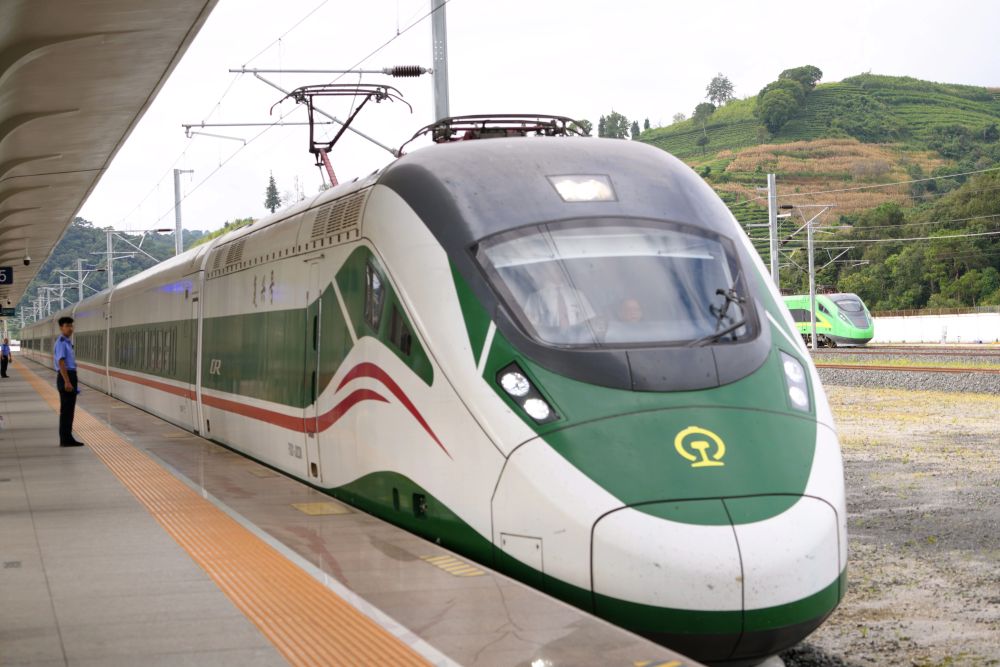
星光·澜湄号

Search documents
“流动的云南”生机勃勃
Xin Lang Cai Jing· 2026-02-08 21:40
Core Insights - In 2025, Yunnan's railway transportation achieved historic breakthroughs, with over 100 million passengers transported, a year-on-year increase of 5.8%, and over 75 million tons of cargo, an increase of nearly 700,000 tons [1] Group 1: Passenger Transport - Yunnan's railway passenger transport saw a significant increase, with over 100 million passengers transported in 2025, marking a 5.8% year-on-year growth [1] - The introduction of new tourist trains and services has enhanced the travel experience, with 67 quality tourist trains and 79 special trains launched for events and festivals [6][7] - The "Train Tour of Yunnan" initiative has successfully transported 556,000 passengers, linking scattered tourist resources and boosting the local tourism economy [7] Group 2: Cargo Transport - The China-Laos Railway has become a vital international logistics corridor, with cross-border cargo volume reaching 10,128 TEUs, a 100.6% increase year-on-year [2] - In 2025, cross-border cargo transport exceeded 5.46 million tons, a 17.9% increase, with a diverse range of goods being transported between China and ASEAN countries [4] - The demand for cold chain transport has surged, with significant increases in the transportation of fruits and vegetables between China and Laos [4] Group 3: Economic Impact - The robust growth in railway transport has contributed to the economic resilience of Yunnan, enhancing connectivity and facilitating trade with Southeast Asia [1][3] - The railway network supports regional economic development by meeting the transportation needs of various goods, including natural rubber and electric vehicles [3][4] - The railway's role extends beyond transportation, acting as a "mobile platform" that stimulates local economies and meets the needs of the population [7]
2025年云南铁路发送旅客超1亿人次
Xin Lang Cai Jing· 2026-01-25 21:22
Core Insights - In 2025, the Kunming Railway Bureau is expected to achieve significant milestones in passenger and freight transportation, with over 100 million passengers and more than 75 million tons of goods transported, marking a year-on-year increase of 5.8% and nearly 70,000 tons respectively [1][2]. Passenger Transport - The Kunming Railway Bureau is optimizing its operational capacity and transportation organization to maximize peak period capacity, with a projected increase of over 10% in peak capacity during key holiday periods in 2025, achieving a record single-day passenger volume of over 606,000 [1]. - To cater to diverse travel needs, the bureau is launching 67 quality tourism trains and 79 special trains for festivals, events, and exhibitions, enhancing the travel experience for passengers [1]. - The "Train Tour Yunnan" circular tourism trains have transported a total of 556,000 passengers across various stations including Kunming, Dali, Baoshan, Lijiang, Xishuangbanna, and Pu'er [1]. Freight Transport - The Kunming Railway Bureau is leveraging the advantages of the China-Laos Railway and the China-Vietnam corridor to introduce innovative international freight services, including the "Lancang-Mekong Express + China-Europe Railway" and other intermodal transport products, facilitating logistics from Laos and Thailand to Europe [2]. - The bureau aims to meet the large-scale transportation needs for natural rubber, tropical fruits from Southeast Asian countries, and various products from China, including new energy vehicles and construction materials [2]. Digital Transformation - The Kunming Railway Bureau is advancing its digital transformation by optimizing the 95306 platform for online services and enhancing full-process service guarantees [3]. - A priority mechanism for the handling of fruits has been implemented to improve transportation efficiency, reducing the transit time from Vientiane, Laos to Kunming, China to 27 hours [3].
中老铁路开行旅客列车超8万列
Xin Hua She· 2025-09-21 08:42
Core Insights - The China-Laos Railway has seen significant growth in passenger traffic, with over 80,000 trains operated and more than 59 million passengers sent as of September 20, 2023 [1][3] - The introduction of international passenger trains between Kunming and Vientiane has greatly facilitated cross-border travel and tourism for citizens of both countries [1][3] Passenger Traffic Growth - Since its opening nearly four years ago, the railway has experienced a robust increase in passenger volume, with monthly passenger numbers rising from 600,000 to over 1.6 million [3] - The domestic segment has increased daily train operations from 8 to a peak of 86, cumulatively sending 48.6 million passengers [3] - The Laos segment has expanded its daily train operations from an initial 4 to a peak of 18 [3] Service Enhancements - To meet travel demand, the railway department has optimized train schedules, increasing the number of cross-border passenger seats from 250 to 420 per day, and the number of entry and exit passengers from 300 to a maximum of 1,300 [3] - Special tourist trains such as "Starry Sky·Lancang-Mekong," "Train Tour in Yunnan," and "Elephant Journey" have been launched, along with dedicated ticket purchase windows for international travelers at stations [3] - The railway has also introduced foreign bank card payment options and supports various foreign traveler identification for ticket purchases, enhancing the overall travel experience [3]

人均3万,餐饮“翻车”:中国没有真正的高端旅游专列
虎嗅APP· 2025-08-30 10:09
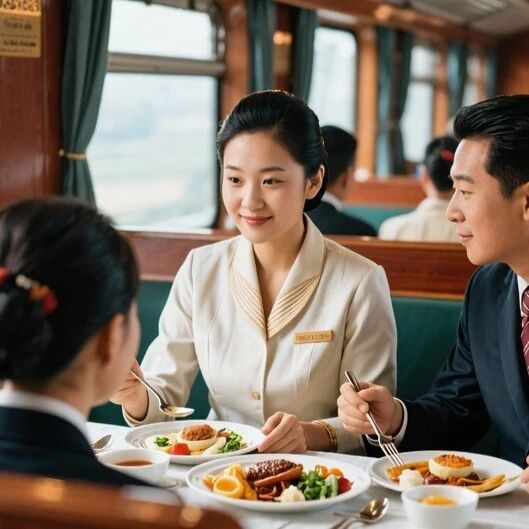
Core Viewpoint - The recent "Panda Special Train" dining incident highlights the lack of truly high-end tourism trains in China, despite the existence of expensive options [3][21][22]. Group 1: Incident Overview - A family from Jilin spent 960,000 yuan (approximately 96,000 million) for a 17-day trip on the "Panda Special Train," expecting high-quality dining but received subpar meals [3][4][5]. - The promotional materials for the train featured appealing food presentations, which were not reflected in the actual dining experience, leading to public outrage [5][8]. Group 2: Market Analysis - The high-end tourism train market in China emerged recently, capitalizing on the halt of outbound tourism during the pandemic and targeting high-net-worth individuals [5][6]. - Since 2022, domestic tourism consumption has shown a "K-shaped differentiation," with a split between high-value experiences and high-emotional-value experiences [6][7]. Group 3: Service Quality Issues - The main issue with high-end tourism trains is that while hardware improvements have been significant, the service quality has not kept pace [12][13]. - The operational teams often lack the necessary expertise, leading to a disconnect between the luxury expectations and the actual service provided [14][15][16]. Group 4: Customer Expectations - Customers expect high-end dining experiences comparable to Michelin standards and a leisurely travel pace, but often face rushed itineraries and inadequate service [16][17]. - The ideal high-end tourism train experience should include unique features, high-quality service, and attention to detail, similar to successful international models [18][19][20]. Group 5: Market Potential - Despite current shortcomings, the willingness of consumers to spend significantly on high-end train experiences indicates a substantial market potential for future development [22][23].
乘列车中老跨境游,体验便捷的“泛亚铁路”
Huan Qiu Shi Bao· 2025-04-23 22:40
Core Insights - The opening of the China-Laos Railway has significantly enhanced cross-border travel and tourism between China and Laos, with a notable increase in international passenger numbers and tourism-related economic growth [1][2][9] Group 1: Economic Impact - The China-Laos Railway has facilitated the transportation of 1.91 million passengers over two years, including 487,000 cross-border travelers, contributing to the growth of the tourism industry along the route [1] - In the first quarter of this year, the number of tourists visiting Luang Prabang increased by 162% year-on-year, with the province's GDP reaching $18.3 million, largely driven by tourism [2] - The railway has led to a 40% increase in wages for certain jobs in Laos, as Chinese investments have created more employment opportunities [4] Group 2: Tourism Development - The introduction of the "Starry·Lanmei" cross-border tourist train has connected Kunming to Vientiane, promoting tourism and cultural exchange between the two countries [5][7] - Chinese tourists have become the largest group of visitors to Luang Prabang, surpassing traditional markets like Thailand and Vietnam since the railway's opening [3] - The railway has made travel between Luang Prabang and Vientiane much more efficient, reducing travel time from over 10 hours by bus to under 2 hours by train [2] Group 3: Employment Opportunities - Local guides and service workers, such as Annu and Alin, report significant income increases due to the influx of Chinese tourists and the demand for bilingual services [3][4] - The railway has created diverse job opportunities in tourism, hospitality, and infrastructure development, benefiting local communities [4][5] Group 4: Future Prospects - The expansion of the railway network and the promotion of tourism products are expected to attract more international visitors, enhancing Laos' appeal as a travel destination [9][10] - The ongoing development of infrastructure and tourism initiatives is anticipated to further integrate Laos into the regional economy, particularly with the advancement of the Pan-Asian railway vision [10]