
星域CDN

Search documents
中国下载网事:那些年,我们在深夜等一个“叮”
3 6 Ke· 2026-02-09 01:40
Core Insights - The article reflects on the evolution of Xunlei (Thunder) as it celebrates its 23rd anniversary, highlighting its journey from a download tool to a broader service provider in the digital content landscape [1][2][28] Group 1: Historical Context - Xunlei was launched in 2003, addressing the significant pain point of slow download speeds in an era when internet usage was primarily about downloading files to local storage [3][4][5] - The introduction of P2SP technology allowed Xunlei to enhance download speeds by utilizing both server and peer-to-peer resources, revolutionizing the downloading experience for users [8][9] - By 2006, Xunlei had surpassed 100 million users, becoming the most popular download software in China, alongside other applications like QQ and Baofeng Video [9] Group 2: Market Dynamics - The period from 2005 to 2007 marked Xunlei's golden age, as the rapid expansion of broadband users transformed download tools into essential infrastructure for home computers [10][11] - Xunlei became a major content distribution channel during a time when copyright regulations were still developing, allowing for widespread sharing of digital content [11][12] - The introduction of premium services in 2009, such as membership-based high-speed downloads, provided Xunlei with a stable revenue stream and redefined user engagement [12][13] Group 3: Industry Challenges - The rise of 4G technology and streaming services around 2014 significantly altered user behavior, leading to a decline in the necessity for traditional downloading tools [16][17][18] - Many once-popular download tools, including Xunlei's competitors, began to fade from the market as users shifted towards streaming and cloud services [19][20] - Regulatory actions aimed at copyright protection further diminished the viability of traditional downloading methods, marking the end of an era for free content sharing [20] Group 4: Transformation and Future Outlook - In response to industry changes, Xunlei began diversifying its offerings in 2015, venturing into cloud computing and CDN services, thus transitioning from a download tool to a comprehensive service provider [22][23] - The company has expanded its product matrix to include cloud storage, media players, and game accelerators, maintaining a user base of over 7 million members [24] - Despite the shift in content consumption methods, the concept of downloading has been redefined, becoming more integrated into cloud services, reflecting a broader change in user expectations and behaviors [24][25]



迅雷起诉前CEO陈磊:隐秘掏空公司,操控带宽供应商进行利益输送,追索资产2亿元!后者长期居留海外,此前双方各执一词
Sou Hu Cai Jing· 2026-01-15 18:29
Core Viewpoint - The ongoing legal dispute between Xunlei (XNET) and its former CEO Chen Lei has escalated into a civil lawsuit seeking 200 million yuan, highlighting issues of asset misappropriation and corporate governance within the company [1][3]. Group 1: Legal Proceedings - Xunlei and its subsidiary, Shenzhen Wangxin Technology Co., have filed a civil lawsuit against Chen Lei and other former executives, claiming damage to company interests and seeking to recover 200 million yuan [1][3]. - The lawsuit is a continuation of a previous criminal case initiated in 2020, which was dropped due to insufficient evidence [5][8]. - The civil lawsuit allows Xunlei to pursue claims with a lower burden of proof compared to criminal cases, focusing on the plausibility of the claims rather than the strict standards of criminal evidence [5][8]. Group 2: Background of the Dispute - The dispute centers around Shenzhen Xingronghe Technology Co., a bandwidth supplier allegedly controlled by Chen Lei, with accusations of improper benefit transfers [1][7]. - Chen Lei claims that Xingronghe was established as a "shadow system" by Wangxin Technology to mitigate risks, while Xunlei argues that its establishment lacked proper board approval and oversight [8][9]. - The conflict has roots in management changes at Xunlei, with Chen Lei being replaced as CEO in 2020 amid allegations of mismanagement and asset misappropriation [10][11]. Group 3: Financial Performance - Xunlei has experienced fluctuating financial performance, with total revenue of 324 million USD in 2024, a decline of 11.1% year-over-year, primarily due to reduced cloud computing services [11]. - The company reported a net profit of 23.9 million USD based on non-GAAP measures, indicating a recovery from previous losses [11]. - Xunlei's stock price has significantly decreased from its initial public offering price of 12 USD per share in 2014, currently trading at 7.7 USD per share [12].
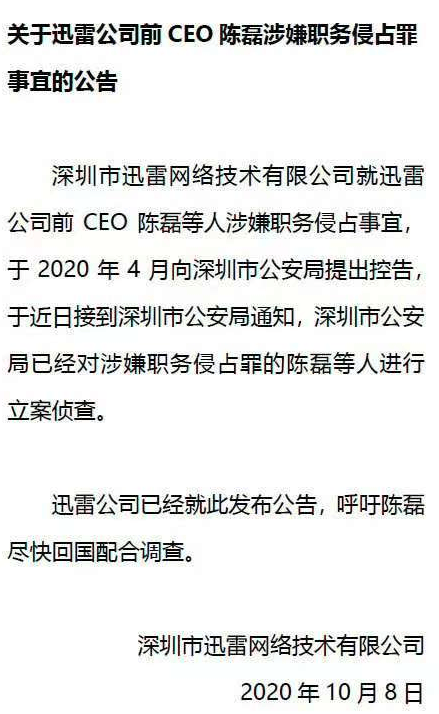
时隔6年,迅雷再诉前CEO陈磊:一场正义终至的司法清算
Sou Hu Cai Jing· 2026-01-15 05:17
Core Viewpoint - The lawsuit filed by Xunlei against former CEO Chen Lei highlights issues of asset misappropriation and corporate governance within the company, stemming from a tumultuous leadership transition six years ago [2][9]. Group 1: Background of the Case - Chen Lei joined Xunlei in 2014 as CTO and became CEO in 2017, but by 2020, he was accused of asset misappropriation and fled overseas to evade legal consequences [2][5]. - Under Chen's leadership, Xunlei's subsidiary, Wangxin Technology, expanded its product offerings but reported continuous financial losses [3][4]. Group 2: Financial Performance - Xunlei's 2019 financial report indicated total revenue of $181 million, a year-on-year decrease of 21.9%, with a net loss of $53.4 million, worsening from a net loss of $40.8 million in 2018 [4]. Group 3: Misappropriation Mechanisms - Chen Lei established a company named "Xing Ronghe" in 2018, which was used to facilitate the misappropriation of funds from Xunlei through inflated transactions and asset transfers [6][8]. - Between January 2019 and April 2020, Chen arranged for approximately $200 million to be paid from Wangxin to Xing Ronghe, including a suspicious transfer of over $20 million just days before his dismissal [7][8]. Group 4: Corporate Governance and Anti-Corruption - The case underscores the challenges of corporate governance and the need for effective anti-corruption measures, particularly at the executive level, as high-ranking officials often exploit their knowledge of internal operations to conceal wrongdoing [9][10]. - Xunlei's lawsuit against Chen Lei is seen as a critical step towards restructuring corporate governance and enhancing compliance within the company [10].

时隔6年,迅雷再诉前CEO陈磊:一场正义终至的司法清算
Zhong Jin Zai Xian· 2026-01-15 04:03
Core Viewpoint - The lawsuit filed by Xunlei against former CEO Chen Lei highlights issues of asset misappropriation and corporate governance within the company, stemming from a power struggle that began six years ago [1][2]. Group 1: Background of the Case - Chen Lei joined Xunlei in 2014 as CTO and was promoted to CEO in 2017, but by 2020, he was accused of asset misappropriation and fled overseas to evade legal consequences [1][2]. - Under Chen's leadership, Xunlei's subsidiary, Wangxin Technology, launched several products but faced continuous financial losses, with a reported revenue decline of 21.9% in 2019, totaling $181 million, and a net loss of $53.4 million [2]. Group 2: Mechanisms of Misappropriation - Chen Lei established a company named "Xingronghe" in 2018, which became a vehicle for asset misappropriation by facilitating transactions that transferred funds from Wangxin to Xingronghe [3][5]. - Chen allegedly arranged for Wangxin to pay approximately $200 million to Xingronghe through inflated transactions, with significant funds being transferred just days before his dismissal [3][5]. Group 3: Corporate Governance and Anti-Corruption Measures - The case underscores the challenges of corporate governance and the need for robust anti-corruption measures, particularly in high-level management, where individuals may exploit their knowledge of internal operations [6][7]. - Xunlei's lawsuit against Chen Lei is seen as a critical step towards restructuring governance and compliance, aiming to deter internal fraud and enhance transparency within the organization [7].