
星载计算单元

Search documents
三体计算星座编织全球最强太空算力网
Ke Ji Ri Bao· 2026-02-13 07:11
Core Insights - The article discusses the successful deployment and testing of the "Three-body Computing Constellation," which focuses on water environment monitoring and has achieved significant advancements in space-based artificial intelligence applications [1][2]. Group 1: Technological Achievements - The Three-body Computing Constellation has successfully completed a full-link capability verification involving satellite payload operation, on-orbit data processing, inter-satellite collaboration, and model computation [1]. - A total of 10 artificial intelligence models have been deployed and validated in orbit, including the largest parameter models globally, such as the 8 billion parameter space-based remote sensing model and the 8 billion parameter space-based astronomical time-domain model [2]. - The overall on-orbit computing power of the constellation has reached 5 petaflops (5POPS), capable of supporting the deployment and inference of models with up to 140 billion parameters, making it the largest space computing constellation in the world [5]. Group 2: Applications and Innovations - The deployed AI models have successfully executed multiple on-orbit tasks, including infrastructure surveys in challenging weather conditions, demonstrating the practical applications of space-based AI [2][3]. - The astronomical research capabilities have been enhanced through the deployment of a space-based astronomical time-domain model, which significantly reduces data transmission volume and processing time while maintaining a high event identification accuracy of 99% [3]. - The integration of a space-based distributed operating system has allowed for unified management and scheduling of computing resources, enhancing the efficiency of constellation operations [4]. Group 3: Future Prospects - The Three-body Computing Constellation aims to drive innovation in space research paradigms, particularly in areas such as deep space exploration and smart city development, by leveraging advanced AI capabilities [1][2]. - The successful inter-satellite networking and ground-satellite integration mark a significant step towards breaking down barriers between satellite networks and terrestrial internet [3].
三体计算星座实现星间组网突破 十个AI模型完成在轨验证
Huan Qiu Wang Zi Xun· 2026-02-13 01:05
Core Insights - The article discusses the successful deployment and testing of the "Three-body Computing Constellation," which focuses on water environment monitoring and other applications in space computing [1][3][5] Group 1: Technological Achievements - The Three-body Computing Constellation has achieved a breakthrough in inter-satellite networking, successfully deploying and validating 10 artificial intelligence models in orbit [1][3] - The constellation's first mission, launched on May 14, 2025, included 12 satellites, which have demonstrated core capabilities in networking, computation, model deployment, and scientific payload verification [3][5] - The deployed models include the world's largest parameter-scale models in orbit, such as an 8 billion parameter space-based remote sensing model and an 8 billion parameter space-based astronomical time-domain model [3][5] Group 2: Operational Efficiency - The AI models have significantly improved operational efficiency, reducing data transmission from hundreds of MB to tens of KB, and processing time from hours to seconds while maintaining a 99% event identification accuracy [5] - The overall on-orbit computing power of the constellation has reached 5 P OPS, capable of supporting the deployment and inference of models with up to 140 billion parameters, making it the largest space computing constellation globally [7] Group 3: Future Applications - The Three-body Computing Constellation is exploring innovative applications in deep space exploration, smart city construction, and natural resource surveys [1][3] - The deployment of AI models in space is expected to transform the paradigm of space research, particularly in fields like astronomy [5][6]

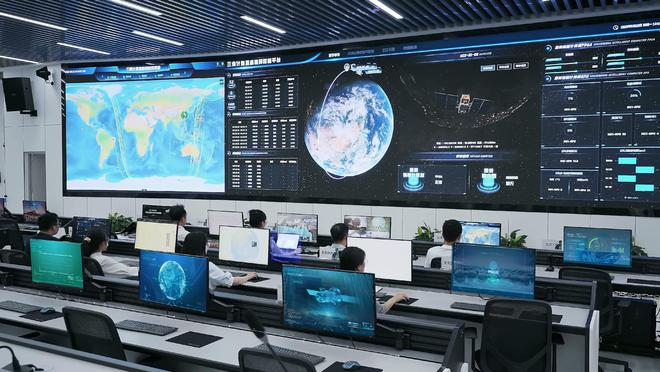
10个AI模型完成在轨验证 三体计算星座编织全球最强太空算力网
Ke Ji Ri Bao· 2026-02-13 00:41
Core Insights - The article discusses the successful deployment and testing of the "Three-body Computing Constellation," which focuses on water environment monitoring and has achieved significant advancements in space-based artificial intelligence applications [1][2][3] Group 1: Technological Advancements - The Three-body Computing Constellation has successfully completed a series of tests, demonstrating its full-chain capabilities from satellite payload operation to on-orbit data processing and inter-satellite collaboration [1] - The constellation has deployed 10 artificial intelligence models, including the largest space-based remote sensing model and astronomical time-domain model, each with 8 billion parameters, marking a significant milestone in on-orbit model deployment [2] - The overall on-orbit computing power of the constellation has reached 5 petaflops (5POPS), capable of supporting models with up to 140 billion parameters, making it the largest space computing constellation globally [3] Group 2: Applications and Impact - The deployed AI models have successfully executed multiple on-orbit tasks, including infrastructure surveys in snowy conditions, showcasing the practical applications of space-based AI in urban planning and resource management [2] - The astronomical research capabilities have been enhanced through the deployment of a cosmic X-ray polarization detector, which allows for rapid classification of gamma-ray bursts, significantly reducing data transmission and processing times [2] - The integration of satellite networks with ground internet has been achieved, breaking down barriers and enabling more efficient management and scheduling of computational resources across the constellation [3]
浩瀚深度联合一苇宇航 聚焦6G星地一体化通信及智能化应用场景
Zhong Zheng Wang· 2026-01-16 13:59
Group 1 - The core viewpoint of the news is the strategic partnership between Beijing Haohan Deep Information Technology Co., Ltd. and Yiyu Aerospace (Beijing) Technology Co., Ltd. to establish a joint laboratory focused on space computing infrastructure and application ecosystem development [1][2] - The collaboration will emphasize high-performance computing on satellites, 6G integrated communication, and intelligent application scenarios, aiming to accelerate the engineering and scaling of space computing capabilities [1] - Yiyu Aerospace will invest in core hardware products such as space servers and satellite computing units, while Haohan Deep will leverage its advantages in data exchange and intelligent data processing to support the integration of ground and space data systems [1] Group 2 - This strategic cooperation signifies a substantial integration of data intelligence and space computing technologies, potentially leading to standardized and scalable applications in space computing systems [2] - The joint laboratory mechanism is expected to create a demonstrative effect for replicable and promotable space computing solutions, contributing to the overall upgrade of China's space computing infrastructure and satellite intelligence industry ecosystem [2]
