
景顺中国科技ETF(CQQQ)

Search documents
美国投资者爆买中国科技ETF
3 6 Ke· 2025-12-18 09:48
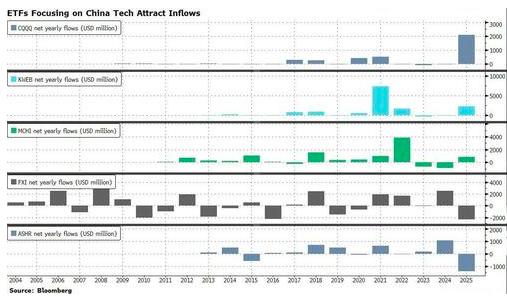
Group 1 - American investors are increasingly attracted to China's technology sector, with significant capital inflows into U.S.-listed ETFs focused on Chinese tech stocks, while non-tech funds are experiencing outflows [1][3] - The largest Chinese stock ETF in the U.S., KraneShares China Internet ETF (KWEB), has attracted $2.3 billion this year, potentially marking its best annual performance since 2021 [3] - In contrast, traditional sector-focused ETFs like iShares China Large-Cap ETF (FXI) have seen a net outflow of $2.3 billion this year [3] Group 2 - Analysts suggest that the launch of DeepSeek and trade tensions initiated by former President Trump have contributed to the inflow of funds into Chinese tech ETFs [3] - Citigroup's economists believe that China is rapidly catching up in both models and hardware in the AI sector, with 2025 being a pivotal year for narrowing the gap with the U.S. [4] - Despite the competitive landscape, U.S. investors are continuing to invest in Chinese companies involved in AI, with significant interest from hedge funds and venture capital firms [7] Group 3 - Ruffer, a London-based investment firm, sees further upside for Chinese tech giants due to their lower price-to-earnings ratios compared to U.S. counterparts like Alphabet [10] - The chief investment officer of Krane Funds Advisors LLC highlights that the companies within KWEB are experiencing stock buybacks and attractive valuations, suggesting a potential revaluation of Chinese stocks by 2026 [10] - Major U.S. investment firms, including Vanguard and BlackRock, have increased their holdings in Alibaba, indicating a growing confidence in Chinese tech stocks [7][10]

富时罗素CEO Fiona Bassett:未来6到12个月 欧洲主权财富基金和养老基金或增加中国配置
Zhong Guo Ji Jin Bao· 2025-11-17 16:35
Group 1: Core Insights - FTSE Russell anticipates that European sovereign wealth funds and pension funds may increase their allocation to China in the next 6 to 12 months, viewing China as an independent asset class rather than just part of emerging markets [1][6] - Global investors are shifting from defensive cash and short-duration bonds to risk assets, including developed and emerging market equities and bonds, with a notable flow of new funds into Chinese and Greater China assets [2][6] - The upgrade of Vietnam's market from frontier to secondary emerging market status by FTSE Russell is expected to facilitate easier access for global investors, although the impact on other emerging markets is minimal [1][8] Group 2: European Investor Concerns - European institutional investors are facing a complex environment shaped by structural, macroeconomic, and regulatory challenges, including high stock valuations, interest rate uncertainty, and geopolitical tensions [4] - There is a growing interest among European asset managers in diversifying their portfolios away from overexposed positions in the US and Europe, with a focus on China's leadership in technology and artificial intelligence [6][4] Group 3: Investment Trends - The demand for Chinese indices, particularly those focused on technology, artificial intelligence, and electric vehicles, is increasing among global investors, with significant inflows into products like the Invesco China Technology ETF [7] - The transition of Vietnam to a secondary emerging market is expected to attract approximately $1 to $1.5 billion in passive fund inflows, with active management inflows projected to be 4 to 5 times that amount [9][8] Group 4: ESG Investment Evolution - There is a notable shift in investor behavior towards more integrated and thematic approaches to ESG investing, with a focus on understanding how ESG factors impact investment returns [11] - Regulatory frameworks in Europe, such as the Corporate Sustainability Reporting Directive (CSRD), are enhancing corporate disclosure standards, which is crucial for ESG investment transparency [11]