指数服务

Search documents
富时罗素亚太区股票及多资产指数联席主管闫岩:积极搭建国际与中国资本互联互通桥梁
Zhong Guo Ji Jin Bao· 2026-02-19 07:54
Core Viewpoint - 2025 is a pivotal year for the resumption of Sino-British financial dialogue and the accelerated high-quality development of China's capital market [1][2] Group 1: Market Developments - Significant achievements in China's capital market include institutional opening, increased long-term capital inflow, and expansion of new productive assets [1] - The Shanghai-Hong Kong Stock Connect's activity has steadily increased, and the QFII/RQFII investment scope has been optimized [1] - The total market capitalization of A-shares has surpassed 100 trillion yuan, with annual trading volume exceeding 400 trillion yuan and average daily trading over 17 trillion yuan [1] Group 2: ETF Market Growth - The Chinese ETF market has grown from non-existence to over 1,000 products and nearly 4 trillion yuan in total scale by the end of 2024 [2] - Passive index fund management scale has historically surpassed active equity funds, marking a significant shift in investment strategies [2] - The management scale of ETFs is expected to exceed 6 trillion yuan in 2025, positioning it as the largest in Asia [2] Group 3: International Integration - The company has actively integrated into China's high-level opening-up, establishing bridges for international and Chinese capital connectivity [3] - The launch of the FTSE China A50 Index and the iShares FTSE China A50 ETF marked significant milestones in tracking Chinese A-shares [3] - The company plans to continue enhancing cooperation with market participants and introduce more innovative index products to support cross-border index ecosystems [3]
中证指数:截至2025年底全球ETF资产规模达到19.85万亿美元
智通财经网· 2026-02-11 12:18
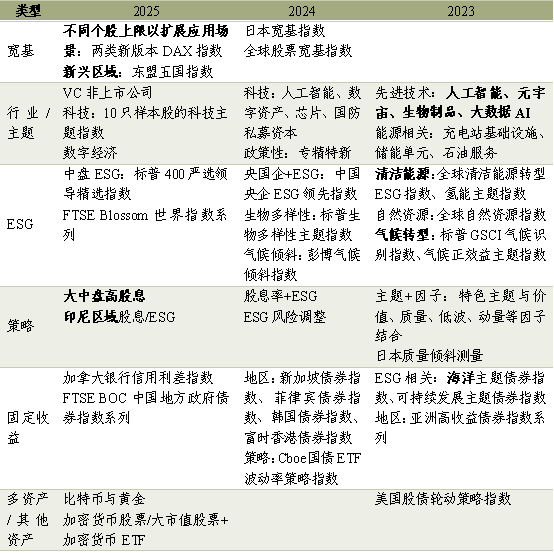
Group 1: Global Index Investment Trends - The global index investment scale is reaching new heights, with ETF assets expected to reach $19.85 trillion by the end of 2025, driven by policy support and increasing demand for index investment [1][7][47] - Smart Beta ETFs are leading the diversification of products, while technology-themed ETFs are gaining significant attention, and low-risk fixed income ETFs continue to attract market interest [1][7][24] - The global ETF market is experiencing growth in both equity and fixed income categories, with equity ETFs being the primary tool for asset allocation [7][10] Group 2: Domestic Index Investment Development - By the end of 2025, there will be 3,433 index products in the domestic market, with a total scale of 7.23 trillion yuan, reflecting a growth of 44.32% compared to the previous year [1][32] - The domestic index investment ecosystem is continuously improving, with a focus on policy-driven growth, supply-demand dynamics, and accelerated innovation [1][32][47] - The bond index products are particularly notable for their rapid growth, with a year-on-year increase of 60.91% [32][46] Group 3: Innovations in Index Products - Internationally, index innovation is focusing on expanding underlying asset types and enhancing regional index systems, with a notable increase in thematic and strategy-based products [4][5][6] - The Smart Beta ETF market is transitioning from slow growth to a period of significant expansion, with a 47.6% year-on-year increase in the number of products [20][22] - The ESG ETF market is evolving from a focus on principles to practical implementation, with total assets reaching $776.7 billion by the end of 2025 [16][18] Group 4: Thematic and Fixed Income ETFs - Thematic ETFs are increasingly concentrated among leading issuers, with a focus on technology, climate, and healthcare sectors, reflecting ongoing market preferences [24][26] - Fixed income ETFs are experiencing significant inflows, particularly in the U.S., where net inflows reached a record high of over $420 billion in 2025 [27][29] - The demand for short-term liquidity management products is driving the expansion of fixed income ETF scales, meeting low-risk investment needs [47]

富时罗素推迟印尼指数审查
Xin Lang Cai Jing· 2026-02-10 08:47
Core Viewpoint - The postponement of the review of the Indonesian index by FTSE Russell due to uncertainties in stock trading freedom represents a significant setback for Southeast Asia's largest economy, which is facing criticism regarding its stock trading and transparency [1][3]. Group 1: FTSE Russell's Decision - FTSE Russell announced the postponement of the scheduled review of the Indonesian index originally set for March, citing feedback from a committee of investment professionals and concerns over unfavorable trading volumes and uncertainties in determining the accurate free float percentage of Indonesian securities [4]. - As of now, newly listed Indonesian stocks will not be added to FTSE Russell's products, nor will there be updates to reflect changes typically included in regular index reviews, such as additions, deletions, or weight changes [4]. Group 2: Impact on Indonesian Market - The Jakarta Composite Index (JKSE) has already lost approximately $120 billion due to warnings from MSCI about the potential downgrade of Indonesia to frontier market status [1][3]. - Moody's downgraded the country's credit rating outlook last week, further impacting investor confidence [4]. Group 3: MSCI's Actions - MSCI has also frozen updates for Indonesian securities in its products, which are widely used as benchmarks by investors, with billions of dollars in passive funds tracking these indices [2][5]. - The decisions made by both FTSE Russell and MSCI can significantly influence capital flows in and out of Indonesia [2][5].
丰富基金产品业绩比较基准,中证指数有限公司首次发布15条债券全价指数
Sou Hu Cai Jing· 2026-01-05 14:28
Core Viewpoint - China Securities Index Co., Ltd. has launched 15 bond full-price indices, including the China Bond Index, to enhance the representation of the domestic bond market [1] Group 1: Index Launch and Features - The newly released indices are derived from existing indices using a full-price calculation method, covering key domestic bond types [1] - The China Bond Index includes government bonds, financial bonds, corporate bonds, and company bonds, reflecting the overall performance of the Chinese bond market [1] - The index family now includes five calculation methods: total return, after-tax total return, net price, interest and reinvestment, and full price, catering to various investment scenarios [1] Group 2: Market Coverage and Growth - China Securities Index has published over 850 bond indices, covering all domestic bond types, including government bonds, local government bonds, credit bonds, interbank certificates of deposit, convertible bonds, and asset-backed securities [1] - The rapid growth of bond ETFs has significantly increased the attention on bond indices, with the domestic bond ETF scale surpassing 810 billion yuan, and over 80% of this being managed by China Securities Index [1] - More than 2,200 public funds use the indices managed by China Securities Index as performance benchmarks [1] Group 3: Future Developments - The company plans to further enrich the bond index series to provide more diverse targets for passive index products and develop performance benchmarks that better meet the actual investment needs for actively managed products [2]
MSCI Isn't Wrong to Be Cautious on DATs
Yahoo Finance· 2025-12-13 16:00
Core Viewpoint - MSCI is considering the exclusion of digital asset treasuries (DATs) from its indexes, which has caused significant concern within the crypto community, especially after JP Morgan's mention of "Operation Chokepoint" [1] Group 1: MSCI's Role and Index Methodology - MSCI is a major index provider with over $18 trillion in ETFs and institutional assets linked to its benchmarks, emphasizing investor protection in its index methodology [2] - The approval of an asset for inclusion in MSCI's indexes carries substantial influence, raising questions about whether DATs meet the necessary benchmarks [2] Group 2: The Rise of Digital Asset Treasuries - Strategy (formerly MicroStrategy) was the first significant player in the Bitcoin treasury space, transitioning from a software business to a leveraged BTC investment under Michael Saylor's leadership [3] - The share price of MSTR increased over 3,000% from its first Bitcoin purchase in August 2020 to its peak in June 2025, prompting other companies to enter the DAT market [4] - The number of corporate entities holding DATs surged from 4 in 2020 to 142 by October 2025, with over half established in the current year [4] Group 3: Challenges Faced by Digital Asset Treasuries - Many new corporate entities acquired crypto under less favorable conditions compared to Strategy, with some issuing secured debt that imposes stricter collateral requirements [5] - The recent crypto market downturn has significantly impacted DATs, reducing their combined market cap from $176 billion in July to approximately $99 billion by mid-November, with many trading below their net asset values [6] - Early investors in DATs are experiencing losses as stock prices decline amid the market sell-off [6]

高盛: 富时罗素多个指数成份股调整将引发8.5亿美元资金流动
Jin Rong Jie· 2025-12-05 04:15
Group 1 - FTSE Russell announced changes to the FTSE China 50 Index, FTSE China A50 Index, FTSE China A150 Index, FTSE China A200 Index, and FTSE China A400 Index, effective after the market close on December 19, 2025 [1] - Goldman Sachs indicated that the changes to the FTSE China 50 Index and FTSE China A50 Index could trigger over $850 million in capital flows, with significant passive investment expected in sectors such as metal producers and healthcare [1]

每经记者专访恒生指数公司行政总裁巫婉雯:我们是如何吸引海外资金流入香港的?
Mei Ri Jing Ji Xin Wen· 2025-11-19 14:31
Core Insights - The Hang Seng Index Company has evolved from a small service company to an international index provider, reflecting the growth of Hong Kong's financial market over more than half a century [1][2] - In 2025, the Hong Kong stock market is expected to rebound strongly, with IPO fundraising returning to the top globally and the Hang Seng Index experiencing a year-to-date increase of over 30% [1][2] Market Performance - The Hang Seng Index is projected to have an upward potential of approximately 7000 points in 2025, with the information technology sector contributing the most at around 2000 points, followed by finance and consumer sectors each contributing about 1900 points [2] - The healthcare sector, despite its 3% weight, is expected to contribute over 400 points, with the Hang Seng Healthcare Index showing a year-to-date increase of over 73% [2] Index Reform and Composition - The Hang Seng Index has undergone significant reforms since its inception in 1969, expanding its constituent stocks from 33 to 88, with a market capitalization coverage of 66% [3][4] - The weight of the consumer sector in the index has increased by 15 percentage points to approximately 30%, while the financial sector's weight has decreased by 13 percentage points to around 30% [3] Product Development and Market Demand - There is a growing demand for thematic indices, particularly in technology and high-yield sectors, with the company launching 15 new indices in 2025, seven of which focus on yield and strategy [6] - The Hang Seng Technology Index has seen significant growth in overseas markets, with assets under management (AUM) in Europe and the US increasing threefold and fourfold, respectively [6] Global Market Engagement - The company has expanded its business to cover 37 markets globally, with a notable presence in Malaysia, where products tracking the Hang Seng Index account for 70% of the local market's turnover [8] - The company aims to enhance Hong Kong's role as a "super connector" by continuously seeking opportunities to launch index products that attract foreign investment [8] Investor Trends - The biotechnology sector has seen a surge in interest, driven by the mainland market, with the number of ETFs tracking this sector increasing from 8 to 13 and AUM doubling to 28 billion RMB [10][11] - There is a notable difference in investment focus between domestic and foreign investors, with overseas investors particularly interested in technology indices [13]
富时罗素CEO Fiona Bassett:未来6到12个月,欧洲主权财富基金和养老基金或增加中国配置
Zhong Guo Ji Jin Bao· 2025-11-17 16:54
Core Insights - FTSE Russell's CEO Fiona Bassett indicates that European sovereign wealth funds and pension funds are likely to increase their allocation to China in the next 6 to 12 months, viewing China as an independent asset class rather than just part of emerging markets [1][2][9] Investment Trends - Global investors are shifting from defensive cash and short-duration bonds to risk assets, including developed and emerging market equities and bonds, with new capital flowing into Chinese and Greater China assets [3][4] - There is a notable interest in high-quality government bonds and physical assets, while investors still use high-quality bonds and gold as tactical hedges [4] European Market Dynamics - Funds are flowing from the US stock market into Europe and emerging markets, driven by the valuation differences and rising policy uncertainties in the US [5][6] - European institutional investors are facing challenges such as high stock valuations, interest rate uncertainties, geopolitical tensions, and internal pressures like weak growth prospects and regulatory fragmentation [6][7] Chinese Market Opportunities - European investors are increasingly interested in China's A-shares, driven by supportive monetary policies and perceived market stability and growth potential [9][10] - There is a growing focus on sectors like technology and advanced manufacturing, with particular interest in artificial intelligence and robotics [9][10] Emerging Market Developments - FTSE Russell has upgraded Vietnam's market status from frontier to secondary emerging market, which will facilitate global investors' access to Vietnam [12][13] - The upgrade is expected to bring in $1 to $1.5 billion in passive fund inflows, with active management inflows anticipated to be 4 to 5 times that amount [14] ESG Investment Trends - Sustainable investing, particularly regarding climate considerations, is becoming increasingly important, with a shift towards more integrated and thematic investment approaches [15] - Regulatory frameworks in Europe are enhancing corporate disclosure standards, which is crucial for ESG investments [15]
富时罗素CEO Fiona Bassett:未来6到12个月 欧洲主权财富基金和养老基金或增加中国配置
Zhong Guo Ji Jin Bao· 2025-11-17 16:35
Group 1: Core Insights - FTSE Russell anticipates that European sovereign wealth funds and pension funds may increase their allocation to China in the next 6 to 12 months, viewing China as an independent asset class rather than just part of emerging markets [1][6] - Global investors are shifting from defensive cash and short-duration bonds to risk assets, including developed and emerging market equities and bonds, with a notable flow of new funds into Chinese and Greater China assets [2][6] - The upgrade of Vietnam's market from frontier to secondary emerging market status by FTSE Russell is expected to facilitate easier access for global investors, although the impact on other emerging markets is minimal [1][8] Group 2: European Investor Concerns - European institutional investors are facing a complex environment shaped by structural, macroeconomic, and regulatory challenges, including high stock valuations, interest rate uncertainty, and geopolitical tensions [4] - There is a growing interest among European asset managers in diversifying their portfolios away from overexposed positions in the US and Europe, with a focus on China's leadership in technology and artificial intelligence [6][4] Group 3: Investment Trends - The demand for Chinese indices, particularly those focused on technology, artificial intelligence, and electric vehicles, is increasing among global investors, with significant inflows into products like the Invesco China Technology ETF [7] - The transition of Vietnam to a secondary emerging market is expected to attract approximately $1 to $1.5 billion in passive fund inflows, with active management inflows projected to be 4 to 5 times that amount [9][8] Group 4: ESG Investment Evolution - There is a notable shift in investor behavior towards more integrated and thematic approaches to ESG investing, with a focus on understanding how ESG factors impact investment returns [11] - Regulatory frameworks in Europe, such as the Corporate Sustainability Reporting Directive (CSRD), are enhancing corporate disclosure standards, which is crucial for ESG investment transparency [11]
富时罗素CEO Fiona Bassett:未来6到12个月,欧洲主权财富基金和养老基金或增加中国配置
中国基金报· 2025-11-17 16:00
Group 1 - The core viewpoint is that global investors are shifting from defensive cash and short-duration bonds to risk assets, including developed and emerging market stocks and bonds, with a notable increase in interest towards Chinese assets [2][5][10] - FTSE Russell's CEO anticipates that European sovereign wealth funds and pension funds may increase their allocation to China in the next 6 to 12 months, viewing China as an independent asset class rather than just part of emerging markets [2][11] - The upgrade of Vietnam's stock market to secondary emerging market status by FTSE Russell is expected to facilitate global investors' access to the Vietnamese market, although the impact on other emerging markets is minimal [2][14][18] Group 2 - European institutional investors are currently facing challenges such as high stock valuations, interest rate uncertainty, geopolitical tensions, and internal pressures like weak growth prospects and regulatory fragmentation [8][9] - There is a growing interest among European asset managers in diversifying their portfolios by increasing allocations to China, particularly in sectors like technology and advanced manufacturing [11][12] - The demand for Chinese indices, especially those focused on technology and artificial intelligence, is rising among global investors, indicating a strong interest in China's growth potential [12][13] Group 3 - The transition of Vietnam to a secondary emerging market is expected to attract significant passive and active fund inflows, estimated at $1-1.5 billion, with around 30 stocks likely to be included in the indices [18] - The ongoing evolution of investor behavior towards ESG and climate considerations reflects a shift from simple ESG fund investments to more integrated and thematic approaches [20] - Despite some negative headlines, there is a substantial and ongoing inflow of capital into the ESG investment space, underscoring the long-term value and market demand for sustainable investments [20]