智平方AlphaBot 2

Search documents
人形机器人热度高涨,春晚“实操大考”给出答案
Jing Ji Wang· 2026-02-27 08:29
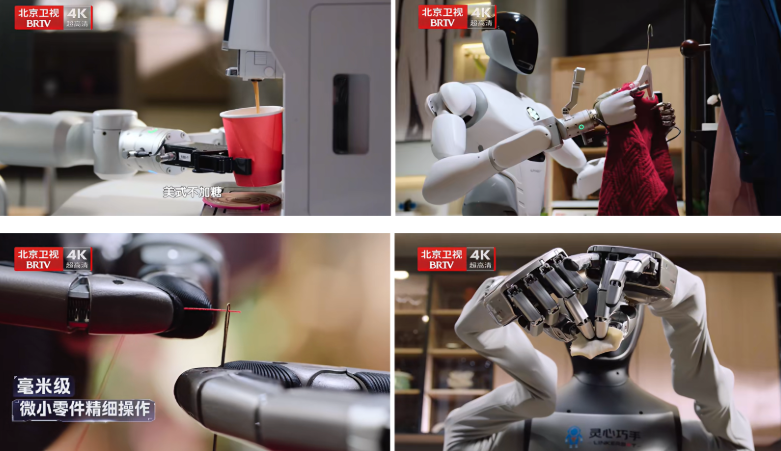
Group 1 - The humanoid robot sector is experiencing a surge in interest and investment following the performances showcased during the Spring Festival Gala, indicating a positive market outlook from multiple brokerages [1] - Unlike previous years focused on dance performances, this year's gala highlighted robots demonstrating practical operational capabilities, signaling a shift towards commercial viability for embodied intelligence technology [3] - Various robots showcased at the gala performed complex tasks such as making dumplings and serving coffee, emphasizing the advancements in robotic dexterity and decision-making algorithms [5] Group 2 - The lightweight humanoid robotic arms are crucial for enabling robots to perform valuable tasks in real-world scenarios, with their design allowing for adaptability in everyday environments [5] - Ruiman's long-term technological advancements in lightweight humanoid robotic arms and integrated joint modules have positioned the company as a foundational support for the embodied intelligence industry, achieving over 90% market share in functional robots [6] - The concentrated display of humanoid robots at the 2026 Spring Festival Gala marks a significant transition for the industry from technology validation to a critical phase of scalable implementation, with core components like robotic arms poised for growth opportunities [6]


人形机器人的9个分岔口
经济观察报· 2025-05-12 12:56
Core Viewpoint - The article discusses the current state and future potential of humanoid robots in China, highlighting the gap between public perception and technological reality, as well as the diverse strategies adopted by leading companies in the industry [2][3]. Group 1: Industry Development - The humanoid robot industry in China has significant milestones, such as the 2025 Spring Festival Gala performance and the recent Beijing Yizhuang Marathon, which showcased the capabilities and limitations of humanoid robots [2][3]. - A field study of nine leading companies in Shenzhen revealed a lack of consensus on technology routes and application scenarios, indicating a transitional phase from laboratory to industrialization [3]. Group 2: Key Divergence Points - The industry faces several critical questions, including whether humanoid robots need legs, faces, and how they perceive the environment [4][12][17]. - Companies are divided into "bipedal" and "wheeled" factions, with each focusing on different capabilities and applications based on their technological strengths [6][7]. Group 3: Technical Challenges - Bipedal robots face significant technical challenges, including the need for complex joint coordination and energy consumption, while wheeled robots are more stable and cost-effective for industrial applications [7][8]. - The perception and interaction capabilities of humanoid robots vary, with some companies prioritizing industrial functionality over human-like features to avoid ethical concerns [13][14]. Group 4: Data and Training - The competition in the humanoid robot industry is increasingly centered around data acquisition for training AI models, with companies employing various strategies to gather real, simulated, and internet data [28][29]. - Companies like Digital Huaxia are investing in data collection centers to create realistic training environments, while others focus on simulation data to reduce costs and accelerate learning [28][30]. Group 5: Market Applications - Humanoid robots are being explored for various applications, including industrial manufacturing, logistics, retail, and education, but the timeline for widespread adoption remains uncertain [33][34]. - The industry is currently prioritizing standardized industrial applications before moving into more complex environments like homes [34][35]. Group 6: Commercialization Challenges - The humanoid robot sector struggles with finding clear commercialization paths, with many companies still reliant on investment rather than sustainable revenue [36][38]. - The transition to mass production is hindered by inconsistent product performance and the need for precise hardware and software integration [40]. Group 7: Public Perception and Future Outlook - Events like the Yizhuang Marathon have sparked debate about the viability of humanoid robots, with some viewing the failures as indicative of a bubble in the industry [42][43]. - Despite challenges, there is a recognition of the progress made in humanoid robotics, and industry insiders advocate for a balanced view that acknowledges both the potential and current limitations of the technology [43].