AI数据训练

Search documents
FF召开特别股东大会并通过关键提案 机器人产品预计本月底交付
Feng Huang Wang· 2026-02-14 03:16
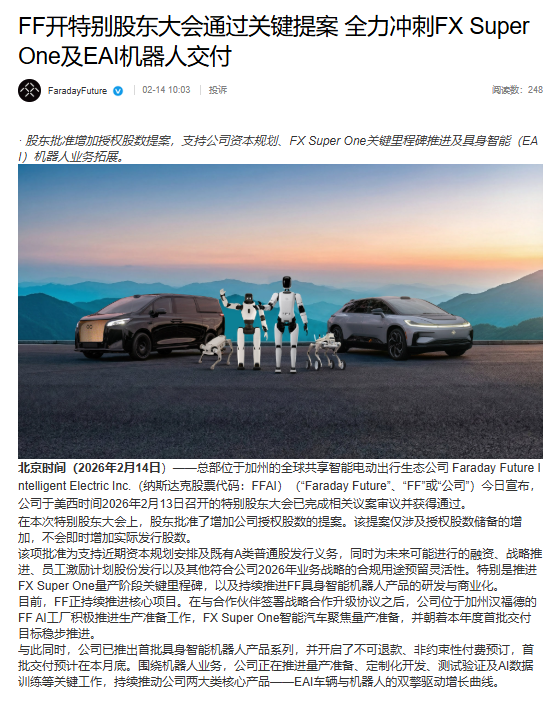
Core Insights - Faraday Future held a special shareholder meeting on February 13, 2026, where shareholders approved a proposal to increase the company's authorized share count, which will not immediately affect the actual number of shares issued [1] Group 1: Business Developments - The company has launched its first series of embodied intelligent robot products and has initiated non-refundable, non-binding paid reservations, with the first deliveries expected by the end of this month [1] - The company is advancing its robot business by preparing for mass production, customized development, testing, validation, and AI data training, aiming to drive growth through its two core product lines: EAI vehicles and robots [1] - The FX Super One smart vehicle is focused on mass production preparations and is steadily progressing towards its goal of first deliveries within this year [1]




FF:公司已推出首批具身智能机器人产品系列,首批交付预计在本月底
Xin Lang Cai Jing· 2026-02-14 02:43
Core Viewpoint - Faraday Future Intelligent Electric Inc. has successfully held a special shareholder meeting on February 13, 2026, where shareholders approved a proposal to increase the company's authorized share count, which will not immediately affect the actual issued shares [1] Group 1: Shareholder Meeting Outcomes - The special shareholder meeting resulted in the approval of a proposal to increase the authorized share count [1] - The increase in authorized shares is intended for reserve purposes and will not lead to an immediate increase in actual issued shares [1] Group 2: Product Development and Launch - The company has launched its first series of embodied intelligent robot products and has initiated non-refundable, non-binding paid reservations, with the first deliveries expected by the end of the month [1] - Faraday Future is advancing its robot business by preparing for mass production, customized development, testing validation, and AI data training [1] - The company aims to drive growth through its two core product categories: EAI vehicles and robots [1]
“稳赚不赔”的代工骗局
虎嗅APP· 2026-01-13 10:11
Core Viewpoint - The article discusses the "hand glove processing" scam that has deceived many individuals in China, highlighting how businesses lure victims with promises of free materials, zero investment, and high profits, only to deliver faulty equipment and unfulfilled promises of returns [5][6]. Group 1: Scam Mechanism - The scam operates by selling refurbished machines at inflated prices, with companies like Wuhan Oufan purchasing machines for 2,800 yuan and renting them out for 13,450 yuan, creating a significant profit margin [6][13]. - Victims invest over 100,000 yuan but receive minimal returns, often only a few thousand yuan, while being penalized for quality issues [6][14]. - The core of the scam is not the production of gloves or socks but the creation of a "debt" and "despair" for ordinary people, exploiting their desire for entrepreneurship [9][16]. Group 2: Psychological Manipulation - The scam preys on cognitive biases, such as overconfidence and anchoring effects, where victims are misled by promises of high earnings, leading them to underestimate the challenges of industrial production [19][20]. - Once victims invest money, confirmation bias leads them to ignore warning signs and focus on positive information, making it difficult to withdraw from the scheme [20]. Group 3: Future Trends of Scams - The article predicts that such scams will evolve, moving from tangible products to more abstract concepts like "digital processing" and "AI data training," which are harder for the average person to understand [22]. - Future scams may also focus on legal compliance, with contracts becoming more complex and obscuring unfair terms, making it difficult for victims to seek legal recourse [24][28]. Group 4: Prevention Strategies - To avoid falling victim to such scams, individuals should verify the legitimacy of the business model by checking the actual market demand and pricing of products [32][35]. - It is crucial to scrutinize the pricing of equipment and ensure it aligns with market values, as inflated equipment costs are often a red flag [37]. - Conducting background checks on companies through official platforms can help identify potential scams, especially if the company has a questionable history [39].

人形机器人的9个分岔口
经济观察报· 2025-05-12 12:56
Core Viewpoint - The article discusses the current state and future potential of humanoid robots in China, highlighting the gap between public perception and technological reality, as well as the diverse strategies adopted by leading companies in the industry [2][3]. Group 1: Industry Development - The humanoid robot industry in China has significant milestones, such as the 2025 Spring Festival Gala performance and the recent Beijing Yizhuang Marathon, which showcased the capabilities and limitations of humanoid robots [2][3]. - A field study of nine leading companies in Shenzhen revealed a lack of consensus on technology routes and application scenarios, indicating a transitional phase from laboratory to industrialization [3]. Group 2: Key Divergence Points - The industry faces several critical questions, including whether humanoid robots need legs, faces, and how they perceive the environment [4][12][17]. - Companies are divided into "bipedal" and "wheeled" factions, with each focusing on different capabilities and applications based on their technological strengths [6][7]. Group 3: Technical Challenges - Bipedal robots face significant technical challenges, including the need for complex joint coordination and energy consumption, while wheeled robots are more stable and cost-effective for industrial applications [7][8]. - The perception and interaction capabilities of humanoid robots vary, with some companies prioritizing industrial functionality over human-like features to avoid ethical concerns [13][14]. Group 4: Data and Training - The competition in the humanoid robot industry is increasingly centered around data acquisition for training AI models, with companies employing various strategies to gather real, simulated, and internet data [28][29]. - Companies like Digital Huaxia are investing in data collection centers to create realistic training environments, while others focus on simulation data to reduce costs and accelerate learning [28][30]. Group 5: Market Applications - Humanoid robots are being explored for various applications, including industrial manufacturing, logistics, retail, and education, but the timeline for widespread adoption remains uncertain [33][34]. - The industry is currently prioritizing standardized industrial applications before moving into more complex environments like homes [34][35]. Group 6: Commercialization Challenges - The humanoid robot sector struggles with finding clear commercialization paths, with many companies still reliant on investment rather than sustainable revenue [36][38]. - The transition to mass production is hindered by inconsistent product performance and the need for precise hardware and software integration [40]. Group 7: Public Perception and Future Outlook - Events like the Yizhuang Marathon have sparked debate about the viability of humanoid robots, with some viewing the failures as indicative of a bubble in the industry [42][43]. - Despite challenges, there is a recognition of the progress made in humanoid robotics, and industry insiders advocate for a balanced view that acknowledges both the potential and current limitations of the technology [43].