
机动车及零部件

Search documents
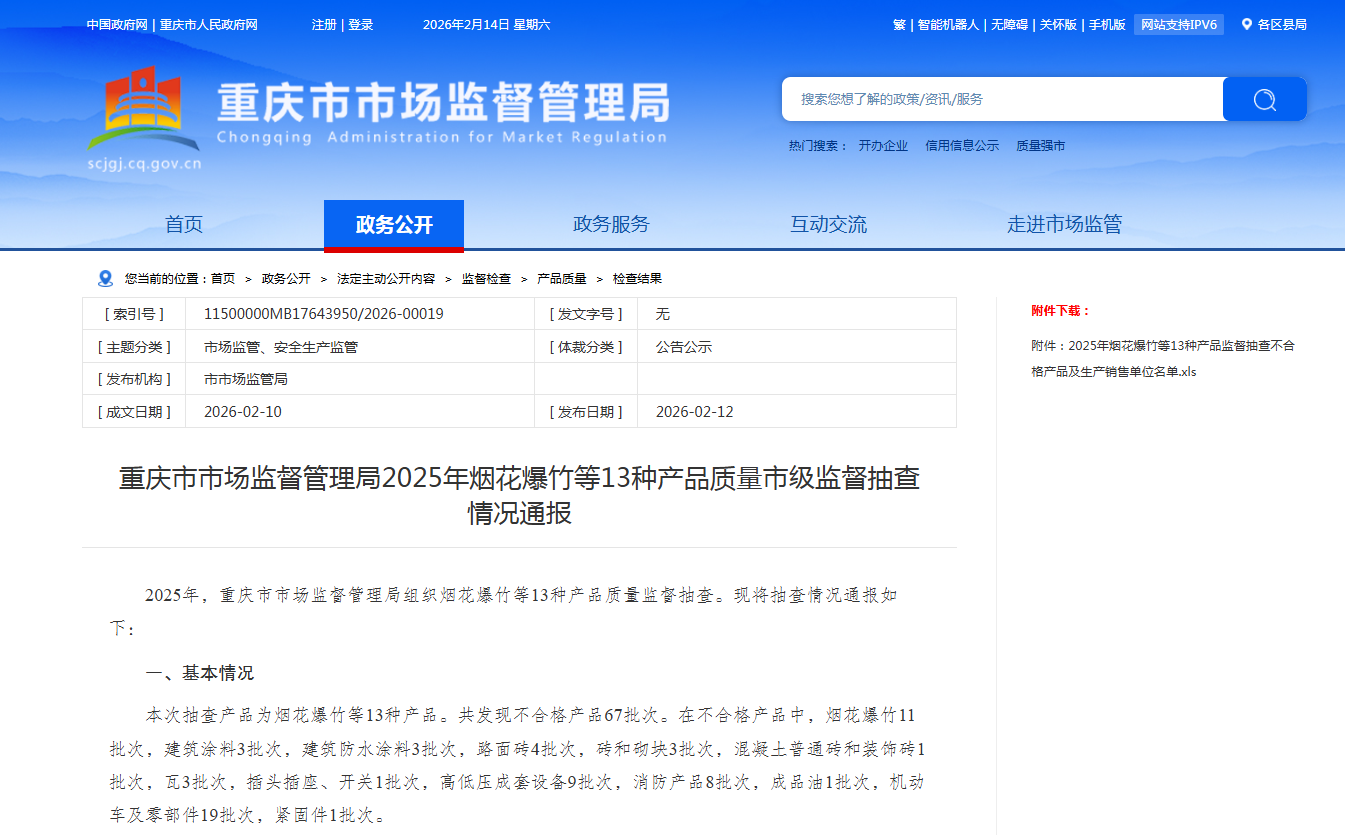
重庆市市场监督管理局发布2025年烟花爆竹等13种产品质量市级监督抽查情况通报
Zhong Guo Zhi Liang Xin Wen Wang· 2026-02-14 09:18
Core Viewpoint - The Chongqing Municipal Market Supervision Administration has released a report on the quality supervision and inspection of 13 products, including fireworks and firecrackers, revealing that 67 batches of products were found to be non-compliant in 2025 [2][3]. Group 1: Inspection Results - A total of 67 batches of products were identified as non-compliant, including 11 batches of fireworks and firecrackers, 3 batches of architectural coatings, 3 batches of waterproof coatings, 4 batches of pavement bricks, and various other products [3][10]. - Specific non-compliance issues for fireworks included drug quantity, measurement errors, ignition line firmness, ignition time, and performance during discharge [4]. - Non-compliance in architectural coatings involved the bonding strength of interior wall putty [5]. - For waterproof coatings, issues included solid content, tensile strength, elongation at break, tear strength, water absorption, and volatile organic compounds (VOC) [6]. - Pavement bricks failed to meet wear resistance standards [7]. - Other products such as concrete bricks, tiles, plugs, sockets, high and low voltage equipment, and fire safety products also had various non-compliance issues [9][10]. Group 2: Regulatory Actions - The Market Supervision Administration will enforce measures such as sealing and confiscating non-compliant products, and will require manufacturers and sellers to implement corrective actions [10][11]. - Companies found to be in violation may face legal consequences, including referral to judicial authorities if criminal activities are suspected [10]. - The administration emphasizes the importance of quality safety management, requiring companies to appoint quality safety supervisors and establish risk control lists [10].

加拿大11月贸易逆差骤扩至22亿加元 黄金出口锐减成主因
Xin Hua Cai Jing· 2026-01-30 00:55
Core Viewpoint - Canada's trade deficit in November 2025 reached 2.2 billion CAD, significantly exceeding market expectations of 690 million CAD and the revised previous value of 400 million CAD [1]. Group 1: Trade Performance - In November, Canada's total exports amounted to 63.94 billion CAD, a decrease of 2.8% from the revised previous month's value of 65.78 billion CAD [1]. - Total imports were 66.14 billion CAD, remaining relatively stable compared to the revised previous value of 66.18 billion CAD [1]. - The significant decline in exports, particularly in the category of metal and non-metal mineral products, was a major factor contributing to the widening trade deficit [1]. Group 2: Export Dynamics - The drop in exports was primarily driven by a 24.4% month-on-month decrease in metal and non-metal mineral products [1]. - Exports of unrefined gold, silver, platinum, and their alloys saw a substantial reduction of 36%, becoming the largest drag on overall export performance [1]. - The volatility in gold exports has been a persistent trend affecting Canada's overall export dynamics in recent months [1]. Group 3: Import Trends - The import of motor vehicles and parts also saw a simultaneous decline, further suppressing trade performance [1]. - Despite the stability in total import values, the sharp contraction in key export categories exacerbated the trade imbalance [1].
加拿大今年4月商品贸易逆差创历史新高
Zhong Guo Xin Wen Wang· 2025-06-05 23:25
Group 1 - Canada's trade deficit with the world surged from 2.3 billion CAD in March to approximately 7.1 billion CAD in April, marking the largest deficit on record [1] - Total goods and services trade deficit reached about 7.5 billion CAD in April [1] - Canadian goods exports fell to approximately 60.4 billion CAD in April, representing a 10.8% month-over-month decline, the largest drop in five years [1] Group 2 - Major declines in goods exports were observed in motor vehicles and parts, consumer goods, and energy products, with motor vehicle exports decreasing by 17.4% and passenger car and light truck exports dropping by 22.9% [1] - Consumer goods exports fell by 15.4% to 7 billion CAD, the lowest level since December 2023 [1] - Energy product exports have declined for the third consecutive month due to decreased demand amid economic uncertainty [1] Group 3 - In April, Canada's total goods imports decreased by 3.5% to approximately 67.6 billion CAD, with significant declines in motor vehicles and parts, industrial machinery, and consumer goods [1] - However, imports of unrefined gold, silver, and platinum group metals saw a substantial increase [1] Group 4 - Exports to the U.S. decreased by 15.7% in April, marking the third consecutive month of decline, while imports from the U.S. also fell by 10.8% [2] - The trade surplus with the U.S. narrowed to 3.6 billion CAD, the smallest surplus since December 2020 [2] - Exports to countries outside the U.S. increased by 2.9%, with the largest growth seen in exports to China, the UK, Algeria, and Brazil [2] Group 5 - Imports from countries outside the U.S. rose by 8.3% to a record 29 billion CAD, with total goods trade with non-U.S. countries reaching 47.3 billion CAD, also a monthly historical high [2] - The international services trade deficit narrowed from 500 million CAD in March to approximately 300 million CAD in April, with both service imports and exports declining slightly [2]