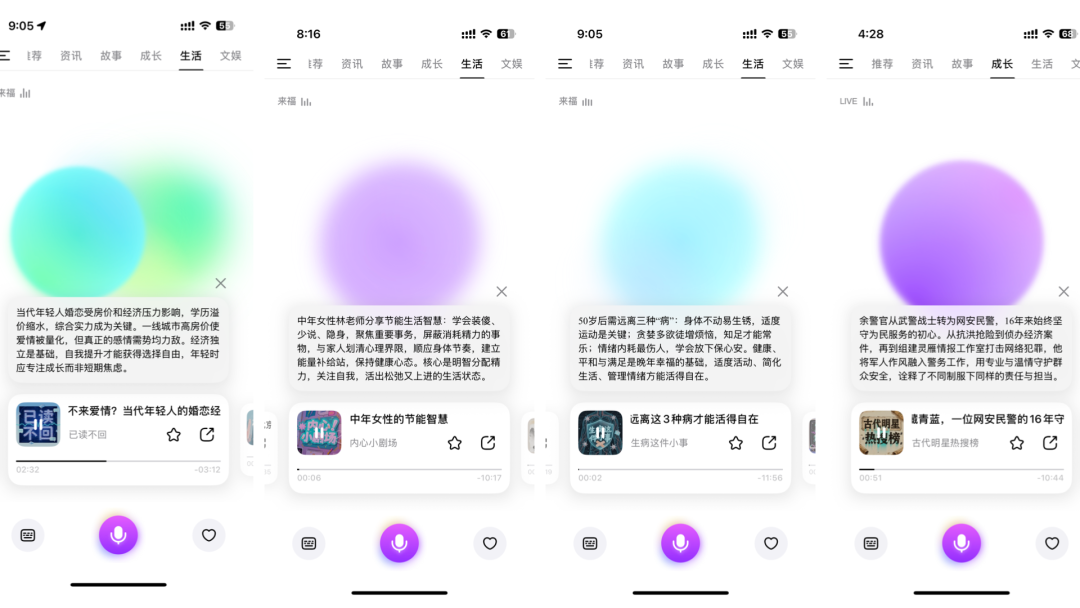
来福电台

Search documents
前百川智能联创的AI音频赌局:我要造“人”,造AI主播
3 6 Ke· 2026-02-09 06:44
Core Insights - The article discusses the journey of Jiao Ke, co-founder of Baichuan Intelligence, who transitioned to founding an AI audio company, Laifu Radio, inspired by the emotional connection depicted in the film "Her" [1][3] - The audio industry is seen as controversial, with significant potential for AI integration, yet it has underperformed in China compared to video platforms [3][4] Group 1: Company Overview - Laifu Radio aims to create AI hosts rather than just an AI podcast platform, emphasizing the human-like interaction and emotional connection with users [10][22] - The company currently has 15 Chinese AI hosts and 2 English hosts, each with distinct styles, aiming to foster user engagement and connection [13][22] - Laifu Radio's operational logic is based on the premise that audio is a natural form of human interaction, which can be enhanced through AI technology [4][11] Group 2: Market Potential and Challenges - The audio content supply in China is limited due to high production costs, leading to a mismatch between user demand and available content [4][26] - Despite skepticism about the audio market's potential, Laifu Radio has successfully secured over $10 million in funding, indicating investor interest in its unique approach [10][66] - The company believes that audio can provide a more personalized experience compared to traditional video content, leveraging AI to meet diverse user preferences [56][67] Group 3: AI Integration and User Engagement - AI technology is seen as a solution to enhance content supply and user interaction, allowing for personalized audio experiences based on user preferences [4][67] - Laifu Radio's model focuses on creating long-term user engagement through daily interactions, termed Daily Talk User (DTU), rather than just daily active users (DAU) [44][45] - The platform allows users to interact with AI hosts in real-time, creating a dynamic and engaging listening experience [19][34] Group 4: Competitive Landscape - Laifu Radio differentiates itself from competitors by focusing on creating a comprehensive service rather than just a tool for content creation [50][64] - The company faces competition from established platforms like Xiaoyuzhou, which primarily rely on human-generated content, making it challenging to integrate AI effectively [54][56] - Laifu Radio's strategy emphasizes the importance of long-term memory in AI applications, which is crucial for providing personalized content and enhancing user experience [67][68]


除了投资人,没人需要AI播客
Hu Xiu· 2025-08-07 12:15
Core Viewpoint - The article critiques the AI podcasting sector, suggesting that many AI podcast products are primarily designed to attract investors rather than meet user needs, highlighting a disconnect between product offerings and actual consumer demand [4][5][24]. Group 1: Market Analysis - The audio podcast market is described as niche, with platforms like Xiaoyuzhou having only a few million daily active users, primarily from first-tier cities [2]. - Even major players like Spotify struggle to monetize their podcast offerings, indicating that podcasts may not be a sustainable business model [2][24]. Group 2: Product Evaluation - AI podcast products are criticized for lacking genuine user engagement, with examples like ChatPods failing to create a compelling user experience [7][8]. - In contrast, Laifu Radio is noted for attempting to create a more engaging narrative, despite the AI-generated content being of poor quality [9][13][15]. Group 3: Content Quality - The AI-generated content is described as subpar, with examples of nonsensical or unappealing topics that do not resonate with potential listeners [16][19]. - The article argues that while AI can summarize or compress information effectively, it struggles to produce original, engaging narratives that are essential for podcasting [20][21]. Group 4: Investment Perspective - The article suggests that the appeal of AI podcasts lies more in the "data flywheel" concept favored by investors, where increased user engagement leads to better data collection and content generation [13][14]. - However, this investment narrative is seen as flawed due to the inherent lack of quality in AI-generated content, which may deter actual user adoption [15][24].