校园贷

Search documents
何以“开正门 堵偏门”:透视校园贷治理 中国金融出版社《校园贷多元治理研究》速览
Jin Rong Shi Bao· 2026-01-09 02:07
Core Viewpoint - The governance of campus loans is crucial for students' academic success and requires a multi-faceted approach involving various stakeholders and strategies [1][4]. Group 1: Research Findings - The "Research on Multi-dimensional Governance of Campus Loans" book presents findings from a four-year study by the Chinese Academy of Social Sciences, focusing on the supply-demand situation and regulatory policies of campus loans [1][2]. - The project emphasizes the importance of judicial guidance in addressing civil and criminal cases related to campus loans, proposing a judicial-led governance path [2][3]. - The book scientifically defines the concept of campus loans and critiques the current "one-size-fits-all" regulatory policies, advocating for a more nuanced approach [2][3]. Group 2: Practical Implications - The research provides practical insights for students on how to navigate campus loans, including recognizing fraud and understanding legal rights [3][4]. - It highlights the need for collaboration among legislative, enforcement, and educational institutions to effectively govern campus loans and protect students [4]. Group 3: Methodological Approach - The study employs various research methods, including surveys, data analysis, and case studies, to provide a comprehensive understanding of campus loan governance [3].
金融教育宣传周丨中意人寿济宁中支“一把手”带队入校园 筑牢“校园贷”防火墙
Qi Lu Wan Bao· 2025-09-19 11:14
Core Viewpoint - The company actively promotes financial literacy among youth to enhance their awareness of risks associated with illegal financial products such as campus loans, beauty loans, and order-filling loans [1][3] Group 1: Financial Education Activities - The company organized a financial knowledge dissemination event at Jining Vocational and Technical College on September 15, 2025, led by the institution's top management [1] - The event featured engaging methods such as thematic banners and promotional materials to create a strong financial education atmosphere [1] - Promotional materials focused on key topics like anti-money laundering, illegal fundraising prevention, online fraud prevention, and financial fraud awareness [1] Group 2: Case Studies and Interactive Engagement - Real-life cases were presented to illustrate the operational tactics and potential risks of campus loans and their variants, such as beauty loans and order-filling loans [3] - The event included an interactive Q&A session to encourage student participation, addressing common financial scenarios and responses to illegal loan offers [3] - Participants received practical gifts for their engagement, enhancing their sense of achievement and reinforcing their understanding of financial safety knowledge [3] Group 3: Impact and Future Initiatives - The event received unanimous recognition and praise from students and faculty, improving their understanding of illegal financial activities and enhancing their risk prevention awareness [3] - The company plans to continue fulfilling its corporate social responsibility by innovating and conducting more diverse financial knowledge dissemination activities [3]


警惕非法“校园贷” ,一地金融监管局发布消费者风险提示
Yang Zi Wan Bao Wang· 2025-09-19 07:12
Core Viewpoint - The Beijing Financial Regulatory Bureau has issued a consumer risk warning regarding illegal "campus loans," highlighting four main deceptive practices used by illicit lending institutions [1][4]. Group 1: Deceptive Practices - Illicit lending institutions disguise "campus loans" under various names such as "training loans," "beauty loans," "rent-back loans," "order-filling loans," and "job-seeking loans," making them highly misleading [4]. - Some institutions exploit students' lack of social experience by having them sign contracts with inflated amounts compared to the actual funds received, or by tricking them into signing blank contracts that are later filled with unfavorable terms [4]. - These institutions lure students with claims of easy loans requiring only an ID and student card, promoting "no collateral, high limits, and low interest rates," which encourages excessive and impulsive borrowing [4]. - Once students fall behind on payments, they face aggressive collection tactics, including threats and harassment, leading to severe personal safety concerns [4]. Group 2: Recommendations for Students and Parents - Students and parents are advised to adopt a rational consumption mindset, practicing frugality and planning expenses to avoid overspending [5]. - It is recommended to seek financial assistance through legitimate channels, such as discussing needs with parents and applying for student loans or scholarships from schools or licensed financial institutions [5]. - Consumers should enhance their self-protection awareness by safeguarding personal information, avoiding unauthorized agreements, and thoroughly reviewing loan contracts to ensure legality and fairness [5]. - In case of falling into illegal "campus loan" traps, it is crucial to remain calm, inform parents and teachers, keep evidence of transactions and communications, and report to authorities for legal recourse [5].
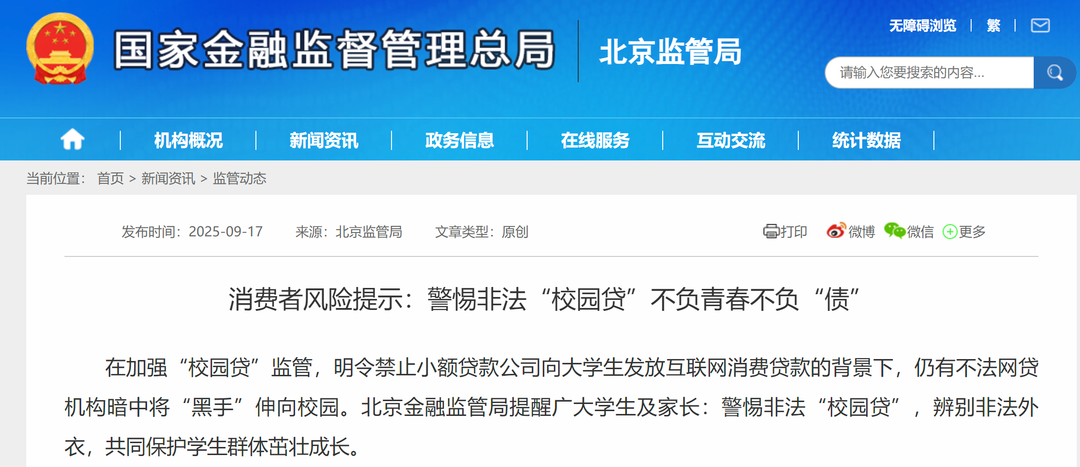
警惕非法“校园贷”!北京金融监管局拆解四大套路,这些坑别踩
Bei Jing Shang Bao· 2025-09-17 08:01
Core Viewpoint - The Beijing Financial Regulatory Bureau has issued a warning against illegal "campus loans," emphasizing the need for students and parents to be vigilant and recognize deceptive practices in the lending industry [1] Group 1: Types of Illegal Campus Loans - Illegal campus loans primarily consist of four deceptive practices, with the first being misleading names that disguise the true nature of the loans, such as "training loans," "beauty loans," and "job-seeking loans" [1] - The second practice involves "yin-yang contracts," where students are tricked into signing contracts with inflated amounts compared to the actual loan received, or signing blank contracts that are later filled with unfavorable terms [1] - The third practice is enticing offers that promise loans with minimal requirements, such as only needing an ID or student card, and promoting low interest rates and quick approval times, which can lead to excessive borrowing and financial strain [1] - The fourth practice involves a cycle of borrowing to repay previous loans, leading to aggressive collection tactics that can threaten students' safety and well-being [2] Group 2: Recommendations for Students and Parents - The regulatory body advises students and parents to adopt a rational consumption mindset, emphasizing the importance of frugality and proper financial planning to avoid overspending and excessive debt [2] - It is recommended that students communicate with their parents regarding financial needs and explore legitimate funding options, such as scholarships or loans from accredited financial institutions [2] - Consumers are urged to protect their personal information, carefully read loan agreements, and ensure that the terms are legal and reasonable before signing [2] - In case of falling into illegal loan traps, students should remain calm, inform their parents and teachers, keep all relevant documentation, and report to authorities to seek legal recourse [2]
趣店二季度营收暴跌超9成 主业“归零”盈利全靠资本操作
Xi Niu Cai Jing· 2025-09-05 09:44
Core Viewpoint - Qudian (NYSE: QD) reported a significant decline in revenue for Q2 2025, with operating income dropping to 3.49 million yuan, a 93.5% year-over-year decrease, while net profit attributable to shareholders surged to 311.8 million yuan, a 213% increase year-over-year [2] Revenue Performance - The revenue of 3.49 million yuan in Q2 2025 represents a drastic decline from 53.3 million yuan in the same period last year [2] - The company attributed the revenue drop to intensified industry competition, leading to a substantial decrease in sales from its last-mile delivery business, which the company has decided to gradually shut down [2] Business Transformation - Qudian has transitioned from a company originally focused on campus loans to a "cash shell" with no core business, following multiple rounds of transformation including ventures into car financing, prepared food, and cross-border e-commerce [2] - The company currently holds over 5.6 billion yuan in cash reserves, including 4.8 billion yuan in cash and cash equivalents and approximately 800 million yuan in restricted cash [2] Profitability Sources - Despite the near-zero revenue from its main business, Qudian achieved significant profit growth due to strong cash flow, with net interest and investment income reaching several hundred million yuan, becoming the primary source of net profit [2] Investment Strategy - Qudian appears to be attempting to replicate Warren Buffett's early "cigar butt" investment strategy by leveraging its substantial cash reserves for investments and buybacks to return value to shareholders [2] - The sustainability of this profit model remains uncertain in the absence of a core business to support it [2]


校园贷重袭校园
Bei Jing Shang Bao· 2025-05-13 14:03
Core Viewpoint - The resurgence of campus loans has led to significant financial distress among university students, with many falling into debt traps due to high-interest loans and aggressive collection practices [1][4][9]. Group 1: Loan Practices and Impact - Many students are lured into taking loans through targeted marketing on e-commerce and social platforms, often resulting in annual interest rates exceeding 24% [4][9]. - A significant number of students report being overwhelmed by relentless collection calls, which severely disrupts their academic and personal lives [3][4]. - The phenomenon of students signing non-student declarations to obtain loans highlights the challenges in accurately identifying borrowers [7][8]. Group 2: Regulatory Environment - Despite regulations prohibiting loans to students, some lending institutions continue to target this demographic, often using loopholes to bypass restrictions [6][9]. - Regulatory bodies have issued multiple notifications to prevent lending to students, emphasizing the need for financial institutions to adhere to risk management protocols [4][10]. Group 3: Risk and Compliance Issues - The lending practices of some institutions pose both compliance and ethical risks, particularly for students without stable income sources, leading to potential over-borrowing [5][9]. - Many lending platforms lack effective identity verification processes, making it difficult to prevent loans to students [10][11]. - The drive for profit in the student loan market has led to some institutions engaging in questionable practices, including hidden fees and high-interest rates [9][10]. Group 4: Recommendations for Improvement - Financial institutions are encouraged to enhance identity verification technologies and implement stricter controls on lending practices to mitigate risks associated with student loans [10][11]. - There is a call for better management of partnerships with third-party platforms to ensure compliance with regulations and protect vulnerable student borrowers [10][11].