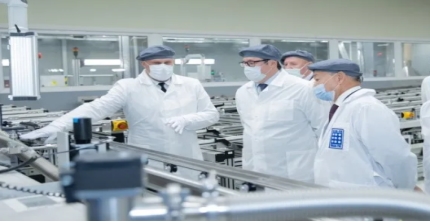
核燃料组件

Search documents
印俄深化经贸合作应对美国施压
Jing Ji Ri Bao· 2025-12-09 22:44
Core Viewpoint - The visit of Russian President Putin to India marks a significant step in strengthening the "special and privileged strategic partnership" between India and Russia, emphasizing the need for bilateral cooperation in various sectors amidst external pressures, particularly from the United States [1][5]. Economic Cooperation - India and Russia signed the "2030 Economic Cooperation Plan" aimed at enhancing bilateral trade, with a target to increase annual trade to $100 billion by 2030, reaffirmed during the visit [1][2]. - The trade volume between India and Russia has surged from over $10 billion in the 2021 fiscal year to approximately $68.7 billion projected for the 2024-2025 fiscal year, largely driven by India's increased oil imports from Russia [2][3]. Energy Cooperation - Energy cooperation is highlighted as a cornerstone of the India-Russia partnership, with Modi stating it is a priority for both leaders. Russia is positioned as a reliable supplier of oil, gas, and coal to India [2][4]. - The share of Russian oil in India's total oil imports has increased dramatically from about 2% in the 2000-2021 fiscal years to over 37% in the 2024-2025 fiscal year, with imports valued at $52.7 billion [3]. Nuclear Energy Collaboration - Significant progress was made in civil nuclear energy cooperation, with India aiming to increase its nuclear power capacity to 100 GW by 2047, relying on Russian technology and equipment [4]. - Agreements were reached to accelerate the construction of new nuclear units at the Kudankulam Nuclear Power Plant and to explore the development of small modular reactors in India [4]. Trade Facilitation and Security - Multiple agreements were signed to enhance trade security and facilitate smoother logistics, including cooperation on transport corridors, customs, and maritime operations [4]. - A framework for labor mobility was established to support the movement of Indian technical workers to Russia, reflecting a commitment to mutual benefits in personnel exchange [5]. Geopolitical Context - The agreements reached during the visit are expected to face scrutiny and pressure from the United States, particularly regarding oil imports and trade negotiations [5][6]. - Modi's cautious remarks on energy cooperation indicate India's strategic balancing act in response to U.S. pressures while seeking to maintain strong ties with Russia [6].
海乐行国际联会与乌尔巴冶金厂携手布局核燃料产业链
Sou Hu Wang· 2025-07-30 07:47
本次海乐行国际联会与 UMP 签署的战略意向书,不仅延续了 UMP 在原有中广核合作基础上的扩展, 还融入新时代国际交流的新机制,特别强调投融资与市场运作、人才培养与技术转化、绿色供应链与第 三国推广、以及"一带一路"背景下的国际合作等全局层面的协同。这一点在意向书的"合作机制设计"章 节中得以体现:一是成立由双方联合派驻的项目工作小组,负责统筹推进签约后各项工作;二是在中国 境内设置联合运营办公室,便于技术对接、质量跟踪与市场推广;三是双方在哈萨克斯坦和中国境内进 行重点人才交流,包括核材料生产管理、物流仓储、防护技术、标准化工程设计等领域;四是拟配合国 家绿色低碳发展战略评估核燃料全生命周期碳排放与安全控制路径,支持供给侧结构性改革与绿色产业 升级。 从国家战略层面来看,此次合作意向恰逢中哈两国在核能战略互信提升的关键节点。近年来,两国在能 源领域的合作持续深化:中哈双方不仅在铀资源开采与供应链建设保持密切合作,也在核电站运营建 2025年7月,北京——在第六届"一带一路"国际合作高峰论坛的重要环节中,中国当代国际商务与产业 桥梁组织——海乐行国际联会与哈萨克斯坦国家原子能工业公司旗下的乌尔巴冶金厂(UM ...