
氢溴酸氘瑞米德韦片

Search documents
上市首日市值翻倍的旺山旺水还能“旺”多久?
Xin Lang Cai Jing· 2025-11-06 12:25
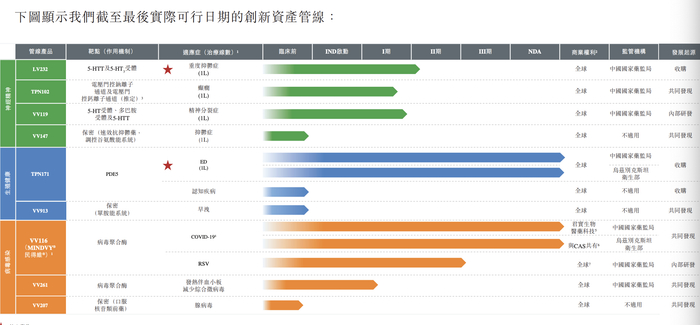
Core Viewpoint - The innovative pharmaceutical company Wangshan Wangshui has successfully listed on the Hong Kong Stock Exchange, achieving a market capitalization of approximately HKD 13.7 billion with a share price increase of 145.73% on the first day of trading [2]. Summary by Sections IPO Details - Wangshan Wangshui plans to globally offer 17.6 million H-shares, accounting for 10.50% of total shares post-IPO, with 90% allocated for international sale and 10% for public offering. The offering price was set at HKD 33.37, leading to an estimated market value of HKD 58.73 billion [2]. Product Pipeline and Market Potential - The company focuses on three core pipelines: a domestic COVID-19 treatment drug, hydrogen bromide deuterated remdesivir tablets, the "most expensive domestic Viagra" sildenafil citrate tablets, and an innovative antidepressant LV232. Additionally, there are four candidate drugs in clinical stages and three in preclinical stages [2][4]. COVID-19 Treatment Drug - The hydrogen bromide deuterated remdesivir tablets, co-developed with Junshi Biosciences, were initially expected to have significant commercial potential, with projections suggesting peak sales exceeding RMB 200 billion. However, actual sales have fallen short due to the end of the pandemic and increased competition [5][7][8]. Sales Performance - In 2023, the revenue from the hydrogen bromide deuterated remdesivir tablets was approximately RMB 1.84 million, constituting 92% of the company's total revenue of RMB 2 billion. The sales contribution from this product was only about RMB 400,000 in early 2025 [8][9]. Competitive Landscape - The market for COVID-19 treatments is highly competitive, with Pfizer's Paxlovid holding a 46% market share in China. Wangshan Wangshui's product has struggled to compete effectively against established alternatives [9]. Male Health Drug - Sildenafil citrate tablets, approved for treating erectile dysfunction, are seen as the company's most commercially viable product. The drug has been positioned to compete directly with existing PDE5 inhibitors, offering advantages such as faster onset and longer duration of action [12][14]. Market Dynamics - The PDE5 inhibitor market in China is projected to grow from RMB 5.5 billion in 2018 to RMB 9.3 billion by 2024, with a compound annual growth rate of 9.4%. However, the market is fragmented, and Wangshan Wangshui faces challenges in gaining market share due to the presence of numerous generic competitors [14][15]. Antidepressant Drug - LV232, an innovative antidepressant, targets a significant market with an increasing number of patients suffering from depression. The global market for antidepressants is expected to grow, with LV232 aiming to differentiate itself by reducing common side effects associated with traditional treatments [16][20]. Clinical Development - LV232 is currently undergoing a Phase II clinical trial for the treatment of major depressive disorder, with completion expected in the second half of 2026. Its success in demonstrating efficacy and reducing adverse effects will be crucial for its commercial viability [19][20].

创新药临床试验审批迈入“30日时代”,药企研发迎来“及时雨”|创新药观察
Hua Xia Shi Bao· 2025-06-19 06:49
Core Viewpoint - The National Medical Products Administration (NMPA) has announced a new policy to expedite the clinical trial approval process for innovative drugs, reducing the review time to 30 working days, which represents a 50% acceleration in the approval process [1][2]. Group 1: Policy Changes and Impacts - The new policy aims to prioritize resources for innovative drugs that have significant clinical value, ensuring that only those meeting specific criteria can access the expedited review process [2][4]. - In 2024, the NMPA approved 48 Class 1 innovative drugs, a 20% increase year-on-year, marking the highest number in five years, with over 70% of these approvals achieved through accelerated pathways [2][3]. - The approval of 39 global new drugs in China from January to May 2024, with 34 being domestic innovations, highlights the vibrant growth of China's pharmaceutical innovation [3]. Group 2: Historical Context and Future Outlook - Prior to 2015, the domestic pharmaceutical market primarily followed a model of imitative innovation, with new drugs typically taking 5-7 years longer to launch in China compared to overseas [4]. - The establishment of rapid review channels and the acceleration of key national research projects are expected to enhance China's competitiveness in global pharmaceutical innovation [4][5]. - The recent establishment of review centers in regions like the Yangtze River Delta and the Greater Bay Area aims to improve regulatory efficiency and support the rapid approval of innovative drugs [5]. Group 3: Global Trends - The FDA has also introduced a new priority review program, reducing its approval timeline from approximately 10-12 months to 1-2 months, indicating a global trend towards faster clinical review processes [5].

君实生物收盘上涨1.69%,最新市净率5.80,总市值325.87亿元
Jin Rong Jie· 2025-06-03 10:54
Core Viewpoint - Junshi Bioscience's stock closed at 33.06 yuan, up 1.69%, with a market-to-book ratio of 5.80, marking a new low in 157 days, and a total market capitalization of 32.587 billion yuan [1] Company Overview - Junshi Bioscience focuses on the research and development of new drugs, as well as the transfer and service of related technologies, including the production and sales of new drugs [1] - The company has 175 authorized patents, with 129 domestic and 46 international patents, covering various aspects of new drug protein structures, preparation processes, uses, and formulation recipes [1] Financial Performance - For Q1 2025, the company reported revenue of 501 million yuan, a year-on-year increase of 31.46%, while net profit was -234.88 million yuan, a year-on-year decrease of 17.01%, with a gross profit margin of 81.24% [2] Market Comparison - Junshi Bioscience's PE (TTM) is -26.43, with a static PE of -25.44 and a market-to-book ratio of 5.80, compared to the industry average PE of 64.63 and a market-to-book ratio of 10.39 [3] - The total market capitalization of Junshi Bioscience is 32.587 billion yuan, which is significantly lower than the industry median market capitalization of 80.24 billion yuan [3]

君实生物收盘上涨2.65%,最新市净率4.96,总市值290.38亿元
Jin Rong Jie· 2025-04-21 11:56
Company Overview - Junshi Biosciences closed at 29.46 yuan, up 2.65%, with a latest price-to-book ratio of 4.96 and a total market capitalization of 29.038 billion yuan [1] - As of February 28, 2025, Junshi Biosciences had 29,351 shareholders, an increase of 260 from the previous count, with an average holding value of 352,800 yuan and an average holding quantity of 27,600 shares [1] Business Operations - The main business of Junshi Biosciences includes the research and development of new drugs, technology transfer, and related services, as well as the production and sales of new drugs [1] - Key products include Toripalimab, Dihydrocodeine Bromide Tablets, Tifcemalimab, Adalimumab, Oncorhynchus mykiss monoclonal antibody, and various other monoclonal antibodies and inhibitors [1] - The company holds 175 authorized patents, with 129 domestic patents and 46 international patents, covering drug protein structures, preparation processes, uses, and formulation recipes, providing long-term patent protection for its products [1] Financial Performance - In the latest financial report for 2024, Junshi Biosciences achieved operating revenue of 1.948 billion yuan, a year-on-year increase of 29.67%, while net profit was -1.281 billion yuan, a year-on-year decrease of 43.90%, with a gross profit margin of 78.92% [1] Industry Comparison - Junshi Biosciences has a TTM PE ratio of -22.67 and a static PE ratio of -22.67, with a market capitalization of 29.038 billion yuan [2] - The industry average PE ratio is 44.27 (TTM) and 43.79 (static), with an average market capitalization of 18.383 billion yuan [2] - The industry median PE ratio is 38.38 (TTM) and 33.06 (static), with a median market capitalization of 7.437 billion yuan [2]