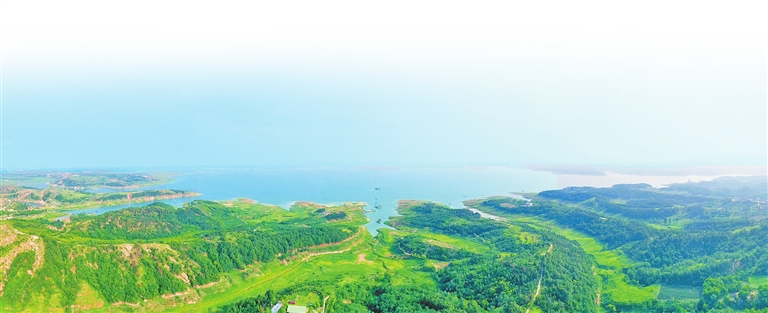
水土保持碳汇

Search documents
荒山变青山,“绿色碳库”卖了150万
Qi Lu Wan Bao· 2025-12-26 11:06
Core Viewpoint - The first carbon trading transaction for soil and water conservation in Shandong Province, valued at 1.5 million yuan, represents a significant step in transforming ecological assets into financial value, showcasing an innovative path to convert "green mountains and clear waters" into "golden mountains and silver mountains" [1][3] Group 1: Carbon Trading and Ecological Value - The transaction involved the sale of 50,000 tons of carbon credits generated from comprehensive soil and water conservation efforts in the Longziyu small watershed, marking a successful pilot for ecological product value transformation in Shandong [1][4] - The carbon credits were derived from a 30-year ecological governance initiative that effectively reduced soil erosion and improved the ecological environment in the region [2][3] - The carbon trading mechanism allows companies to purchase carbon credits to offset their emissions, thus facilitating carbon neutrality goals [3][4] Group 2: Ecological Governance and Investment - Since 1998, a total investment of 19.839 million yuan has been made in soil and water conservation projects in the region, leading to significant improvements in ecological conditions and land productivity [2][5] - The establishment of a collaborative governance mechanism has attracted over 30 million yuan in social capital for the enhancement of the watershed [2][5] - The successful transformation of the Longziyu watershed serves as a model for other regions in Shandong, with 10 cities completing 18 transactions totaling 90.21 million yuan across various ecological product categories [5][6] Group 3: Policy and Market Support - The success of these projects is underpinned by a robust policy framework that includes specific guidelines and financial support for soil and water conservation initiatives [7][8] - The market-driven approach encourages social capital participation through innovative funding models, enhancing the sustainability of ecological governance [8] - Future plans include the establishment of more ecological clean small watersheds and the continuous improvement of mechanisms for realizing ecological value [8]
【省水利厅】陕西水土流失面积强度“双下降”
Shan Xi Ri Bao· 2025-10-15 00:24
Core Insights - The conference on high-quality development of soil and water conservation was held in Yan'an, focusing on integrated management of natural resources in Shaanxi province [1][2] - Shaanxi province has implemented significant measures to combat soil erosion, including the construction of 3,585 sediment control dams and the treatment of 1.72 million square kilometers of soil erosion area [1] - The province aims to reduce the area of soil erosion to 60,000 square kilometers by the end of 2024, achieving a soil conservation rate of 70.81% [1] Group 1 - Shaanxi province has adopted a comprehensive governance model for soil and water conservation, which includes building terraces on gentle slopes and planting trees on steep slopes [1] - Yan'an has constructed 11,600 sediment control dams, intercepting approximately 1 billion tons of sediment, leading to an 88% reduction in sediment entering the Yellow River compared to historical averages [1] - The improvement in ecological environment has revitalized local industries, particularly in the development of specialty fruit industries such as apples and jujubes, covering over 10 million acres and benefiting hundreds of thousands of farmers [1] Group 2 - Shaanxi is exploring mechanisms for realizing the value of ecological products related to soil and water conservation, including the first national transaction of new farmland and production capacity indicators in Qianyang County [2] - The province has also completed the largest water conservation carbon trading transaction in Baota District, Yan'an, and the first carbon trading transaction for sediment control dams in Gaoxigou Village, Yulin [2] - Shaanxi is advancing smart water conservation initiatives, utilizing remote sensing technology for dynamic monitoring of soil erosion and digitizing results for over 16,000 small watersheds and 10,000 sediment control dams [2]
四水映绿 豫见两山丨石缝“绣”绿成金山
He Nan Ri Bao· 2025-08-16 23:33
Core Insights - The article highlights the successful ecological restoration efforts in the Xiaocaoyu small watershed, which have transformed the area from barren land to a lush green environment, significantly improving water conservation and local livelihoods [4][5][6]. Group 1: Ecological Restoration - The Xiaocaoyu small watershed has seen a forest coverage increase from less than 20% to 58% after the implementation of water and soil conservation projects [8]. - The annual soil erosion rate was previously 4000 tons per square kilometer, but post-restoration, the area can now retain 32,000 tons of sediment annually, reducing sediment flow into the Danjiangkou Reservoir [8]. - The restoration efforts included the establishment of 80 small water conservation projects, which have created a network of water retention facilities and improved local biodiversity [5][6]. Group 2: Economic Impact - The ecological restoration has led to the creation of economic opportunities, with local villagers earning additional income from the cultivation of pomegranates and other crops, with some families seeing annual income increases of over 20,000 yuan [6][7]. - The first carbon credit transaction in Henan Province, involving 10,000 tons of carbon credits from the Xiaocaoyu watershed, was completed for 300,000 yuan, showcasing the financial benefits of ecological projects [6][8]. - The annual direct economic benefits from ecological projects in the region are estimated at 18 million yuan, with per capita income from water conservation industries exceeding 800 yuan [7][8]. Group 3: Community Engagement - Local community involvement has been crucial, with thousands of villagers participating in restoration activities, demonstrating a strong commitment to environmental stewardship [5][6]. - The transformation of the area has led to the establishment of numerous agritourism businesses, with high occupancy rates in local accommodations, indicating a shift towards sustainable tourism [7].