水壶

Search documents
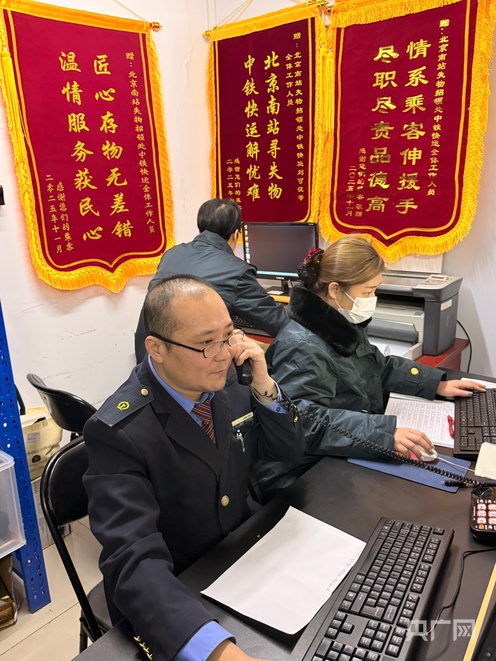
坐火车哪个环节最易遗失行李物品?记者探访北京南站失物招领处
Yang Guang Wang· 2026-02-10 23:59
Core Insights - The article discusses the increasing number of lost items at Beijing South Railway Station during the Spring Festival travel season, with over 400 items lost daily [1][3]. Lost Items Overview - The lost items primarily consist of small personal belongings such as water bottles, headphones, hats, umbrellas, and chargers, with larger items like suitcases being less common [1][3]. - The lost items are mostly forgotten by passengers when they disembark, as they are in a hurry and do not check their belongings [3][4]. Statistics and Trends - The number of lost items has risen from approximately 300 to over 400 per day as the Spring Festival approaches [3][4]. - On February 9 alone, the station collected three baskets of lost water bottles and a large bag of hats, indicating seasonal trends in lost items [4][6]. Recovery Process - Passengers can retrieve their lost items in person or have them sent via express delivery, with same-day delivery available for local residents [7][8]. - Approximately 25% of lost items are claimed by their owners, with many passengers unaware of the recovery process or the notifications sent via the 12306 app [7][8]. Recommendations for Passengers - Passengers are encouraged to utilize the 12306 app to report lost items and track their recovery status, which can streamline the process of reclaiming belongings [8].

小家电代工龙头造纸行业专家周日双交流
2025-11-16 15:36
Summary of Conference Call Records Company and Industry Overview - The conference call discusses the small home appliance manufacturing industry and the paper industry, focusing on a leading company in the small appliance sector and its performance in both domestic and international markets [1][2][3]. Key Points on Small Appliance Industry - **Sales Performance**: The company expects fourth-quarter sales to remain flat year-on-year at approximately 31.2 million units, with a 0.5% decrease in profit margin due to weak performance in the European and American markets [1][3]. - **Future Outlook**: For 2026, the company is optimistic about the export market, projecting a sales and volume growth of around 10%, contingent on the impact of Black Friday, Christmas promotions, and the Chinese New Year on orders [1][5]. - **Domestic Sales**: During the Double Eleven shopping festival, brands like Morphy, Dongling, and Baishengtou showed good performance with year-on-year growth. Morphy and Baishengtou achieved profit growth through innovation and price increases, while Dongling's profitability did not show significant improvement [1][6][7]. - **Product Launches**: The company is set to launch kettle and coffee products in collaboration with Pop Mart in February 2024, targeting the Chinese and East Asian cross-border e-commerce markets. The expected retail price for kettles is between 700-1,000 RMB, and for coffee machines, it is around 1,000-1,500 RMB, positioning them in the mid-to-high-end market [1][11][13]. - **Profitability from Collaboration**: The partnership with Pop Mart is expected to yield higher profitability compared to traditional domestic OEM collaborations, with an increase of at least 10%-15% in profitability [1][14]. Key Points on Paper Industry - **Price Trends**: From October to November, paper prices rose unexpectedly, with corrugated paper prices exceeding 3,000 RMB/ton and wood pulp prices increasing by approximately 150 RMB/ton. This was driven by rising costs and seasonal demand [1][17]. - **Waste Paper Prices**: The upward trend in waste paper prices is expected to continue due to tightened environmental policies leading to reduced supply [2][18]. - **Market Dynamics**: The paper industry is experiencing increased concentration among leading companies, which is expected to impact pricing and supply dynamics [2][17]. - **Impact of Environmental Policies**: Stricter environmental regulations have led to a reduction in waste paper supply, affecting costs and market stability. This trend is anticipated to persist due to ongoing policy constraints [21][22]. - **Future Price Outlook**: The price of packaging paper is expected to continue rising, with potential increases of 50-70 RMB/ton, driven by strong demand and rising raw material costs [23][25]. Additional Insights - **Technological Advancements**: The adoption of biomass power generation and alkali recovery technology is becoming more prevalent among large paper manufacturers, which could lead to long-term cost reductions and compliance with carbon emission regulations [37][38]. - **Market Challenges**: Smaller companies in the paper industry face greater pressure due to these policies, while larger firms are better positioned to benefit from the transition to greener practices [35][36]. This summary encapsulates the key insights from the conference call, highlighting the performance and outlook of both the small appliance and paper industries, along with the implications of market dynamics and regulatory changes.
卢比奥对中国“垄断”稀土感到愤怒:美国想要蛋糕,却不愿进厨房
Sou Hu Cai Jing· 2025-06-10 01:24
Group 1 - The core issue discussed in the recent US-China leadership call is the trade and technology disputes, particularly focusing on China's control over rare earth exports [1] - US Treasury Secretary labeled China as an "unreliable partner" due to its restrictions on rare earth exports, claiming that China had previously intended to supply the US but has now withheld it [1] - US Secretary of State expressed outrage over China's "monopoly" on rare earths over the past 25-30 years, accusing China of deceitful practices to achieve global dominance [3] Group 2 - Historically, the US has abundant rare earth resources but outsourced the "dirty work" of mining and processing to China due to environmental regulations and cost concerns [5] - China invested significantly over three decades to develop its rare earth industry into a global leader, while the US focused on deindustrialization and financial markets [5][7] - The US faces challenges in re-establishing its rare earth supply chain, including high costs, long timelines, and a lack of technical expertise [7] Group 3 - The US's realization of the importance of rare earths came only after imposing sanctions on China regarding chips and technology, highlighting a lack of foresight in its industrial strategy [8] - The current geopolitical negotiations will depend on what concessions the US is willing to make in areas such as tariffs and technology exports in exchange for rare earth access [8]