
水轮发电机组

Search documents
东方电气(01072) - 海外监管公告 - 2025年年度报告
2026-03-31 14:55
香港交易及結算所有限公司及香港聯合交易所有限公司對本公告的內 容 概 不 負 責,對 其 準 確 性 或 完 整 性 亦 不 發 表 任 何 聲 明,並 明 確 表 示,概 不對因本公告全部或任何部份內容而產生或因倚賴該等內容而引致的 任 何 損 失 承 擔 任 何 責 任。 茲載列東方電氣股份有限公司在上海證券交易所網站(www.sse.com.cn)刊 登 之《東 方 電 氣 股 份 有 限 公 司2025年 年 度 報 告》,僅 供 參 閱。 承董事會命 海外監管公告 2025年年度報告 本公告乃根據香港聯合交易所有限公司證券上市規則第13.10B條而作出。 东方电气股份有限公司2025 年年度报告 公司代码:600875 公司简称:东方电气 東方電氣股份有限公司 馮 勇 聯席公司秘書 中國‧四川省‧成都 2026年3月31日 於 本 公 告 刊 發 日 期,本 公 司 董 事 如 下: 非 執 行 董 事: 羅 乾 宜 先 生(董 事 長)及 張 少 峰 先 生 董 事: 張彥軍先生及孫國君先生 獨 立 非 執 行 董 事: 黃 峰 先 生、曾 道 榮 先 生 及 陳 宇 女 士 三、 立信会计师事务 ...
东方电气:东方巨擎,筑能源之基-20260225
Soochow Securities· 2026-02-25 00:25
Investment Rating - The report assigns a "Buy" rating for the company, with a target price of 41.9 CNY based on a 32x PE for 2026 [7]. Core Insights - The company has a robust growth outlook, with expected revenue and net profit growth driven by strong order inflows and advancements in heavy gas turbine technology [7]. - The company is positioned as a leader in the energy equipment sector, with a comprehensive business layout across various energy sources, including coal, nuclear, hydro, and renewable energy [12][13]. - The report highlights the company's ability to maintain a solid market share in traditional energy sectors while also expanding into renewable energy and gas turbine markets [7][12]. Summary by Sections Company Overview - Established in 1958, the company has evolved into a leading player in the energy equipment sector, covering a wide range of energy sources and technologies [12]. - The company has a strong market presence in coal, nuclear, hydro, and renewable energy sectors, with significant investments in R&D and manufacturing capabilities [12][13]. Financial Performance - The company has shown steady revenue growth, with projected revenues of 60.7 billion CNY in 2023, increasing to 100 billion CNY by 2027, representing a CAGR of approximately 10-15% [7]. - Net profit is expected to rebound from 2.9 billion CNY in 2024 to 5.4 billion CNY by 2027, with a significant increase in profit margins driven by operational efficiencies and high-margin product offerings [7]. Market Position and Strategy - The company is leveraging its technological advancements in heavy gas turbines to expand into international markets, particularly in Europe and the Middle East [7]. - The report emphasizes the importance of the company's diverse energy portfolio, which positions it well to meet the growing demand for flexible and clean energy solutions [12][13]. Future Outlook - The company is expected to benefit from the increasing demand for clean energy technologies, with projected revenue growth in clean energy equipment and renewable energy sectors [7]. - The report anticipates that the company's heavy gas turbine exports will contribute significantly to its revenue growth, enhancing its competitive position in the global market [7].

央视《新闻联播》:我国装备工业“压舱石”作用持续提升
中汽协会数据· 2026-01-30 12:33
Core Viewpoint - In 2025, China's implementation of a new growth stabilization plan for the machinery and automotive industries emphasizes the synergy between supply and demand, deepening the integration of technological and industrial innovation, thereby enhancing the supply capacity of high-quality equipment [1] Group 1: Equipment Manufacturing Industry - In 2025, significant innovations in China's equipment manufacturing sector include the application of a 4000-ton wheeled crane in large wind turbine installation and the successful launch of the world's largest 24-meter diameter vertical shaft tunneling machine [3] - The added value of China's above-scale equipment manufacturing industry accounted for 36.8% of the total above-scale industrial value, an increase of 2.2 percentage points from 2024 [3] - The cultivation of emerging industries is accelerating, with hundreds of national-level specialized and innovative "little giant" enterprises in the automotive sector and over 140 humanoid robot manufacturing companies [3] Group 2: Automotive and Electronics Industries - In 2025, the added value of the automotive and electronics industries grew by 11.5% and 10.6% year-on-year, ranking first and second among all industrial categories [5] - The production of green products, such as wind turbine and hydropower generator sets, has seen significant growth [5] - By the end of 2025, 197 excellent-level smart factories have been established in the equipment manufacturing sector, accounting for 39% of the national total [5] Group 3: Future Directions - The next step involves promoting the deeper application of artificial intelligence in product development, quality inspection, and customer service, laying a solid foundation for high-quality industrial development [7]

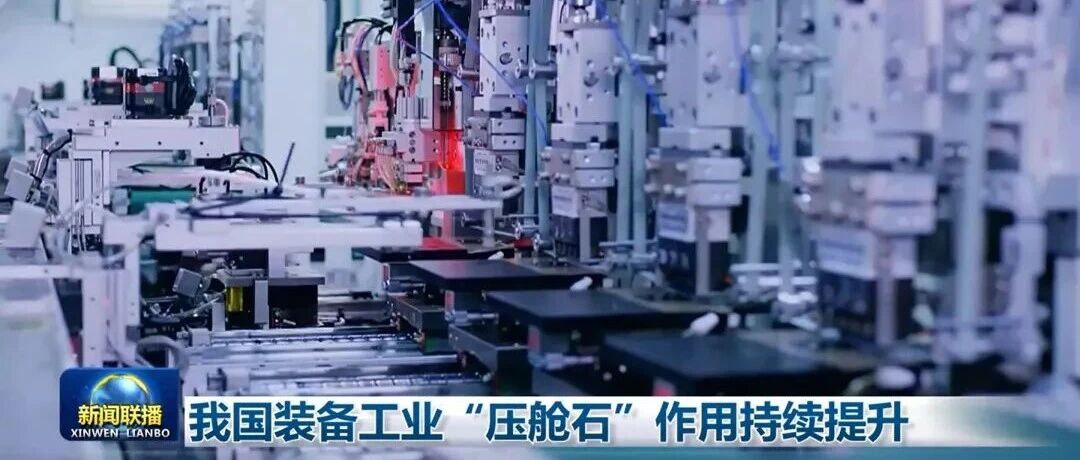
央视《新闻联播》:我国装备工业“压舱石”作用持续提升
Yang Shi Xin Wen· 2026-01-30 01:04
Core Insights - In 2025, China implemented a new growth stabilization plan for the machinery and automotive industries, focusing on collaborative efforts from both supply and demand sides, deepening the integration of technological and industrial innovation, and enhancing the supply capacity of high-quality equipment [1] Group 1: Equipment Manufacturing Industry - In 2025, significant innovations in China's equipment manufacturing sector were noted, including the application of a 4000-ton wheeled crane in large wind turbine installation and the successful launch of the world's largest 24-meter diameter vertical shaft tunneling machine [3] - The added value of China's above-scale equipment manufacturing industry accounted for 36.8% of the total above-scale industrial value, an increase of 2.2 percentage points from 2024 [3] - The number of national-level specialized and innovative "little giant" enterprises in the automotive sector has reached hundreds, and the number of humanoid robot manufacturing companies has exceeded 140 [3] Group 2: Automotive and Electronics Industries - In 2025, the added value of the automotive and electronics industries grew by 11.5% and 10.6% year-on-year, ranking first and second among all major industrial categories [5] - The production of green products, such as wind turbines and hydropower units, saw significant growth [5] Group 3: Smart Manufacturing - By the end of 2025, a total of 197 excellent-level smart factories had been established in the equipment manufacturing sector, accounting for 39% of the national total [5] - Among the first batch of 15 leading smart factories, 6 were from the equipment manufacturing industry, representing 40% [5] Group 4: Future Directions - The next steps involve promoting deeper applications of artificial intelligence in product development, quality inspection, and customer service, laying a solid foundation for high-quality industrial development [7]
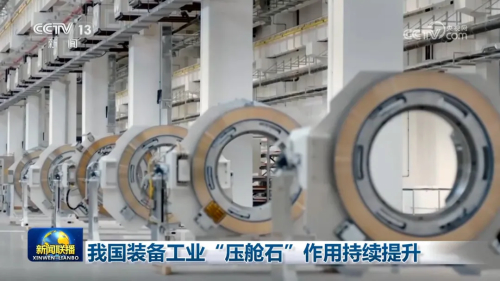
我国装备工业“压舱石”作用持续提升
Yang Shi Wang· 2026-01-29 11:51
Core Viewpoint - In 2025, China will implement a new round of growth stabilization work plan for the machinery and automotive industries, focusing on collaborative efforts from both supply and demand sides, deepening the integration of technological and industrial innovation, and enhancing the supply capacity of high-quality equipment [1] Group 1: Equipment Manufacturing Industry - By 2025, the added value of China's equipment manufacturing industry above designated size will account for 36.8% of the total industrial output, an increase of 2.2 percentage points from 2024 [1] - Significant innovations in the equipment manufacturing sector include the application of a 4000-ton wheeled crane in large wind turbine installation and the successful launch of the world's largest 24-meter diameter shaft boring machine [1] - The number of national-level specialized and innovative "little giant" enterprises in the automotive industry has reached hundreds, with over 140 companies producing humanoid robots [1] Group 2: Growth in Key Industries - The added value of the automotive and electronics industries is expected to grow by 11.5% and 10.6% year-on-year, respectively, ranking them as the top two industries in terms of industrial growth [1] - There has been a significant increase in the production of green products such as wind turbine generators and hydroelectric generators [1] Group 3: Smart Manufacturing - By the end of 2025, a total of 197 excellent-level smart factories will have been established in the equipment manufacturing sector, accounting for 39% of the national total [1] - Among the first batch of 15 leading smart factories, 6 are from the equipment manufacturing industry, representing 40% of the total [1] Group 4: Artificial Intelligence Integration - The next step for the industry is to promote deeper integration of artificial intelligence applications in product development, quality inspection, and customer service, laying a solid foundation for high-quality industrial development [2]
2025年全国规模以上工业增加值增长5.9 新质生产力加速形成
Yang Shi Wang· 2026-01-21 09:21
Group 1 - In 2025, China's industrial economy demonstrates strong resilience, with a year-on-year growth of 5.9% in industrial added value for large-scale enterprises, an acceleration of 0.1 percentage points compared to the previous year [1] - In December, the industrial added value grew by 5.2% year-on-year, showing a positive momentum in industrial production recovery at the end of the year [1] - The manufacturing sector continues to play a key supporting role, with a year-on-year growth of 6.4% in added value, and 36 out of 41 major industrial categories achieved growth, resulting in a growth coverage of 87.8% [1] Group 2 - The equipment manufacturing industry shows significant growth, with a year-on-year increase of 9.2% in added value, accounting for 36.8% of the total industrial output, an increase of 2.2 percentage points from the previous year [2] - The automotive industry grew by 11.5%, and the electronics industry by 10.6%, contributing 12.4% and 18.1% respectively to the overall industrial growth [2] - Traditional industries are advancing green transformation, with the petroleum processing industry growing by 6.7%, and the biomass fuel processing sector growing by 16.8% [2] Group 3 - High-tech manufacturing continues to lead industrial high-quality development, with a year-on-year growth of 9.4% in added value, contributing 26.1% to the overall industrial growth [3] - Key sectors such as integrated circuit manufacturing and aircraft manufacturing saw growth rates of 26.7% and 24.8% respectively [3] - The digital product manufacturing sector also shows strong growth, with a year-on-year increase of 9.3% in added value, contributing 20.3% to overall industrial growth [3] Group 4 - From January to November 2025, profits of large-scale industrial enterprises continued to grow, with equipment manufacturing profits increasing by 7.7%, driving an overall profit growth of 2.8 percentage points for all large-scale industrial enterprises [4] - The industrial economy in China is achieving structural optimization and quality improvement under pressure, with new growth drivers accelerating formation [4] - The need for continued adherence to new development concepts and the strengthening of the real economy is emphasized for high-quality industrial development [4]
国家统计局:2025年新能源汽车产量同比增长25.1%
Sou Hu Cai Jing· 2026-01-19 07:34
Group 1 - The core viewpoint of the articles indicates that China's industrial value-added is expected to grow by 5.9% in 2025, with a faster growth rate compared to the previous year, and December's growth rate is 5.2%, accelerating by 0.4% from November [1] - Traditional manufacturing industries are showing significant transformation, with the petroleum processing industry expected to grow by 6.7% in 2025, and the biomass fuel processing sector experiencing a remarkable growth of 16.8%, contributing 1.7 percentage points more to the petroleum processing industry's growth compared to last year [1] - The chemical fiber industry is projected to grow by 8.2%, with the bio-based materials manufacturing sector growing by 27.9%, contributing 23.1% to the chemical fiber industry's growth, an increase of 16.4 percentage points from the previous year [1] - The production of green low-carbon products is increasing rapidly, with the output of new energy vehicles expected to grow by 25.1% in 2025, driving significant increases in the production of lithium-ion batteries for vehicles and charging piles by 41.7% and 11.0% respectively [1] - Wind turbine and hydroelectric generator production are expected to grow by 48.9% and 29.3% respectively, supported by the development of green energy [1] - The output of lithium carbonate, carbon fiber, and bio-based chemical fibers is projected to increase by 57.1%, 47.7%, and 19.5% respectively [1] Group 2 - In 2025, China's automobile production and sales are expected to reach 34.53 million and 34.40 million units respectively, marking a year-on-year growth of 10.4% and 9.4%, achieving a historical high and maintaining the world's largest market for 17 consecutive years [2] - New energy vehicles are projected to exceed 16 million units in production and sales, with domestic new car sales accounting for over 50%, becoming the dominant force in China's automotive market [2] - The automotive export market shows strong resilience, with over 7 million vehicles exported, and the export scale reaching new heights, including 2.615 million new energy vehicles exported, which is a 100% year-on-year increase [2]
西方专家:中国电网一旦最终成熟,将影响全球乃至掀起能源革命
Sou Hu Cai Jing· 2026-01-05 15:43
Core Insights - China's electricity development reflects the modernization and industrial upgrading of the nation, evolving from a mere 1.85 million kilowatts of installed capacity at the founding of the People's Republic of China to a projected 3.35 billion kilowatts by the end of 2024, making it the largest in the world [2][31]. Historical Development - The first electric light in China was lit in 1879 in Shanghai, but it was largely symbolic and did not impact the general populace [4]. - At the founding of New China, the annual electricity generation was 4.3 billion kilowatt-hours, equivalent to the consumption of a medium-sized city today [5]. - Prior to the reform and opening-up in 1978, China's electricity construction faced multiple challenges, including funding shortages and outdated technology, leading to frequent power outages and limited industrial production [7]. Reform and Growth - Post-1978 reforms marked a significant shift, with electricity being prioritized for economic development, leading to rapid expansion in thermal power and rural electrification [8]. - By 1987, installed capacity surpassed 100 million kilowatts, alleviating power shortages [8]. - The 1990s saw systematic and large-scale electricity construction, with major projects like the Three Gorges Dam laying the groundwork for future energy stability [10]. Structural Changes - The 2002 electricity system reform separated generation and grid operations, introducing market competition and significantly improving operational efficiency [12]. - Installed capacity grew from approximately 300 million kilowatts in 2000 to over 1 billion kilowatts in 2010, and is expected to reach 3.35 billion kilowatts by the end of 2024 [12]. New Energy Revolution - China is transitioning from coal dependency to a diversified energy structure, with non-fossil energy sources projected to account for 58.2% of total installed capacity by the end of 2024, aiming for around 60% by 2025 [21]. - Major hydropower projects like the Three Gorges and Baihetan have significantly reduced coal consumption and carbon emissions [15]. - Wind and solar power have evolved from supplementary sources to primary energy sources, with costs dropping over 80% compared to a decade ago [19]. Technological Advancements - China has developed strong cross-regional transmission capabilities through self-developed ultra-high voltage technology, enabling efficient long-distance power transmission with low line loss [22]. - The national unified electricity dispatch system enhances grid resilience and stability, effectively managing extreme weather and equipment failures [24]. Economic Impact - Reliable and low-cost electricity supports the growth of energy-intensive industries, providing a competitive edge for sectors like manufacturing and AI data centers [26][27]. - Stable electricity pricing reduces uncertainty for businesses, fostering expansion and innovation [27]. Global Influence - China's electricity industry is increasingly exporting technology and capabilities globally, with core products like solar panels and wind turbines being widely adopted in international projects [29]. - This export includes comprehensive capabilities in planning, design, construction, and management, reshaping the global energy market [29].
堪比印钞机,让“宁王”都坐不住了
3 6 Ke· 2026-01-05 01:29
Core Viewpoint - The collaboration between State Power Investment Corporation, Sichuan Tieneng Power Development Co., and CATL marks a significant entry of private capital into the hydropower sector, indicating a shift in the energy landscape towards more diverse investment sources [1][11]. Group 1: Project Overview - The newly established company, Guoneng Dadu River (Danba) Hydropower Development Co., will focus on the investment, construction, and operation of the Danba Hydropower Station, which has a total installed capacity of 1.15 million kilowatts and a total dynamic investment of 15.273 billion yuan [1]. - The Danba Hydropower Station is the ninth of 28 hydropower stations on the Dadu River, equipped with four 275,000-kilowatt mixed-flow turbine generator sets and one 50,000-kilowatt ecological generator set [1]. Group 2: Financial Implications - CATL's investment of 458 million yuan represents a financial opportunity, with the project's internal rate of return on capital estimated at 5.95% [2]. - The hydropower sector is characterized by low operational costs after initial high investments, with a typical large hydropower station requiring only a small workforce for maintenance [4]. Group 3: Market Dynamics - The average annual power generation of the Danba Hydropower Station is projected to be 4.718 billion kilowatt-hours, generating approximately 1.403 billion yuan in annual revenue at a tax-inclusive electricity price of 0.2974 yuan per kilowatt-hour [5]. - The average cost of hydropower is significantly lower than that of other energy sources, with a gross profit margin of 66.6% for companies like Yangtze Power, indicating the high profitability potential of hydropower projects [5]. Group 4: Industry Challenges and Trends - Small hydropower stations face several challenges, including management difficulties due to their scattered nature, aging equipment, and low automation levels [7]. - The number of small hydropower stations in China has decreased from over 47,000 in 2017 to about 41,000 by the end of 2022 due to regulatory clean-up efforts [9]. - The upcoming IEC 61116:2025 standard for small hydropower stations will raise industry standards, potentially leading to the exit of non-compliant stations and providing a competitive edge to technically advanced companies [10]. Group 5: Strategic Implications - The partnership between State Power Investment Corporation and CATL reflects a broader trend of integrating hydropower with energy storage solutions, enhancing grid stability and efficiency [10]. - This collaboration may serve as a benchmark for larger energy and solar companies, highlighting the growing role of private capital in the energy transition [11].

11月经济数据解读:延续稳中有进发展态势
East Money Securities· 2025-12-30 09:54
Consumption - In November 2025, the total retail sales of consumer goods reached 43,898 billion yuan, with a year-on-year growth of 1.3%, down 1.6 percentage points from the previous value of 2.9%[12] - Sales of "two new" products and real estate-related consumption continued to decline, with automotive consumption down 8.3% and home appliances down 19.4% year-on-year[12] - Service retail sales grew by 5.4% year-on-year from January to November, indicating a gradual release of service consumption potential[14] Investment - Fixed asset investment continued to decline, with a year-on-year decrease of 2.6% in November, marking three consecutive months of negative growth[23] - Real estate development investment fell by 31.4% year-on-year in November, a significant increase in the decline compared to the previous month's 23.2%[23] - Equipment purchase investment showed a year-on-year growth of 6.3%, contributing 1.8 percentage points to overall investment growth[24] Trade - In November, exports increased by 5.9% year-on-year, rebounding from a previous decline of 1.1%[32] - Exports to the EU saw a significant recovery with a growth rate of 14.8%, while exports to the US decreased by 28.6%[32] - Imports rose slightly by 1.9% year-on-year, with notable increases in the import of integrated circuits and automatic data processing equipment[34]