永赢信息产业智选

Search documents
涉嫌联合大V违规带货?这家基金公司什么情况
Sou Hu Cai Jing· 2026-02-04 07:56
Core Viewpoint - Yongying Fund has recently gained attention due to its outstanding performance in the public fund market, but it is also facing scrutiny over regulatory violations related to product promotion and underperformance of several funds against benchmarks [3][4]. Group 1: Fund Performance - Yongying Technology Smart A (022364.OF) achieved a remarkable 233.29% return in 2025, leading the public fund performance rankings [3]. - Yongying High-end Equipment Smart and Yongying Information Industry Smart funds have been implicated in a controversy involving unauthorized promotion, resulting in a significant increase in their assets under management [6]. - Despite the strong performance of some funds, many of Yongying's products have underperformed against their benchmarks over a three-year period, with 17 funds showing lower returns than their respective benchmarks [4][10]. Group 2: Regulatory Issues - A report highlighted that a financial influencer promoted Yongying's funds without proper qualifications, leading to a surge in investment and raising concerns about compliance with regulatory standards [6]. - Following the controversy, Yongying Fund announced purchase limits on the implicated funds, restricting individual investors to a maximum of 1 million yuan per day [6]. - The company has also increased the risk ratings of several funds, including Yongying High-end Equipment Smart, from "R3 medium risk" to "R4 medium-high risk" [8]. Group 3: Fund Management and Strategy - Yongying Information Industry Smart, managed by Wang Wenlong, has a management scale of 899 million yuan but has underperformed with a net value growth rate of -12.77% since its inception [7]. - Yongying High-end Equipment Smart, managed by Zhang Lu, has shown significant growth in management scale, reaching 9.765 billion yuan, but its performance has been volatile, with a net value growth rate of 94.62% in 2025, while earlier years saw negative returns [7][9]. - The Yongying Smart series focuses on new productivity tools, with specific investments in AI applications and high-end equipment sectors like satellite internet [7].

2025年公募权益基金分红回升明显,2026年监管提明确要求规范行为
Sou Hu Cai Jing· 2026-01-26 05:57
Core Viewpoint - The article discusses the significant rebound in equity fund dividends in 2025, highlighting both the achievements and the regulatory challenges that have emerged in the industry [3][5]. Summary by Sections Equity Fund Dividends in 2025 - In 2025, over 813 public equity funds implemented dividends, totaling 2,028 distributions and a cumulative dividend amount of 59.218 billion yuan, representing a 62.7% increase from 36.395 billion yuan in 2024 [3]. - Although the total dividend amount did not surpass the peak of 65.180 billion yuan in 2021, it marked a new high since 2022, indicating a strong rebound in the market [3]. Characteristics of High Dividend Funds - The funds that contributed to the high dividends were primarily broad-based index funds and leading industry theme funds, which experienced significant performance growth and had substantial assets under management [3]. - Core index funds like the CSI 300 and CSI 500 saw substantial net value increases due to a market-wide rally, allowing many large-scale ETFs to distribute dividends exceeding 1.5 billion yuan [3]. - Additionally, top-performing industry funds in sectors like consumption and new energy, as well as growth-oriented active equity funds with returns exceeding 60%, became key contributors to dividends, with some funds distributing multiple times within the year [3]. Concentration and Size of Dividends - The high dividends in 2025 exhibited characteristics of concentration and large amounts, primarily occurring in the fourth quarter when the Shanghai Composite Index surpassed 4,000 points [4]. - This timing allowed leading fund managers to realize profits and distribute dividends, contrasting sharply with other funds that delayed dividends or expanded their scale [4]. Regulatory Requirements for Dividend Distribution - Recent regulatory communications have emphasized the need for compliance in dividend distribution, targeting non-compliant practices that exploit tax advantages [5][6]. - The report identified three main types of violations: creating "high net worth fund shells," leaking dividend information to facilitate tax evasion, and catering to specific clients' tax avoidance requests [5]. - Regulatory actions included suspending related business for some fund companies and holding responsible individuals accountable [5]. Emphasis on Compliance and Investor Protection - The regulatory framework aims to ensure that dividend distributions are legitimate and beneficial to investors, advocating for a return to the original purpose of sharing profits with investors [6]. - Historical trends indicate that fund managers often distribute dividends during market peaks as a rational choice to lock in profits for investors [6][9]. Market Environment and Investor Dynamics - The current market environment supports substantial dividend distributions, with a significant number of funds experiencing over 50% returns since the market recovery in 2024 [9]. - The article notes that a large portion of new investors, particularly younger generations, may lack experience in navigating market cycles, highlighting the responsibility of fund managers to protect these investors [10]. Strategies for Responsible Fund Management - Some fund managers have begun implementing strategies such as suspending large purchases and limiting subscriptions to protect existing investors and maintain fund stability [11][12]. - The article emphasizes that effective dividend distribution should be coupled with measures to prevent excessive inflows that could dilute existing investors' returns [11][12].
永赢基金,不代表永远能赢!
Xin Lang Cai Jing· 2026-01-23 07:56
Core Insights - Yongying Fund achieved significant success in equity investment in 2025, with a notable increase in management scale and performance metrics [4][26] - The fund's management scale reached a record high of 631.645 billion yuan by the end of Q4 2025, with equity fund scale growing by over 120 billion yuan [5][28] - Despite strong performance, challenges such as frequent changes in the research team and high volatility in returns pose risks for the future [3][26] Management Scale and Performance - By the end of Q4 2025, Yongying Fund's public management scale was 631.645 billion yuan, marking a new high since its establishment [5][28] - The equity fund scale increased by over 120 billion yuan in 2025, primarily driven by the "Smart Selection" series, which reached 78.489 billion yuan by the end of Q4 2025 [5][28] - The average return of equity products in 2025 was 44.05%, outperforming the industry average of 24.63% [5][28] Fund Performance and Volatility - Yongying Technology Smart Selection A achieved a remarkable return of 233.29% in 2025, but saw a sharp decline to 3.05% by January 22, 2026 [29][33] - The fund experienced a maximum drawdown of -27.04%, significantly higher than the industry average of -16.94% [11][33] - The fund's concentrated holdings strategy led to high volatility, with an annualized volatility of 34.71% compared to 20.8% for similar products [9][33] Team Changes and Challenges - Since 2024, 12 fund managers have left Yongying Fund, including 10 from the equity team, indicating significant turnover [13][35] - The average tenure of fund managers at Yongying Fund is 3.53 years, which is below the industry average [39] - The recent departure of experienced managers has raised concerns about the stability of the investment research team [38][40] Product Structure and Strategy - Yongying Fund's product structure remains heavily weighted towards fixed income, with over 70% of its funds in this category as of Q4 2025 [30][41] - The "Smart Selection" series focuses on high-growth sectors such as AI, robotics, and digital economy, aiming to capture specific industry opportunities [21][44] - The fund's differentiated product strategy helps avoid common issues of product homogeneity and overlap in holdings [21][44]

热门产品掀起限购潮 基金公司差异化导购
Zhong Guo Zheng Quan Bao· 2026-01-18 20:56
Core Viewpoint - Fund companies are implementing purchase limits on popular products to avoid rapid scale expansion and protect existing investors' returns, reflecting a shift from scale-driven to investor return-driven strategies [1][4]. Group 1: Fund Purchase Limits - Several fund companies have initiated purchase limits on high-performing funds, particularly those focused on AI applications and commercial aerospace, due to increased market activity in these sectors [1][5]. - On January 12, 2026, following a surge in the AI application sector, Debon Fund announced a reduction in purchase limits for its popular fund from 10 million yuan to 100,000 yuan for A shares and from 1 million yuan to 10,000 yuan for C shares [2]. - Yongying Fund also limited large purchases for two of its actively managed equity funds starting January 14, 2026, due to their significant recent gains [2]. Group 2: Reasons for Limiting Purchases - Fund managers indicate that limiting purchases after a price increase is primarily to protect performance, as new inflows can dilute returns when the fund's net asset value is high [4]. - Limiting fund size helps avoid operational challenges associated with large capital inflows, which can hinder effective portfolio management and lead to unpredictable fluctuations in net asset value [4]. - The current trend shows a cautious approach to fund size expansion, contrasting with previous years when many new products were launched during market upswings [4]. Group 3: Alternative Investment Options - Fund companies are exploring other niche sectors and products like "fixed income plus" and FOFs to provide investors with balanced investment options amid crowded market segments [1][6]. - Some companies are focusing on promoting long-term high-performance products rather than popular sector funds, emphasizing their integrated research platforms to enhance fund manager capabilities [6].
热门产品掀起限购潮基金公司差异化导购
Zhong Guo Zheng Quan Bao· 2026-01-18 20:45
Core Viewpoint - Fund companies are implementing purchase limits on popular products to prevent rapid scale expansion and protect existing investors' returns, reflecting a shift from scale-driven to investor return-driven strategies [1][2][3] Group 1: Fund Purchase Limits - Several fund companies, including 德邦基金 and 永赢基金, have announced purchase limits on high-performing funds focused on AI applications and other hot sectors due to increased market interest [1][2] - 中欧基金 has also implemented purchase limits on three of its products, with one fund's net asset value capped at 2 billion RMB to control its scale [2] - 工银瑞信基金 announced limits on its FOF product, indicating a trend of limiting purchases even amid a hot market [2] Group 2: Reasons for Limiting Purchases - Fund managers indicate that limiting purchases is necessary to protect performance, as new inflows at high net asset values can dilute returns and lead to inefficient cash management [2][3] - Limiting fund size helps avoid operational challenges associated with large-scale funds, which can hinder effective portfolio management and lead to significant net asset value fluctuations [3] Group 3: Market Strategy Adjustments - Fund companies are exploring alternative investment options, such as "固收+" and FOF products, to provide investors with balanced choices amid crowded sectors like AI and commercial aerospace [1][3] - Marketing strategies are shifting focus from popular sectors to long-term high-performing products, with an emphasis on the company's integrated research platform rather than individual fund managers [4]
调节资金流入节奏 权益类基金扎堆限购
Shang Hai Zheng Quan Bao· 2026-01-18 18:15
Group 1 - Several equity funds have initiated subscription limits to control rapid growth and maintain operational stability as market enthusiasm rises and new capital flows in [1][2] - Fund companies like Zhongyin, Zhongou, and Rongtong have announced limits on large subscriptions, with specific caps set for various funds, such as Zhongyin's limit of 10,000 yuan for single accounts [1] - The trend of fund subscription limits is seen as a measure to optimize entry timing for new capital and enhance the holding experience for existing investors during market recovery [1][2] Group 2 - Recent data indicates that despite market fluctuations, the first fundraising scale of equity funds in the past three months has approached 150 billion yuan, with an average equity fund position of 86% as of January 9, 2026 [3] - Industry experts remain optimistic about the spring market, suggesting that the current market sentiment has not peaked, and the upcoming earnings forecasts will shift market logic from valuation recovery to profit growth [3] - The global economic recovery is expected to benefit emerging markets, including A-shares, due to the effects of major economic policies and liquidity easing, which will likely lead to sustained capital inflows [3]
70余只基金开年大涨超20%!
Guo Ji Jin Rong Bao· 2026-01-16 15:54
Core Insights - The equity funds have shown remarkable returns in early 2026, with 74 funds achieving over 20% returns, primarily driven by sectors like AI applications and commercial aerospace [1][3][4] Fund Performance - As of January 15, 2026, 41 mixed funds lead the performance, with the top fund, Shenwan Lingshin, achieving a 38.57% return, while several others surpassed 30% [1][3][4] - Active equity funds outperformed passive index funds, with 48 of the 74 high-performing funds being actively managed [4] Investment Trends - The surge in fund performance is attributed to a combination of industry trends, capital flow, and fundamental improvements, particularly in AI and related growth sectors [6] - Despite recent market corrections, many fund managers remain optimistic about AI as a key investment direction for 2026, focusing on areas like overseas computing power and AI large models [9][10] Market Outlook - The A-share market is expected to enter a phase of improved overall conditions and deepening structural characteristics, driven by global liquidity and the acceleration of AI trends [9] - The food and beverage sector is also gaining long-term investment appeal after a five-year adjustment period, alongside promising segments in service consumption and new consumption [10] Fund Allocation Strategy - A balanced investment strategy is recommended, combining core growth-style funds focused on AI and semiconductors with satellite investments in cyclical and high-dividend stocks to mitigate risks [6][7]
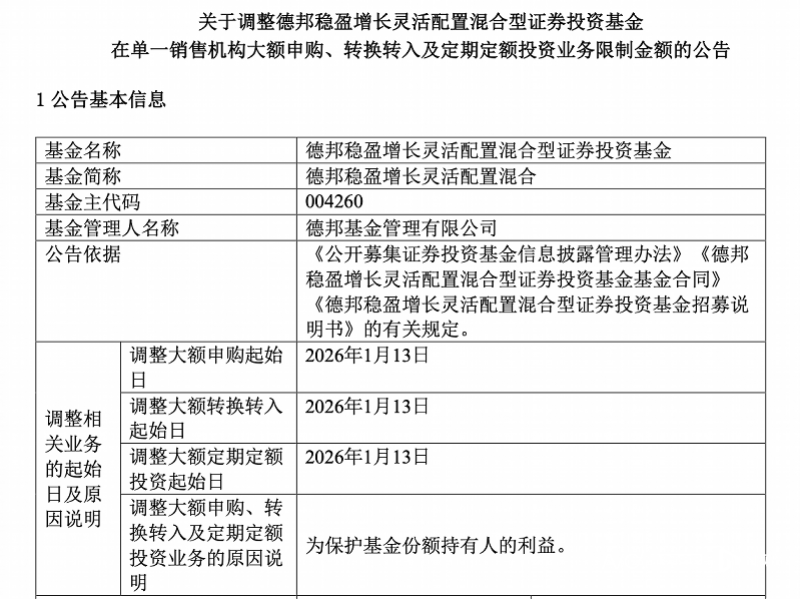
刚开年就限购?德邦基金24小时两调上限,多只绩优产品加码“控流”
Sou Hu Cai Jing· 2026-01-14 14:20
Core Viewpoint - The recent rumor about "Debon Stable Growth Flexible Allocation Mixed Fund" attracting 12 billion yuan in a single day has sparked widespread discussion in the investment community, leading to the fund's management implementing multiple purchase restrictions to protect existing investors' interests [1][2]. Group 1: Fund Management Actions - On January 12, the fund denied the rumor of 12 billion yuan inflow, stating that such data is non-public information [2]. - Following the denial, the fund announced a purchase limit of 10 million yuan for Class A and 1 million yuan for Class C shares starting January 13 [2][4]. - On January 13, the fund further reduced the purchase limits to 100,000 yuan for Class A and 10,000 yuan for Class C shares, effective January 14 [4]. Group 2: Market Context and Trends - The fund's actions are part of a broader trend in the industry, with multiple high-performing funds implementing purchase restrictions since the beginning of 2026, indicating a "purchase limit wave" [6]. - On January 13, nearly 30 equity funds announced purchase restrictions, reflecting a shift in industry logic towards protecting investor interests rather than pursuing aggressive growth [6][7]. - Analysts suggest that limiting large purchases helps manage operational difficulties associated with larger fund sizes and creates a "scarcity effect" that may attract more investors [7]. Group 3: Fund Performance - As of January 13, the latest net asset values for Class A and C shares were 1.29 yuan and 1.27 yuan, respectively, with a single-day increase of 8.32% on January 12 [5]. - The top ten holdings of the fund included stocks that experienced significant price increases, contributing to the fund's net value surge [5].
运作超三年半,中欧小盘成长混合触发比例配售
Xin Lang Cai Jing· 2026-01-14 07:25
Core Viewpoint - The announcement from China Europe Fund regarding the subscription confirmation ratio for the China Europe Small Cap Growth Mixed Fund indicates that the fund's net asset value has exceeded the control limit of 2 billion yuan, leading to a partial confirmation of subscription applications at a ratio of 47.843581% as of January 12, 2026 [1][3][4]. Group 1: Fund Management and Control - The China Europe Small Cap Growth Mixed Fund, established on June 28, 2022, has been operational for over three and a half years, yet it has triggered a subscription limit due to exceeding the set asset value cap [1][3]. - The fund's management has set a net asset value limit of 2 billion yuan to control its scale, as stated in the announcement made on November 6, 2025 [4]. - If the total net subscriptions on any given day would push the fund's net asset value above 2 billion yuan, all valid subscription applications that meet sales and quota restrictions will be partially confirmed based on a proportional allocation principle [4]. Group 2: Market Trends and Implications - In the context of high-quality development in the public fund industry, fund companies are proactively limiting subscriptions during favorable market conditions to ensure the effectiveness of investment strategies and stabilize fund operations, thereby protecting the interests of investors [2][4]. - Since the beginning of 2026, there has been a significant influx of capital into the equity market, leading to subscription limits on several equity funds, including those focused on AI applications [2][4]. - For instance, on January 13, 2026, Debon Fund reduced the subscription limits for its Debon Stable Growth A and C class shares from 10 million yuan and 1 million yuan to 100,000 yuan and 10,000 yuan, respectively [2][4].
单日吸金120亿?德邦基金24小时两度限购!否认市场传闻
Nan Fang Du Shi Bao· 2026-01-14 07:20
Core Viewpoint - The recent rumor about Debon Fund's "Debon Stable Growth Flexible Allocation Mixed Fund" attracting 12 billion yuan in a single day has sparked widespread discussion in the investment community, although the company and several distribution channels have denied this claim [2][3] Fund Actions - On January 12, Debon Fund issued a purchase limit announcement, stating that starting January 13, the A-class shares would have a single-channel daily purchase limit of 10 million yuan, while C-class shares would be limited to 1 million yuan [3] - Following this, on January 13, the company further reduced the purchase limits to 100,000 yuan for A-class and 10,000 yuan for C-class shares, citing the need to protect the interests of existing fund holders [4][5] Market Context - The actions taken by Debon Fund are part of a broader trend in the industry, where multiple high-performing funds have implemented purchase limits since the beginning of 2026, indicating a shift towards protecting investor interests rather than merely expanding fund size [7][8] - On January 13 alone, nearly 30 equity funds announced purchase limits, reflecting a significant change in market logic where "protecting holder interests" and "controlling scale" are becoming new industry norms [7][8] Fund Performance - As of January 13, 2026, the latest adjusted net asset values for Debon Stable Growth A/C shares were 1.29 yuan and 1.27 yuan respectively, with a daily net value increase of 8.32% on January 12, driven by significant gains in several top holdings [6]