安信均衡增长

Search documents
安信基金明星产品突发人事变动,揭开共管真相?
Xin Lang Cai Jing· 2026-02-27 16:26
Core Viewpoint - The departure of Chen Zhenyu, the deputy general manager of Anxin Fund, from the management of Anxin Value Growth Mixed Fund, despite its solid performance, indicates a significant internal restructuring and power dynamics within the company [1][4]. Group 1: Management Changes - Chen Zhenyu's resignation from Anxin Value Growth, where he achieved an annualized return of 13.71%, raises questions about the internal governance and the dynamics of power within Anxin Fund [1][3]. - The management structure, characterized by a "deputy general manager nominally in charge with junior managers executing," suggests a potential "shadow management" scenario, prompting discussions about the actual contributions of senior leaders in fund management [2][3]. Group 2: Institutional Investor Behavior - The recent departures of multiple fund managers from Anxin New Growth Fund, following significant outperformance, coincide with a sharp withdrawal of institutional investors, indicating a strategic exit aligned with profit-taking and tax considerations [3][4]. - The high institutional ownership of 96.22% in Anxin New Growth Fund prior to the mass exit highlights the fund's tailored nature for large investors, raising concerns about the implications for retail investors left behind [3][4]. Group 3: Implications for Fund Stability - The frequent changes in fund managers, with 42 products experiencing management changes since 2025, pose challenges to the stability of investment research and management within Anxin Fund [3][4]. - The transition of power and the shift from a focus on scale and star managers to addressing sustainability pressures post-institutional exits reflect a critical juncture for Anxin Fund [4].
270只基金年内退场
Di Yi Cai Jing Zi Xun· 2025-12-17 15:58
Core Insights - The fund liquidation process is accelerating as the year-end approaches, with 270 funds having announced their exit this year, primarily due to insufficient scale or number of investors [2][5] - The trend of fund liquidation has become normalized, reflecting poor performance and loss of investor trust, pushing the industry towards a more refined product offering [2][5] Fund Liquidation Trends - As of December 18, 2023, the 17th fund of the month entered liquidation, with 47 additional funds issuing warnings about potential liquidation due to low asset values [3][4] - Equity funds are the most affected, with many newly established funds under a year old facing liquidation risks [4][5] Performance and Investor Trust - Over 60% of the funds that have exited this year are equity funds, attributed to poor performance and lack of investor confidence [5] - The market volatility has exacerbated the risks for "mini funds," which are funds with low asset values [5][9] Regulatory Changes and Fund Management - Fund companies are modifying automatic termination clauses to extend the liquidation period and provide more options for "mini funds," requiring investor input for decisions [6][8] - Failed attempts to hold shareholder meetings indicate low investor engagement, which complicates the decision-making process for fund companies [7][8] Market Dynamics - The current market environment has led to a significant number of funds struggling to maintain minimum asset values, with 2061 equity funds below 60 million yuan and 1586 below 50 million yuan [9]


270只基金年内退场
第一财经· 2025-12-17 15:48
Core Viewpoint - The article discusses the ongoing trend of fund liquidations as the year-end approaches, highlighting that 270 funds have been liquidated this year, with over 80% due to insufficient scale or number of investors [3][6]. Group 1: Fund Liquidation Trends - As of December 18, 2025, the 17th fund of the month entered liquidation, with 47 additional funds issuing warnings about potential liquidation [5]. - The majority of liquidated funds are equity funds, with 171 out of 270 funds liquidated this year being equity funds, accounting for over 60% of the total [6][11]. - Many newly established funds, some less than a year old, are facing liquidation, indicating a challenging environment for new products [5][6]. Group 2: Causes of Liquidation - Poor performance and loss of investor trust are cited as primary reasons for the liquidation of equity funds, exacerbated by a volatile market [6][10]. - A significant number of funds are failing to meet the minimum asset threshold of 50 million yuan, leading to liquidation warnings [5][6]. - Among the liquidated funds, at least 57 were initiated without meeting the minimum fundraising requirement of 200 investors or 200 million yuan, indicating a systemic issue in fund management [7]. Group 3: Mini Fund Challenges - The article highlights the ongoing struggles of "mini funds," which are funds with low asset sizes that are increasingly at risk of liquidation [8][10]. - Some fund companies have adjusted their automatic termination clauses to extend the liquidation period from 50 to 60 days, providing more options for struggling funds [9]. - Despite efforts to maintain operations, many funds are facing challenges in gathering sufficient investor participation for decision-making meetings [10]. Group 4: Market Dynamics and Future Outlook - The current market conditions are leading to a concentration of resources towards more competitive and viable funds, as the industry shifts towards a focus on quality over quantity [3][6]. - Fund companies are weighing the strategic value of maintaining underperforming funds, with some opting to retain funds that may have future potential despite current challenges [10]. - The scarcity of fund shell resources has increased the difficulty of reissuing certain specialized products after liquidation, suggesting a tightening market for fund offerings [10].

270只基金年内退场,次新基金与债基均难幸免
Di Yi Cai Jing Zi Xun· 2025-12-17 14:21
Group 1 - The core viewpoint of the article highlights the ongoing trend of fund liquidations as the year-end approaches, with 270 funds having announced their exit this year, primarily due to insufficient scale or number of investors [1][3][4] - A total of 47 funds have issued liquidation warnings this month, indicating a significant number of products are at risk of being forced out of the market [2][3] - Equity funds are identified as the most affected category, with 171 out of the 270 liquidated funds being equity funds, representing over 60% of the total [3][4] Group 2 - The article notes that many newly established funds, including those less than a year old, are facing liquidation, reflecting a broader trend of underperformance and loss of investor confidence [1][2] - The bond market's continued adjustment in the fourth quarter has also led to several bond funds facing liquidation or warning signs, indicating a challenging environment for these products [3][4] - The industry is witnessing a shift towards a more selective approach, with resources likely concentrating on more competitive products as the number of funds exceeds ten thousand [1][5] Group 3 - Fund companies are modifying their automatic termination clauses to extend the liquidation period and provide more options for "mini funds," but the decision to liquidate or continue operations still requires investor input [5][6] - Instances of failed shareholder meetings to decide on fund continuance are becoming common, reflecting low investor engagement and interest in these products [6][7] - The article suggests that the decision to maintain or liquidate a fund often depends on the strategic positioning of the product within the company's portfolio, with some companies willing to retain funds that may have future potential [7][8]
“空仓躲牛市”的大成兴远启航净值创新高,徐彦出手了?
2 1 Shi Ji Jing Ji Bao Dao· 2025-09-12 12:47
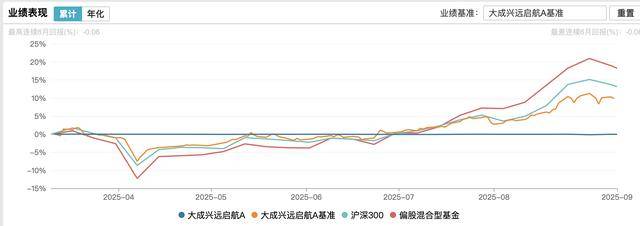
Core Viewpoint - The newly established fund, Dachen Xingyuan Qihang, managed by veteran fund manager Xu Yan, has faced criticism for its near-zero operation strategy amidst a rising market, leading to questions about its investment approach and performance [1][2][3]. Fund Performance and Strategy - Since its inception in March, Dachen Xingyuan Qihang has maintained a net value close to its face value, with a stock allocation of only 0.73% and cash making up 84.95% of its net value as of June 30 [2][3]. - Xu Yan acknowledged in the fund's mid-year report that the current market environment has changed significantly, necessitating a more cautious investment approach [1][4]. - As of September 11, the fund's A-class share net value reached 1.0035, marking a new high since its establishment, despite the fund's minimal stock holdings [1][3]. Market Context - The Shanghai Composite Index reached a new high of 3892.74 points on September 12, with many newly launched funds quickly building positions and achieving significant returns [1][2]. - In contrast, Dachen Xingyuan Qihang's lack of aggressive investment has led to investor frustration, especially as other funds have capitalized on the market rally [2][3]. Manager Background - Xu Yan, a seasoned fund manager with a history at Dachen Fund, has emphasized his focus on absolute returns rather than relative performance, managing a total fund size of 19.367 billion yuan as of the second quarter [5]. - His management style is characterized by low turnover rates and a focus on long-term value, with several of his funds achieving over 100% returns since he took over [5].
六个月建仓期接近尾声,徐彦新基仍没动静,投资者:我在这基金里躲牛市
Sou Hu Cai Jing· 2025-09-10 20:25
Core Viewpoint - The A-share market has shown unexpected enthusiasm since the beginning of the year, with many active equity funds recovering and achieving significant returns, while the newly established fund, Dachen Xingyuan Qihang, managed by Xu Yan, has remained inactive, leading to widespread controversy and questioning of its strategy [1][2][4]. Fund Performance - Dachen Xingyuan Qihang was established on March 11, 2025, but its net value has barely changed, with A-class shares at 0.9983 and C-class shares at 0.9953 as of September 9, 2025 [2][4]. - The fund has only invested in two stocks, Antu Biology and Meituan, with a stock position of just 0.73% and cash making up 84.95% of its net value [4]. Market Reaction - Since May, market skepticism has grown regarding the fund's "zero allocation" strategy, with investors expressing frustration over missed opportunities in a rising market [4][6]. - Xu Yan acknowledged the lack of systematic investment in the mid-year report, citing significant changes in market conditions and the need for caution due to rational valuation returns [4][5]. Comparison with Peers - In contrast to Dachen Xingyuan Qihang, many newly established active equity funds have quickly completed their allocations and participated in the market rally, with some achieving net value growth exceeding 20% [5][6]. - Funds like Anxin Balanced Growth, established on the same day as Dachen Xingyuan Qihang, have seen net value increases of 20.12% this year, highlighting the stark difference in performance [6]. Industry Trends - The performance of newly established funds this year has shown a clear dichotomy, with some achieving over 50% net value growth while others have recorded losses [7][9]. - The current market environment raises questions about the viability of value investing strategies that prioritize slow and steady approaches, especially in a rapidly changing market [9].