永辉MINI社区小店

Search documents
巨亏21.4亿,胖东来为何救不了“永辉们”?
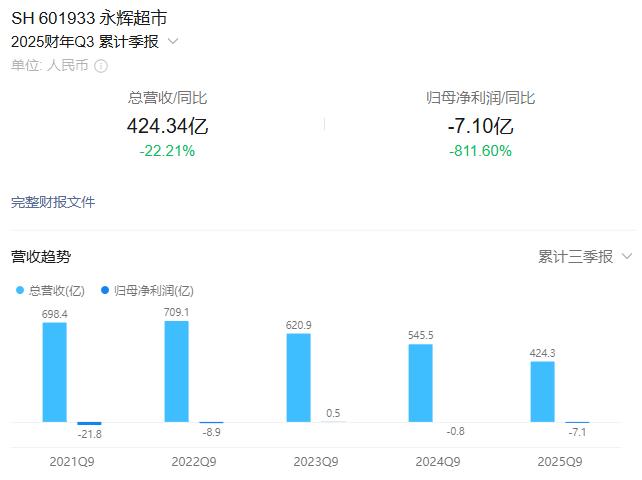
3 6 Ke· 2026-02-05 12:01
Core Viewpoint - The "Fat Reform" initiative by Yonghui Supermarket has resulted in significant financial losses, leading to widespread criticism and reevaluation of the company's strategies and capabilities in the competitive retail market [1][2]. Group 1: Financial Performance and Losses - Yonghui Supermarket reported a staggering loss of 21.4 billion yuan due to the "Fat Reform" initiative, raising concerns about its operational effectiveness [1]. - The company has faced continuous financial decline since 2018, with net profit dropping and cash flow deteriorating, indicating severe operational risks [2]. - From 2021 to 2025, Yonghui's cumulative losses exceeded 116 billion yuan, with annual losses of 39.44 billion yuan, 27.63 billion yuan, 13.29 billion yuan, 14.65 billion yuan, and 21.4 billion yuan respectively [3]. Group 2: Strategic Initiatives and Failures - The "Super Species" initiative aimed to merge fresh produce with dining but resulted in over 2.6 billion yuan in losses due to high operational costs and complex supply chain management [3]. - The Yonghui MINI community stores struggled to compete with online group buying, leading to the closure of nearly 400 stores within a year [3]. - Despite attempts at digital transformation and warehouse store models, Yonghui's efforts have not yielded the desired results, further complicating its financial situation [2][3]. Group 3: Market Position and Competitive Challenges - The "Fat Reform" was seen as a last-ditch effort for Yonghui, which has been unable to adapt effectively to the competitive pressures from online grocery services and community group buying [2]. - The company's aggressive imitation of the "Fat Donglai model" has been criticized for lacking a deep understanding of its core principles, leading to strategic misalignments [10][14]. - Yonghui's operational model, focused on scale and efficiency, clashes with the new consumer era's emphasis on experience and trust, highlighting a fundamental disconnect in its business strategy [16][18]. Group 4: Future Outlook and Recommendations - Yonghui's future success may depend on a balanced approach that combines a return to retail fundamentals with innovative model integration, focusing on enhancing single-store profitability and regional collaboration [17][18]. - The company must shift its focus from rapid imitation to long-term value creation, understanding that retail transformation is a continuous process rather than a quick fix [18].


永辉学习胖东来,结果每天一开门就亏600万
盐财经· 2026-01-24 09:56
Core Viewpoint - Yonghui Supermarket is experiencing continuous losses, with a projected net profit loss of 2.14 billion yuan for 2025, marking the fifth consecutive year of losses, totaling over 11.6 billion yuan since 2021 [2][4][11]. Group 1: Financial Performance - The company reported a daily loss of nearly 6 million yuan over the past year [3]. - From 2021 to 2025, Yonghui's losses were 3.944 billion yuan, 2.763 billion yuan, 1.329 billion yuan, 1.465 billion yuan, and 2.14 billion yuan respectively [4]. - In the first half of 2025, Yonghui's revenue was approximately 29.95 billion yuan, a decrease of 20.73% compared to the previous year [34]. Group 2: Strategic Changes and Challenges - Yonghui has attempted various strategies to reverse its decline, including launching "Super Species," community mini-stores, and digital transformation, but these efforts have not yielded positive results [7]. - The company initiated a transformation plan inspired by the successful case of another supermarket, but after 20 months, the anticipated improvements have not materialized, and losses have increased [10][11]. - The transformation involved significant costs, with each store renovation costing between 5 million to 8 million yuan, leading to a total of approximately 9.1 billion yuan in related expenses for 2025 [31][32]. Group 3: Market Position and Consumer Perception - Despite initial positive consumer responses to store renovations, long-term customer retention remains a challenge, with a 19% decline in customer traffic [34][35]. - The price adjustments post-renovation have led to consumer dissatisfaction, as many perceive the new prices as higher than before, deviating from Yonghui's original "everyday low price" strategy [25][26]. - The company has struggled to establish a unique product identity, with its private label offerings lacking distinctiveness compared to competitors [42]. Group 4: Industry Context - The challenges faced by Yonghui are not unique, as other traditional supermarkets are also struggling with store closures and adapting to changing consumer preferences [45]. - The retail landscape has shifted, with price-sensitive consumers gravitating towards community group buying and discount stores, while those seeking quality and experience are moving towards membership-based stores [43][45].